New Venture Funds - September 2026
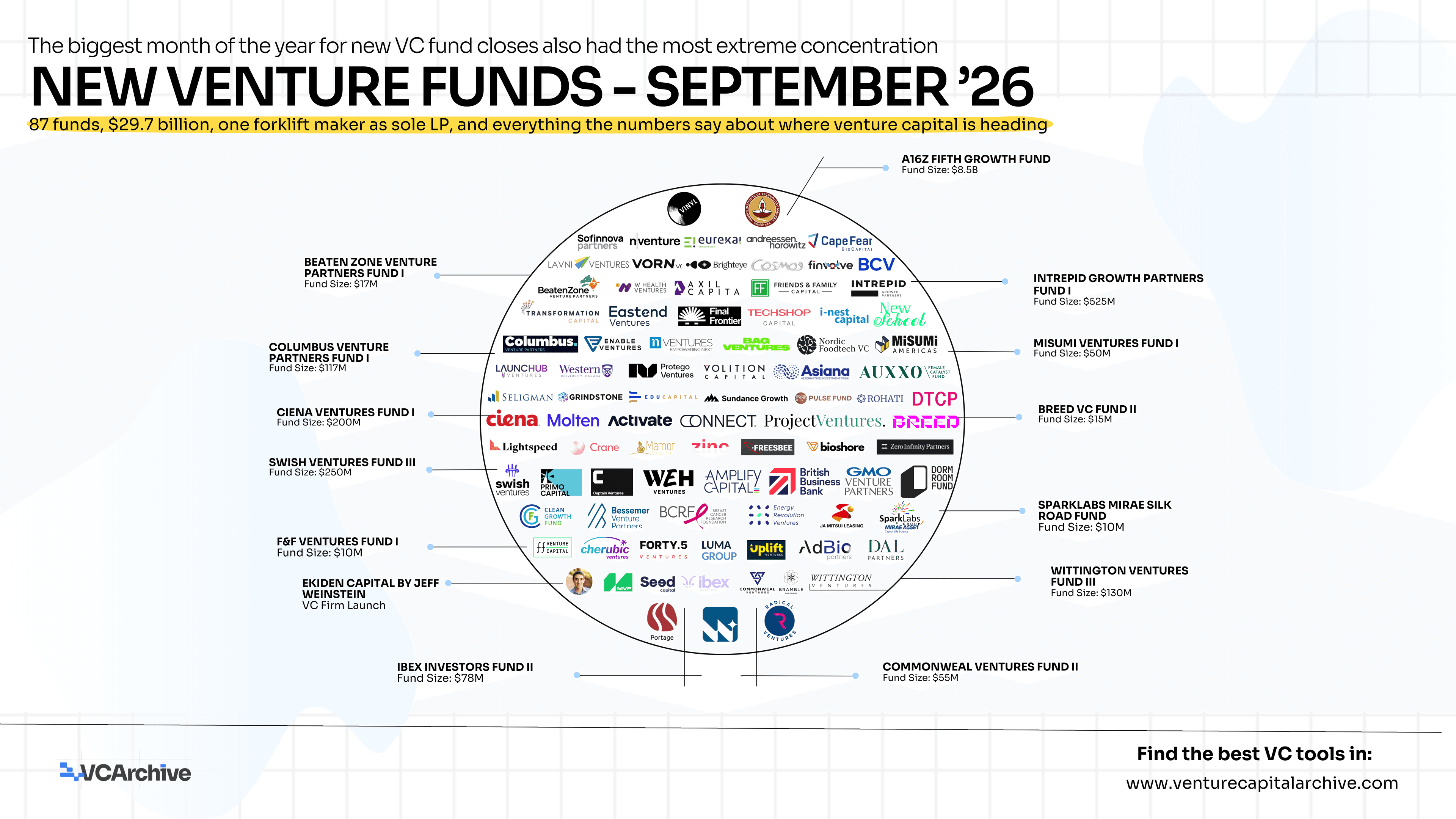
We track every fund close every month. Not because the volume is interesting, though September's 87 funds and $29.7 billion in disclosed commitments made it the busiest month of the year, but because the composition tells you things the headline numbers never do.
September told four stories simultaneously. The concentration story. The corporate LP story. The second fund story. And the quiet geography story that most people will miss entirely. All four are worth understanding before you read the list below.
The concentration story
Start with the number that defines the month more than any other.
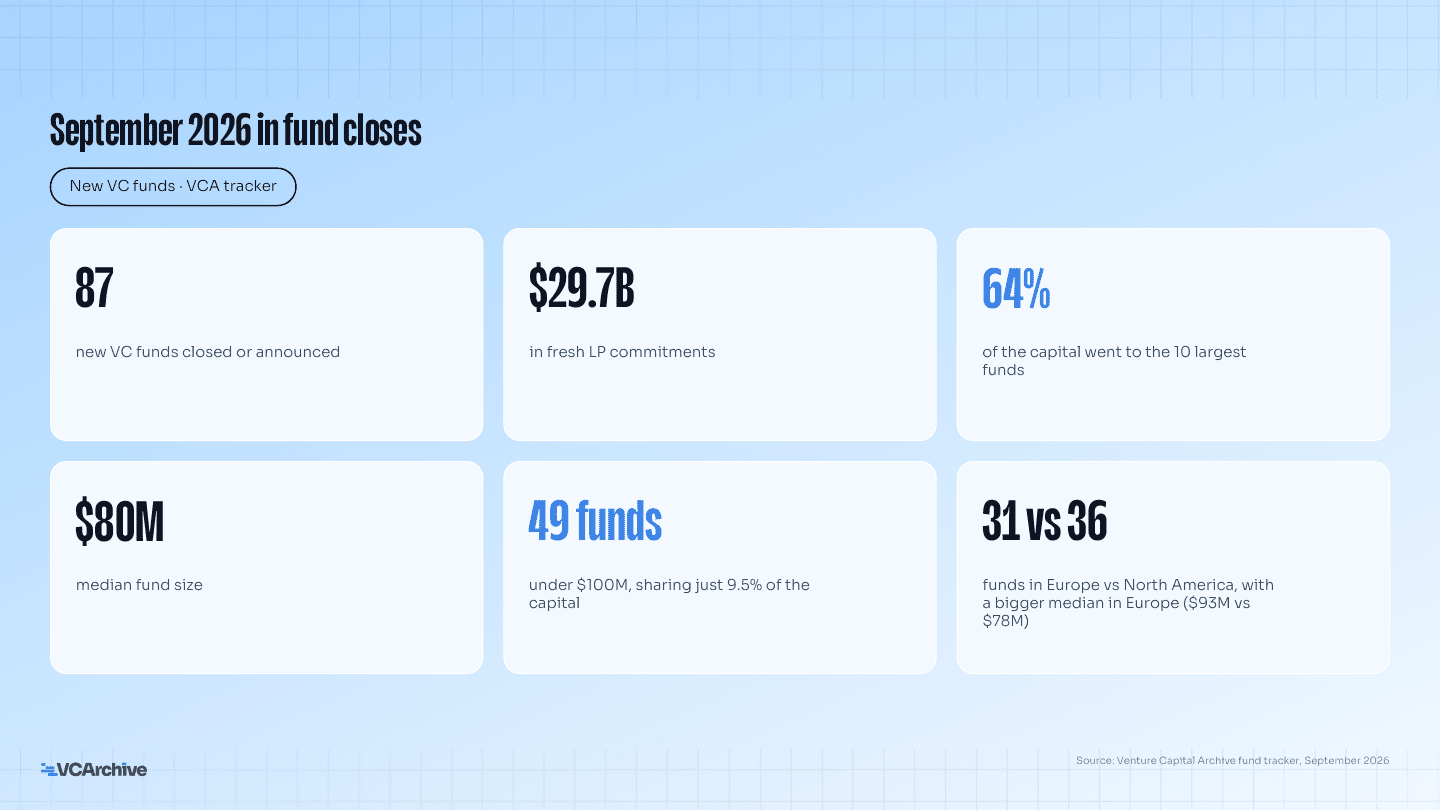
Ten funds captured 64% of September's capital. Four funds raised over a billion dollars and took 44% between them. Forty-nine funds raised under $100 million and shared 9.5%.
This is not new. Venture funds raised $72.4 billion across 405 funds during the first half of 2026, nearly matching the $75 billion raised during all of 2025, but the capital was highly concentrated. September made it more visible than any previous month this year. The distribution by fund size tells the story cleanly:
- 16 funds under $25 million: 1% of capital
- 14 funds at $25 to $50 million: 2% of capital
- 19 funds at $50 to $100 million: 6% of capital
- 20 funds at $100 to $250 million: 13% of capital
- 4 funds over $1 billion: 44% of capital
The middle of the market is not disappearing. It is being squeezed from both directions simultaneously. Mid-market managers lack the scale advantages of mega-funds and the nimbleness of micro-funds, leaving them vulnerable to LP consolidation.
The $100 million to $250 million band had the most funds by count, 20 of them, but captured only 13% of capital. That is the band where the squeeze is most visible and most consequential for the GPs trying to build there.
The corporate LP story
This is the one worth paying the most attention to.
13 funds in September had a corporate as LP or sponsor, worth $2.5 billion together. 1 in 5 dollars outside the four $1 billion-plus funds sat in a fund with a corporate behind it. The median corporate-backed fund was $110 million, 41% larger than the $78 million median for the rest of the month.
The examples from September make the logic clear.
Jungheinrich as sole LP in Uplift Ventures' $110 million Fund I
A forklift manufacturer betting on deep tech, industrial automation, robotics, and mobility. Not a passive financial allocation. A strategic bet on the technologies that will define the next generation of its own industry, made at the venture stage where the relationship can be built before the companies reach commercial scale.
ASML, TSMC, and Quanta Computer in Matter Venture Partners' $450 million Fund II
The supply chain that Matter's hardtech startups will eventually sell into. These companies are not seeking diversification. They are buying early access to the companies they will need as customers, partners, or acquisitions in five years.
Broadridge and Fifth Third Bank in Portage's $600 million Ventures IV
Future customers, potential partners, and potential acquirers of Portage's fintech portfolio. The LP cheque is the cheapest option on the table for that kind of strategic access.
The pattern is consistent. Corporate LPs are not writing cheques for financial returns. They are buying proximity to the next generation of their own industry, at a stage and price that will never be available to them again.
For GPs raising right now, the corporate LP angle is one of the most underexplored paths to a meaningful anchor commitment. For founders, knowing which of your potential investors has a strategic corporate LP behind them changes who you should be talking to and why.
14 more funds were backed by public money, from the British Business Bank at $591 million to the EIF backing multiple European vehicles. Government capital has become a structural feature of the venture landscape, particularly in Europe, where public anchors are increasingly the precondition for a fund close rather than a supplement to private LP capital.
The second fund story
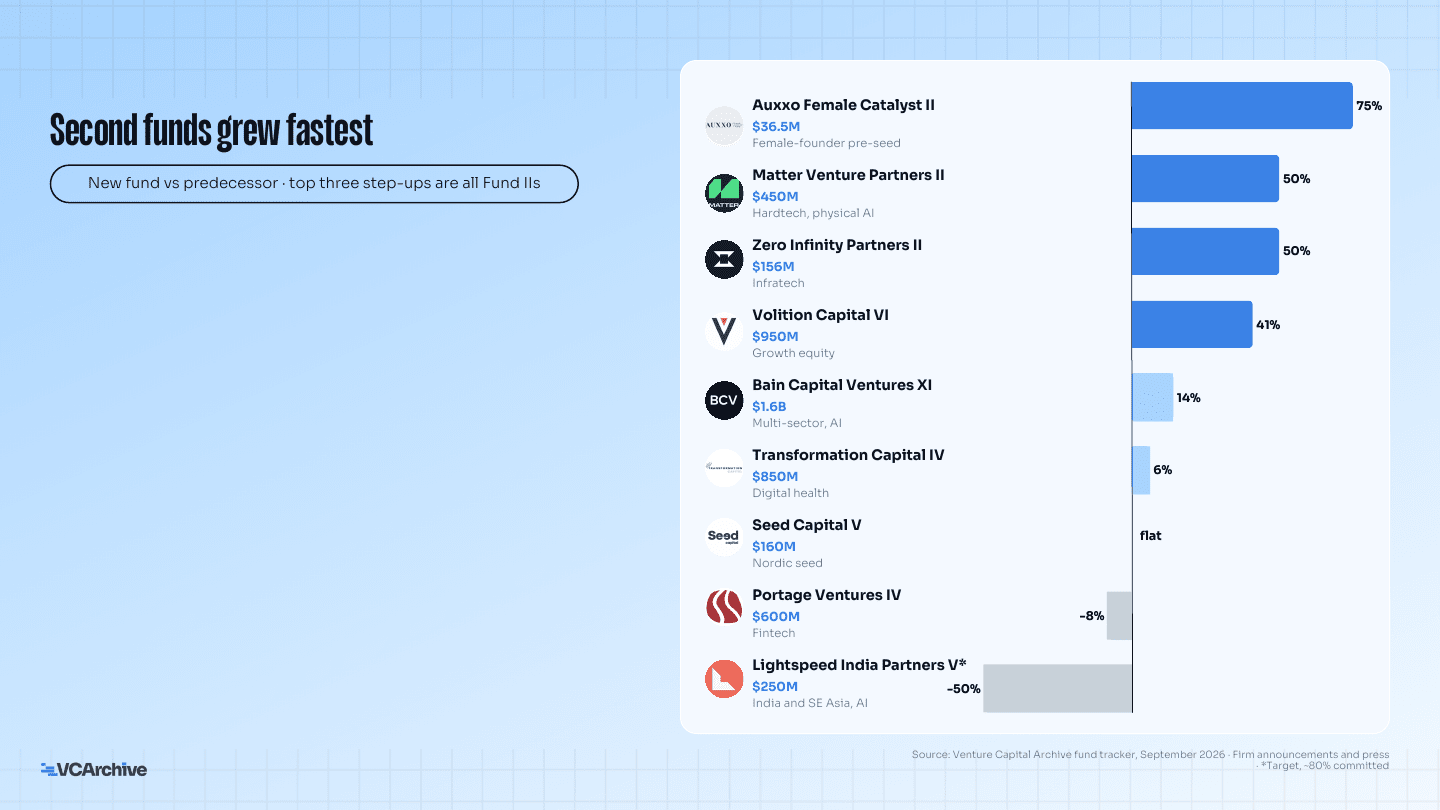
The top three step-ups in September were all Fund IIs. Auxxo Female Catalyst II grew 75% from Fund I. Matter Venture Partners II grew 50%. Zero Infinity Partners II grew 50%.
Inside a brutal LP environment where capital concentration reached a 15-year high, the managers raising Fund II at meaningful step-ups are proving something important: a strong first fund, in the right category at the right moment, still opens doors.
Auxxo growing 75% is the clearest signal. A pre-seed fund focused on female founders across healthcare, fintech, and sustainability, raising its second vehicle at nearly double the size of its first, in the toughest LP environment in a decade. That is what performance-backed conviction looks like when it reaches LP desks.
The negative step-ups are equally informative. Portage Ventures IV came in 8% below Ventures III. Lightspeed India Partners V is targeting $250 million, down 50% from its predecessor. In both cases the signal is precise: LPs have become more specific about which managers deserve more capital and which deserve less. The days of automatic step-ups based on brand alone are over.
First-time VC funds raised just $3.6 billion in 2025, an 85% drop from 2021, reflecting that LPs are favouring proven venture firms in this more risk-aware climate. The corollary is that the managers who did raise Fund I and deployed it well are now raising Fund II at meaningful step-ups. The bar is higher. The reward for clearing it is also higher.
The geography story nobody is writing about
Europe fielded 31 funds in September against North America's 36. But Europe's median fund size was $93 million versus $78 million for North America, meaning European funds, on a per-close basis, are raising with more LP conviction than their US counterparts.
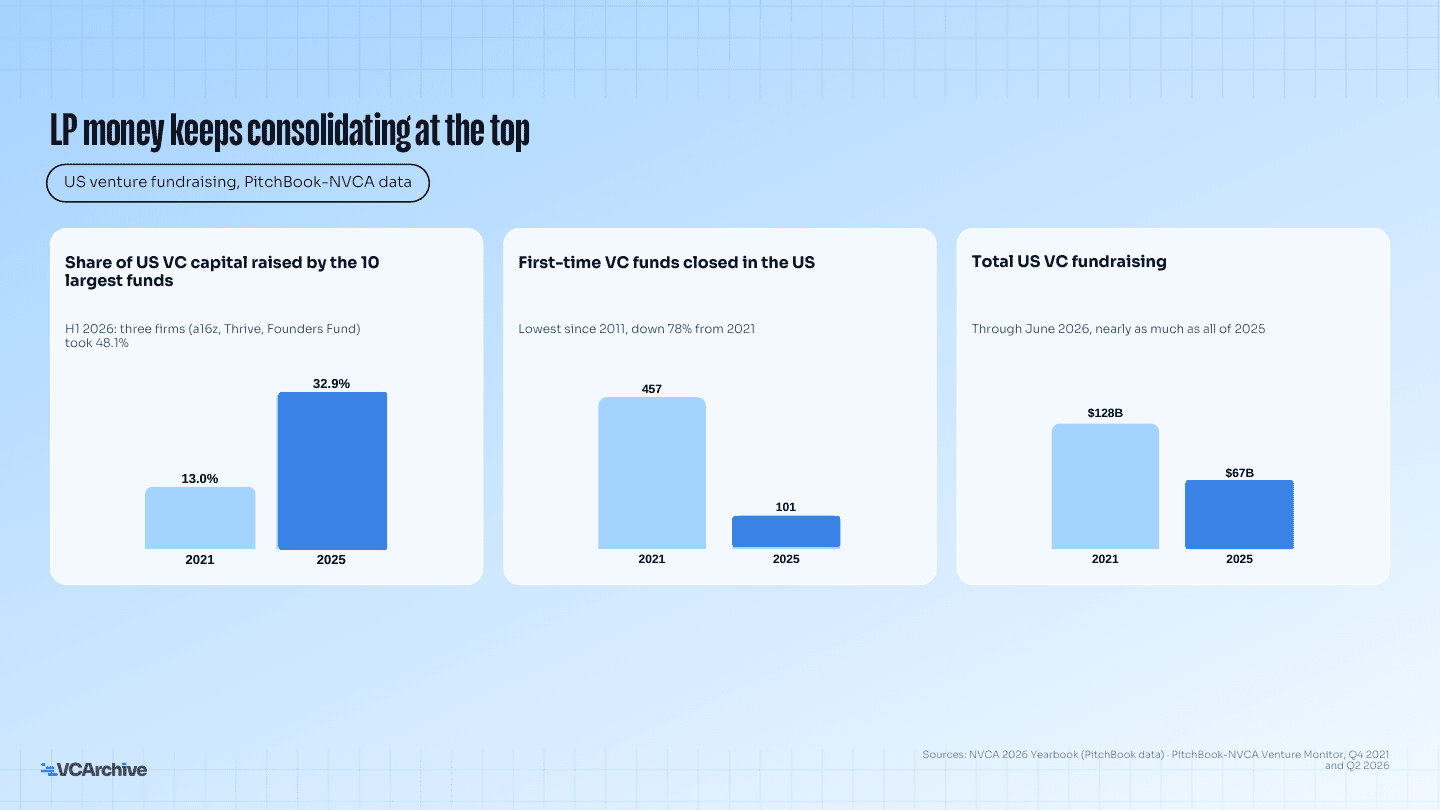
That reversal deserves more attention than it typically gets. For years the European venture narrative was about catch-up - smaller funds, shorter runways, fewer exits, more conservative LPs. September's data suggests something is changing in how European GPs present themselves and how European LPs respond.
The geographic spread beyond the traditional hubs is also worth noting:
- Sri Lanka: Lavni Ventures at $21 million for fintech, SaaS, edtech, and healthtech
- South Africa: two funds closing in the same month, one for digital inclusion, one for generalist B2B software
- Bulgaria: Launch Hub Ventures at $84 million for AI, fintech, gaming, and deep tech from Sofia
- Cyprus: Freesbee Ventures at $15 million for applied AI from Larnaca
- Argentina: Innventure for agrifood and precision agriculture from Buenos Aires
These are not tourist capital vehicles. They are locally rooted funds building investment infrastructure in markets that have matured enough to support it. Capital is increasingly flowing to new corners of the globe, with emerging markets cultivating local VC networks and benefitting from remote work and digital adoption trends.
What this means before you open the list
The current private market cycle is increasingly defined by a narrow set of consensus opportunities. September's 87 funds are 87 different responses to that reality. Some are leaning directly into the consensus - AI infrastructure, defence, digital health, enterprise software. Others are deliberately building in the white space the consensus creates: food tech, disability tech, breast cancer research, edtech, climate adaptation, university spinouts.
A few things worth holding before you use the list:
For founders: the fund that fits your company is not the biggest one or the most recognisable one. It is the one whose thesis most precisely matches what you are building, whose portfolio companies solve adjacent problems, and whose LP base creates strategic value beyond the capital. A corporate-backed fund whose LP is your most likely first enterprise customer is worth more than a similarly-sized fund with no strategic angle into your market.
For emerging GPs: September's data makes the corporate LP path look more attractive than it has ever been. The median corporate-backed fund was 41% larger than its non-corporate equivalent. If you are raising Fund I or Fund II in a category with obvious corporate strategic interest, the LP conversation you are not having is almost certainly the most important one.
For LPs: the liquidity unlock that has been promised for three years is finally arriving. The question is whether that freed capital goes back to the same concentrated set of mega-managers or flows toward the specialist funds building in the white space the top ten percent cannot reach.
The 87 funds below are the full picture of where new conviction capital formed in September 2026. Use it as a map.
New Venture Funds - September 2026



















Rows per page
More from Dario Villena
View author profile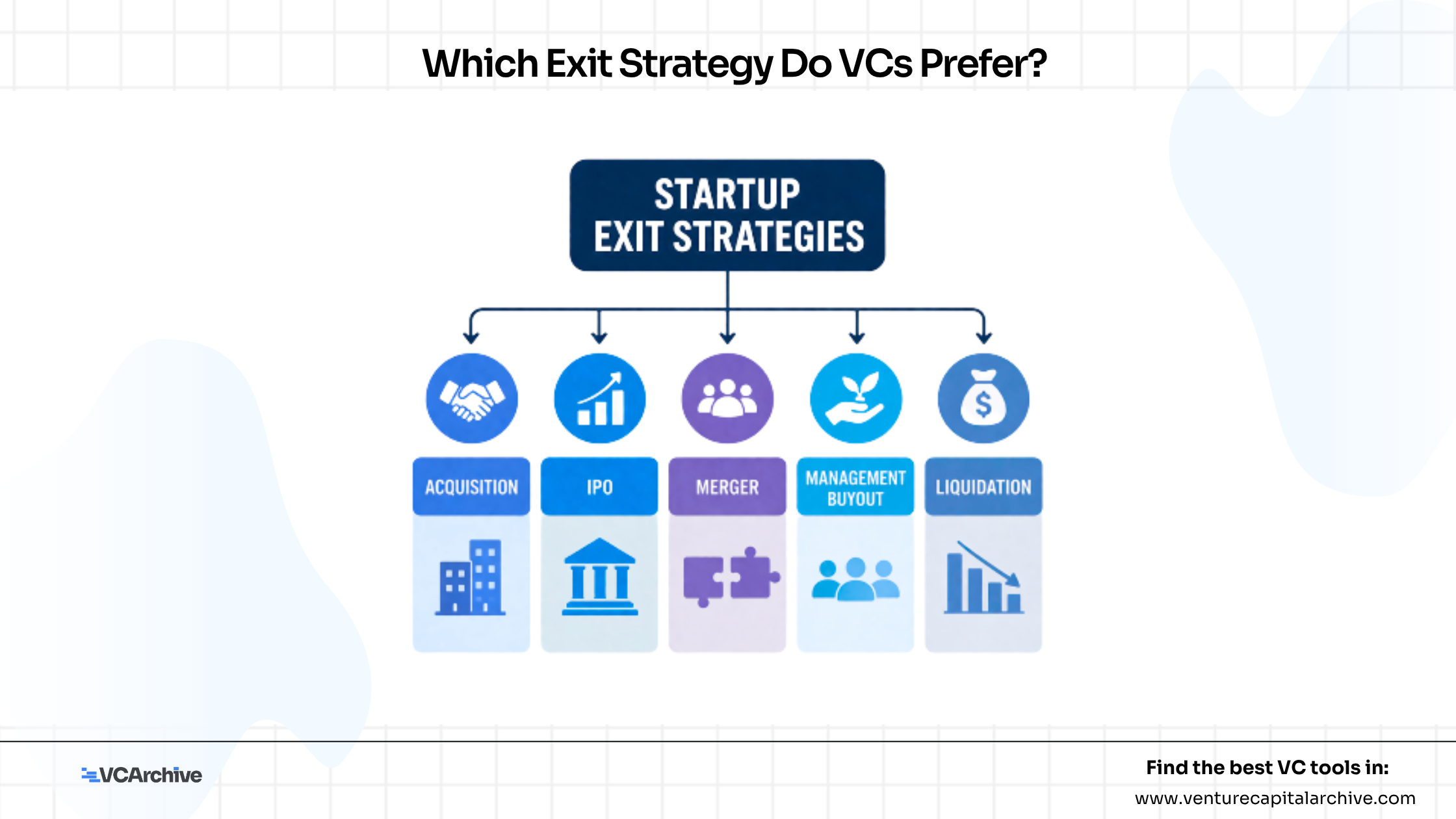
Which Exit Strategy Do VCs Prefer?
Most venture capitalists do not prefer any particular exit strategy. What they prefer is a strong company to have several options.
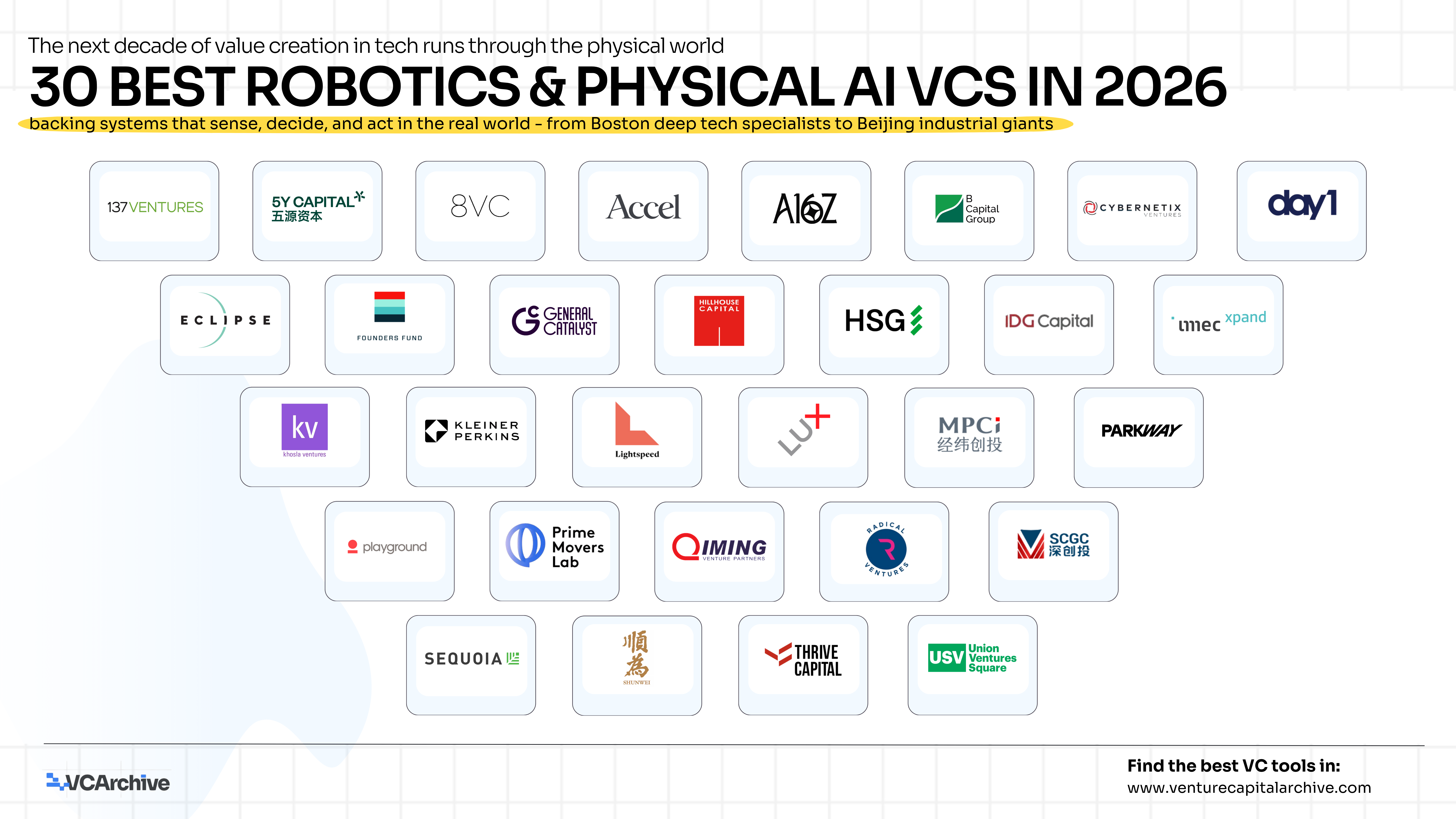
30 Best Active Robotics & Physical AI VCs in 2026
Software built the last decade. Physical AI is building the next one. These are the funds that are backing it.
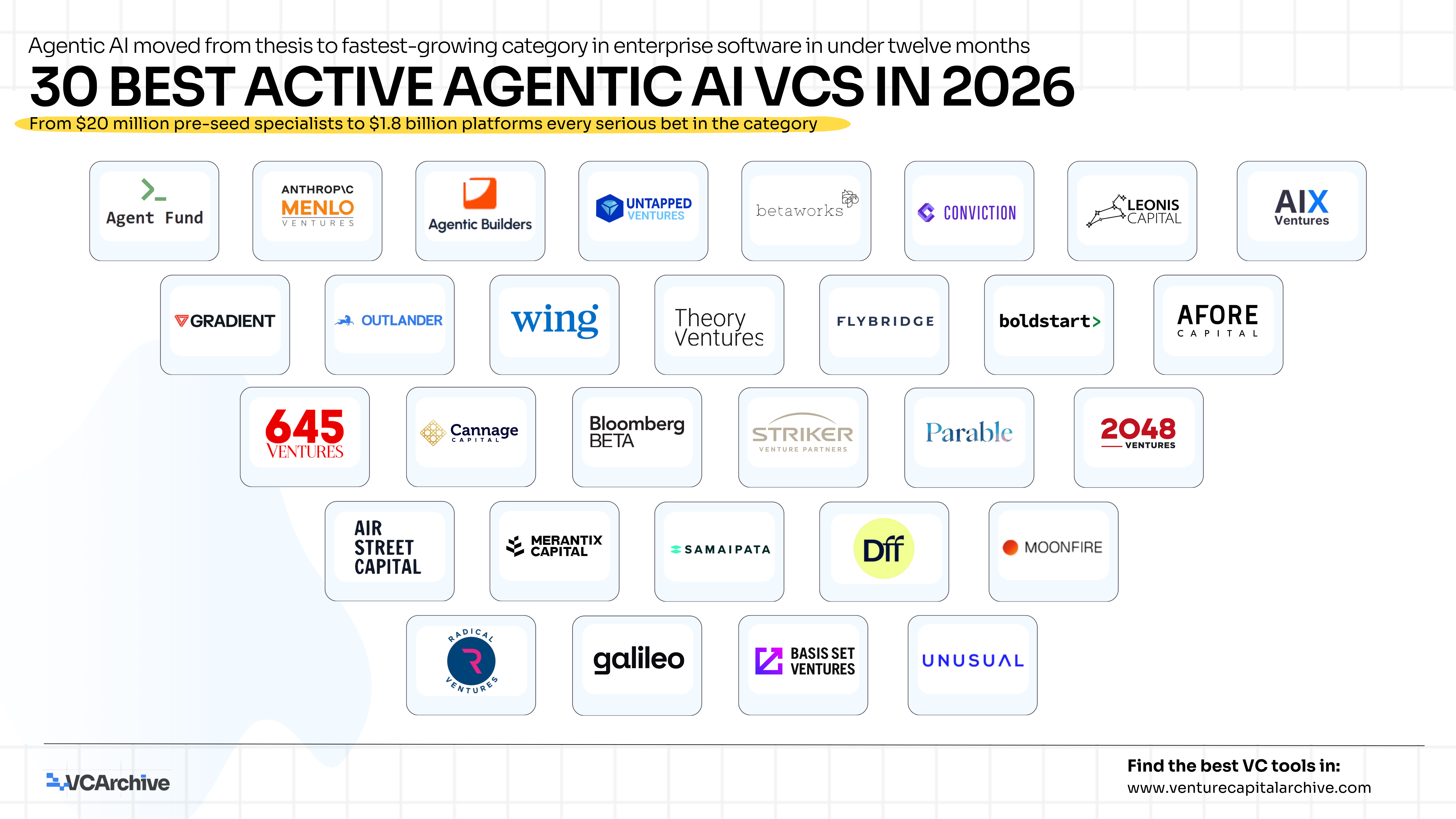
30 Best Active Agentic AI VCs in 2026
The shift from AI that assists to AI that acts autonomously is the biggest investment theme of 2026 and these 30 funds are at the centre of it