New Venture Funds - August 2026
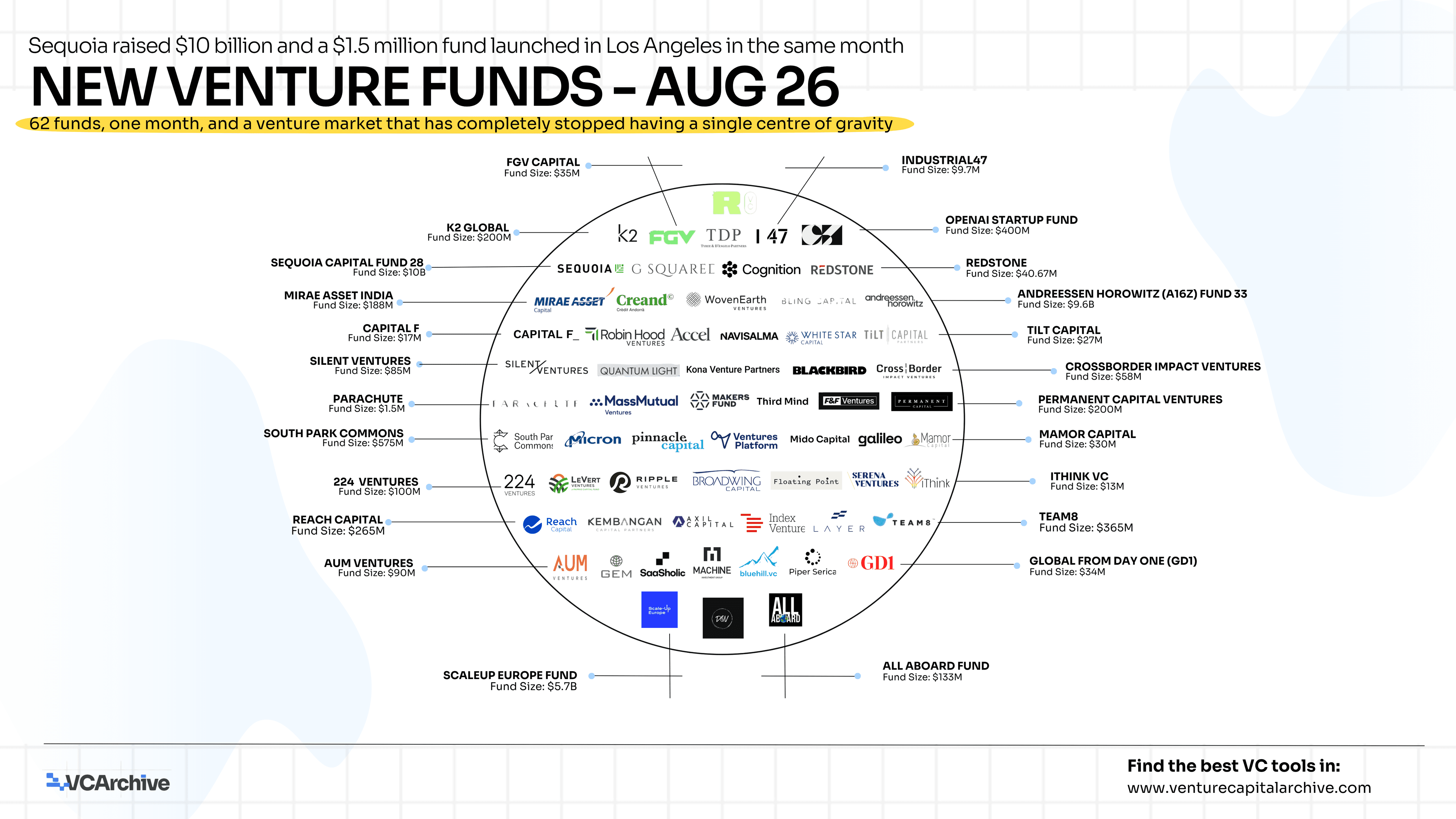
There is a number from August 2026 that reframes every other number in this list.
US startups raised more than $400 billion in the first half of 2026 alone, already exceeding the $440 billion invested during all of 2025. Crunchbase estimates global startup investment reached $510 billion in the first half of 2026, already exceeding the $440 billion invested during all of 2025. OriginBrief
Half a trillion dollars in six months. Records broken before summer ended.
And yet most founders raising right now will tell you it feels harder than those numbers suggest. That disconnect is not a contradiction. It is the defining feature of the 2026 venture market — and August's 62 fund launches are the clearest illustration of it we have seen all year.
The market in one sentence
"This level of concentration is without precedent in modern venture history." That was JPMorgan Chase's head of market insights, describing Q1 2026, where the top five deals — OpenAI, Anthropic, xAI, Waymo, and Databricks — together represented around three-quarters of total venture investment. International Banker
The headline numbers are real. The distribution underneath them is extreme. The result is a barbell market: exceptional companies can raise amounts once associated with public offerings, while smaller startups are still being asked to prove much more before capital scales. Tech Startups
August's fund launches sit at both ends of that barbell simultaneously.
What the month actually produced
Three numbers worth holding before you read the list:
- $9.6 billion — a16z's new fund, including a dedicated $1.1 billion hardware vehicle — the first time the firm has separated physical AI from its general software pool
- $10 billion — Sequoia's raise, the largest in the firm's history
- $1.5 million — a fund launched in Los Angeles for frontier technology, in the same month, in the same market
That range is not noise. It is the market operating exactly as it should — concentrating at the top into managers with decades of track record and fragmenting at the edges into increasingly specific theses that the mega-funds cannot serve.
Four things that defined August
01 — a16z made a bet that hardware needs its own fund
a16z creating a dedicated $1.1 billion hardware fund rather than funding physical AI from its general pool signals that the firm believes hardware investment requires a different LP base, different return timeline expectations, and different operational expertise than software VC. OriginBrief
That is not a minor portfolio adjustment. It is a structural statement about where the next decade of value creation sits. When the most influential venture firm in the world decides that physical AI is categorically different from software AI and needs its own vehicle, other firms face pressure to articulate their own hardware strategy or risk being seen as underexposed to the physical buildout. Several of August's other fund launches — Micron Ventures for AI and semiconductors, Navisalma for deep tech and robotics from Stockholm, 224 Ventures for AI infrastructure and robotics — are positioned exactly at that intersection.
02 — AI accounted for 86% of venture dollars in Q2
AI accounted for 86% of venture dollars in the second quarter. Not 86% of deals. 86% of dollars. Tech Startups
At this point, calling AI a theme in venture capital is like calling water a theme in swimming. It is the medium. Every fund on August's list has AI somewhere in its mandate — not because every GP woke up and decided to be an AI investor, but because almost every category of company worth backing in 2026 is being built with AI at its core.
The more interesting question is what the 14% that is not AI looks like. August had some answers. A $250 million gaming-only fund. A $155 million climate and clean energy vehicle. A $58 million health tech impact fund in Toronto. A dedicated agricultural and food technology vehicle in San Francisco. These are the funds making deliberate bets on categories that the AI capital wave has not fully reached — and positioning for the moment when it does.
03 — The ScaleUp Europe Fund changed the conversation about European deep tech
The ScaleUp Europe Fund closed $5.7 billion for AI, quantum technologies, semiconductors, robotics, and cleantech across the EU. Backed by the European Commission, it is one of the largest dedicated deep tech vehicles ever raised in Europe and a direct response to the concern that European deep tech founders are systematically underserved by domestic capital compared to their US counterparts.
Capital likes sectors where hard problems create durable demand. The ScaleUp Europe Fund is a $5.7 billion expression of that conviction applied to the categories Europe is best positioned to lead — quantum, advanced manufacturing, climate infrastructure, and semiconductor design that does not depend on Asian or American supply chains. Mean CEO's BLOG
04 — The geography kept expanding
August produced new fund formation in Nigeria, South Africa, Brazil, South Korea, Norway, Andorra, New Zealand, and India alongside the usual US and European hubs.
- Ventures Platform in Abuja deploying into fintech, agritech, and edtech across Africa
- Mamor Capital in Waterfall City, South Africa, focused on digital inclusion and sustainable investments
- SaaSholic in São Paulo backing SaaS and enterprise software across Latin America
- RunwayVC in Oslo for AI, fintech, and health tech across the Nordics
- Kona Venture Partners in Seoul for AI and fintech in Korea
- Global From Day One in Auckland for SaaS, deep tech, and healthcare from New Zealand
Each of these exists because the founder ecosystem in its home market has matured past the point where international capital alone is sufficient. Local GPs with local networks and local pattern recognition are building the infrastructure to capture opportunities that funds based in San Francisco or London cannot efficiently access.
What this means if you are raising right now
The money has not disappeared. It has become more judgmental. That is frustrating for weak startups and very good for serious ones. Mean CEO's BLOG
A few practical things worth understanding before you approach any fund on this list:
AI tied to revenue beats AI tied to a demo. Investors want AI tied to revenue, not just tied to a demo. The compression from impressive demo to fundable company has never been shorter — which means the compression from fundable company to closing a round requires proving the commercial logic, not just the technical one. Mean CEO's BLOG
The specialist advantage is real. For startups seeking early-stage investment, smaller and specialist funds can be just as relevant as the headline-grabbing mega-funds. A $13 million fintech and AI fund in New York and a $10 billion Sequoia vehicle are not competing for the same companies. The specialist that has spent years understanding your specific category will evaluate your company more accurately and add more value post-close than a generalist writing a small cheque from a large fund. Foundevo
Structure beats adrenaline. In my own ventures I have learned that structure beats adrenaline over time. The founders raising well in August 2026 are the ones who treated fundraising as a system — mapping the right funds before outreach, building relationships before they needed them, and arriving at each conversation having done the work to understand what the fund on the other side of the table is actually trying to accomplish. Mean CEO's BLOG
Before you open the list
Venture capital's signal today is not that risk appetite has returned evenly across the startup market. It is that investors are paying aggressively for bottlenecks created by the deployment of artificial intelligence: electricity, model security, autonomous logistics, semiconductor design, licensed media, verifiable information, and specialized workflow software. Tech Startups
August's 62 funds are 62 different articulations of where conviction sits in a market that has never had more capital and never been more selective about where it goes. Sequoia and a16z closing combined $19.6 billion. An OpenAI vehicle closing $400 million to back companies built on its own infrastructure. A $1.5 million fund that will write a cheque into a founder nobody else has found yet.
All of it is August 2026. Use the list as a map, not a menu. The right door for your company is specific. Finding it before you send the first message is the work worth doing.
New Venture Funds - August 2026














Rows per page
More from Dario Villena
View author profile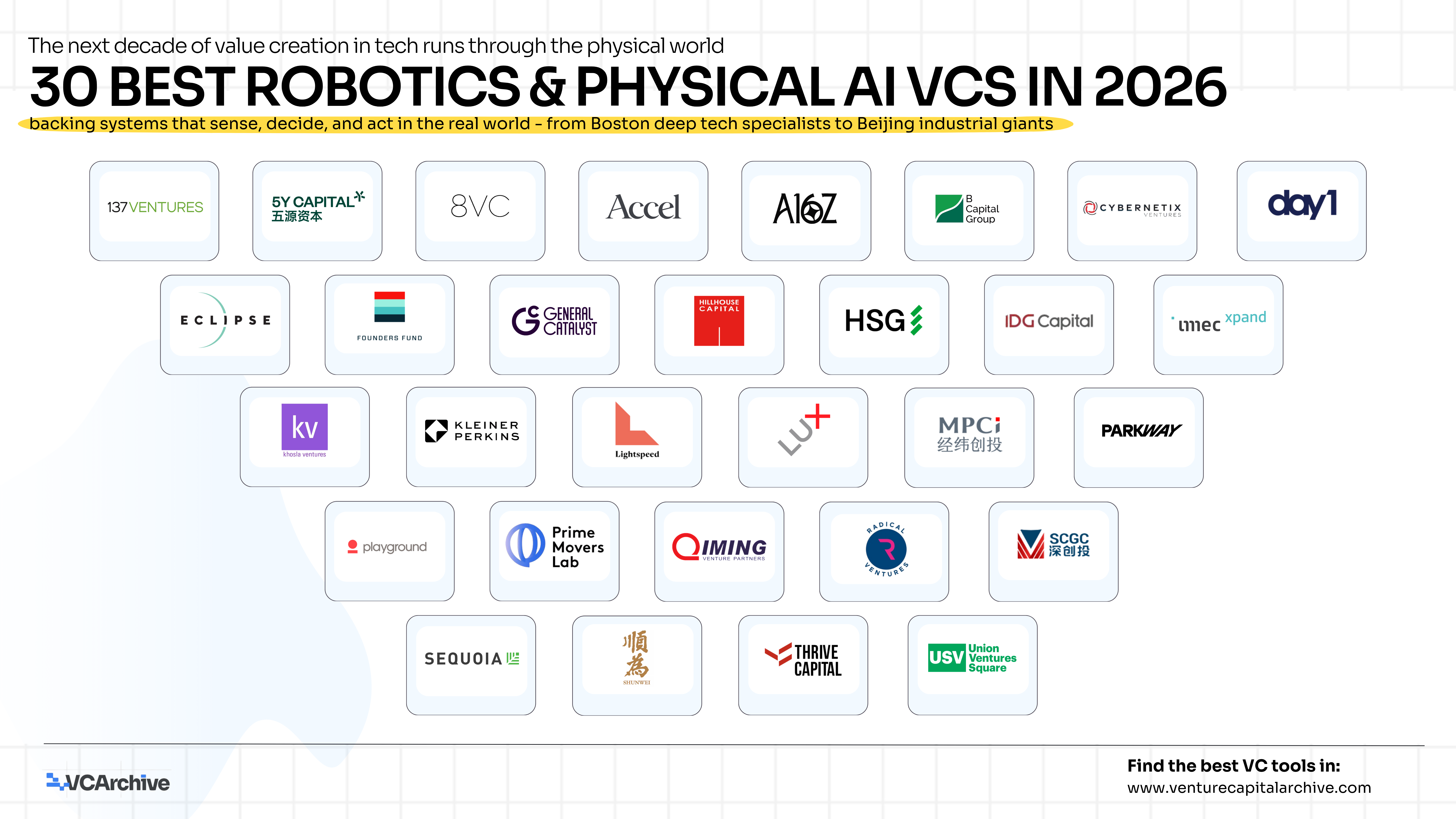
30 Best Active Robotics & Physical AI VCs in 2026
Software built the last decade. Physical AI is building the next one. These are the funds that are backing it.
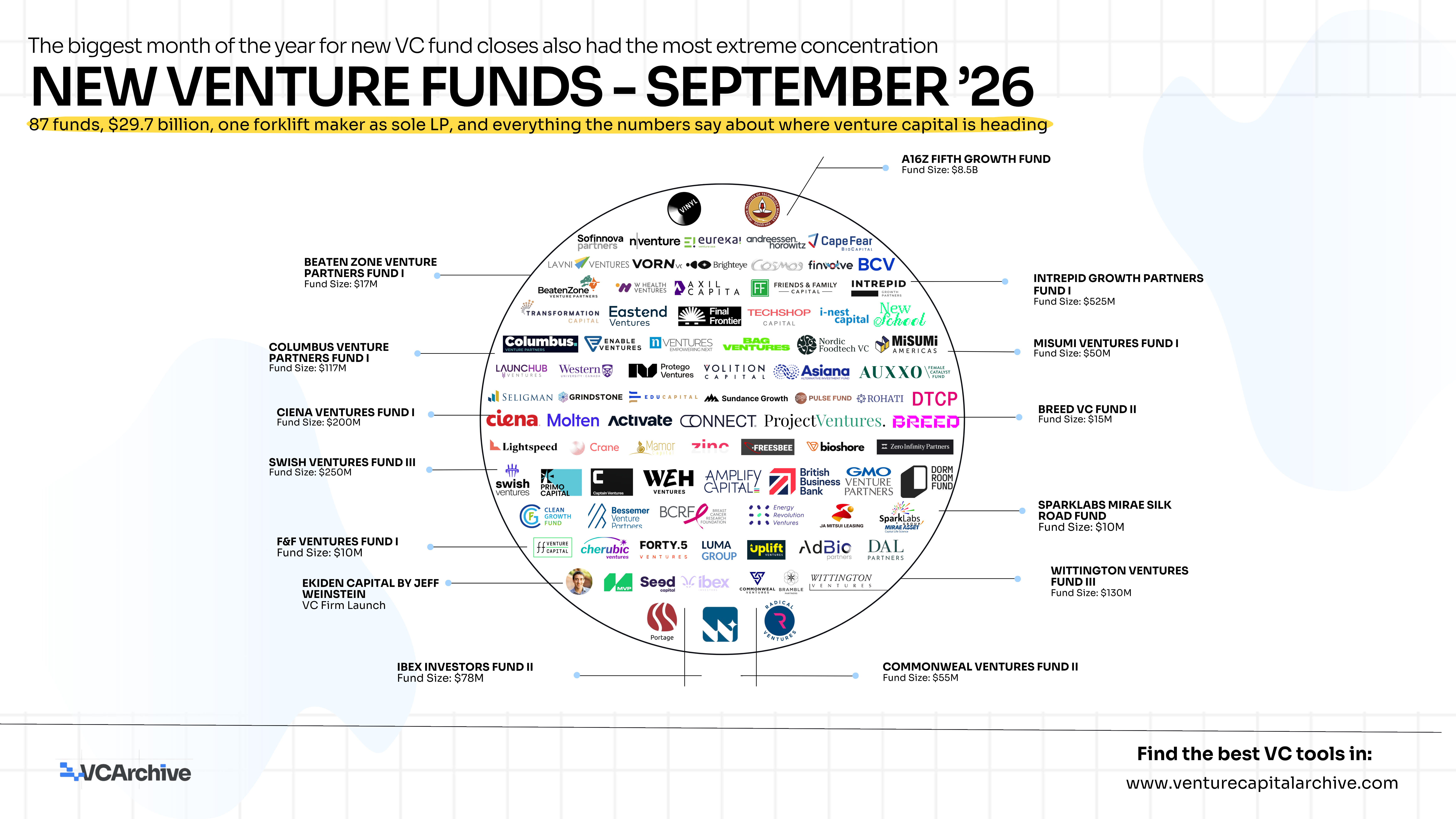
New Venture Funds - September 2026
The biggest fund formation month of 2026 also had the most extreme concentration we have tracked.
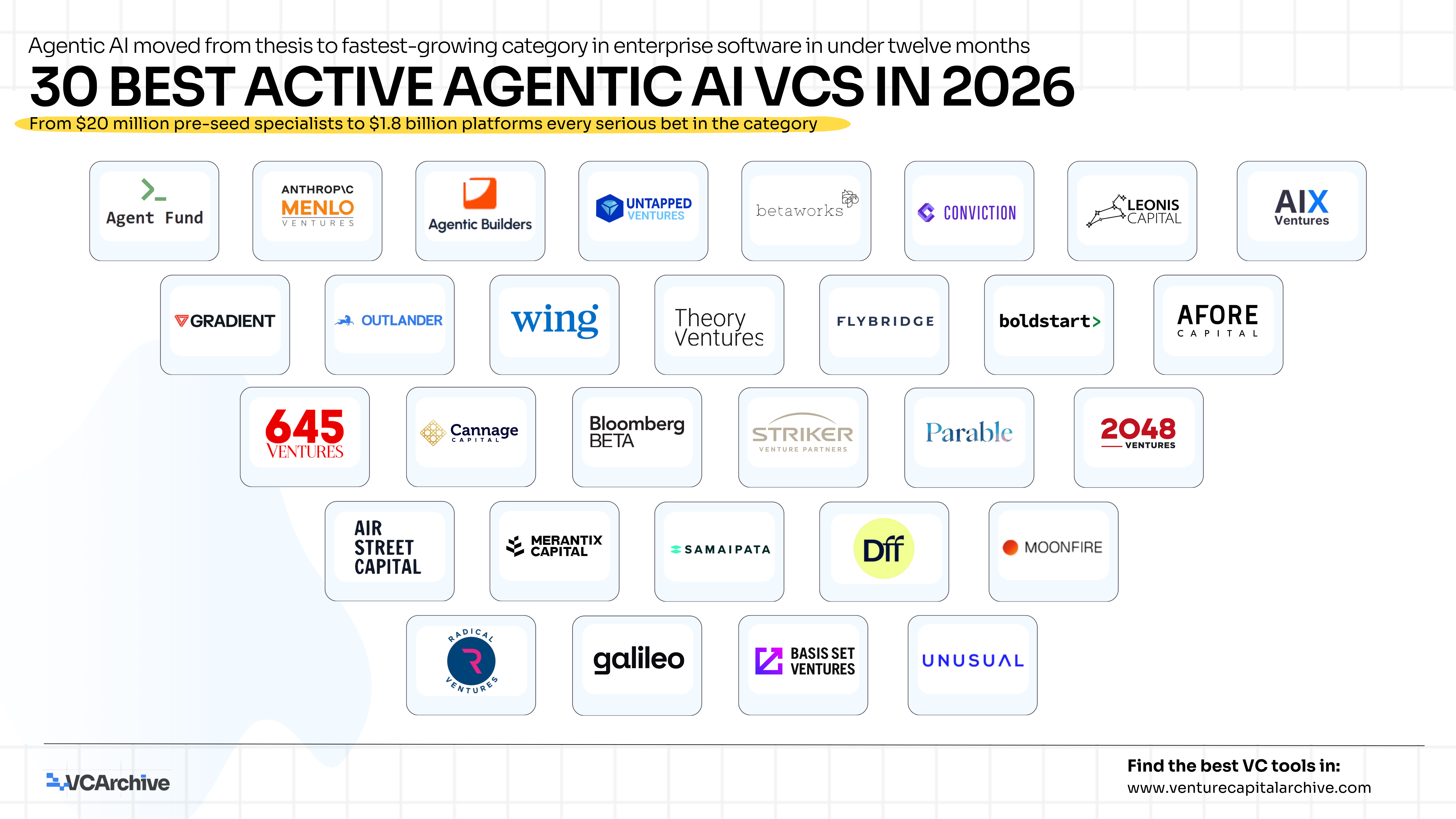
30 Best Active Agentic AI VCs in 2026
The shift from AI that assists to AI that acts autonomously is the biggest investment theme of 2026 and these 30 funds are at the centre of it