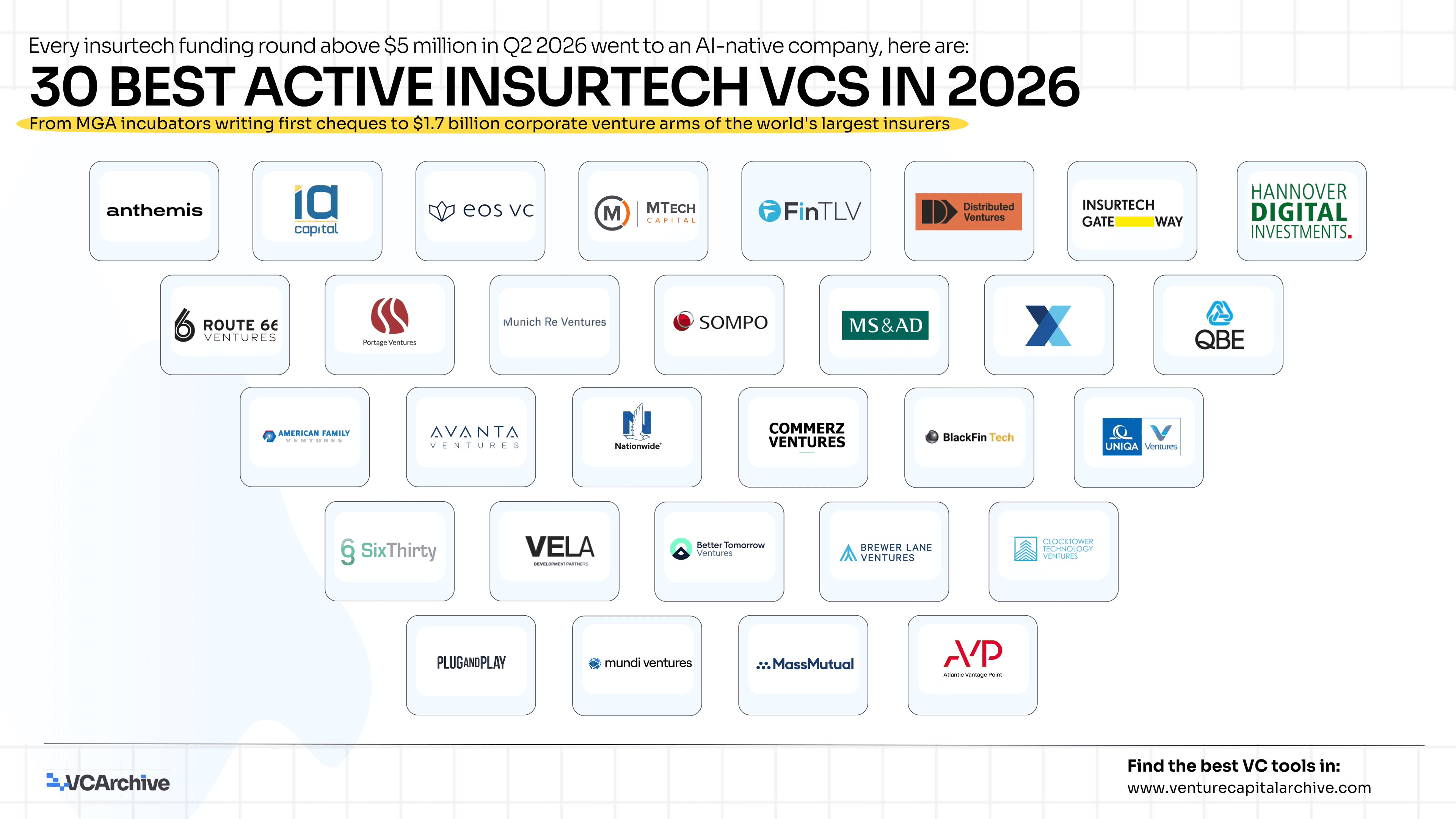
30 Best Active Insurtech VCs in 2026
Insurance has always had a reputation problem.
It is the product everyone needs, nobody wants to buy, and actively dreads using. The claims process. The policy language. The phone queue. The letter in the post telling you that the thing you thought was covered is not actually covered under clause 14b subsection three.
For decades, technology promised to fix this. Insurtech was going to make insurance fast, personal, transparent, and maybe even enjoyable. Then the hype cycle ran its course, funding collapsed, and a lot of very expensive digital-first insurance companies discovered that underwriting discipline matters more than a clean app interface.
That correction is over. What replaced it is more interesting than the original wave.
The numbers that define the moment
Let's start with three facts that are hard to process without sitting with them for a moment.
$2.44 billion flowed into insurtech in Q2 2026 alone — the highest quarterly total in four years and a clear signal that the funding drought is finished.
99.1% of that capital went to AI-focused startups. Not AI-adjacent. Not AI-powered. AI-native companies whose core product is built around machine intelligence rather than having intelligence bolted on afterwards.
Every single insurtech funding round above $5 million in Q2 2026 went to an AI-native company. Not most of them. Every one.
That last number is the one worth sitting with. A category that spent years debating whether AI was a differentiator has apparently resolved the debate. AI is no longer a feature. It is the baseline. If your insurtech company is not AI-native in 2026, you are not competing for the same capital as the companies that are.
What actually changed — and why now
The first wave of insurtech was about distribution. Put insurance online. Make it easier to buy. Remove the broker. Build a clean interface. It worked well for customer acquisition and badly for combined ratios.
The second wave was about data. Use telematics, IoT, and behavioural signals to price risk more accurately. Pay-per-mile car insurance. Health policies tied to smartwatch activity. Usage-based everything. The thesis was right. The execution was slow because the data infrastructure was not ready.
The third wave — the one we are in now — is about autonomous operations. VCs are actively moving away from basic AI assistants to fund autonomous, outcome-driven systems: specialised multi-agent AI networks managing end-to-end claims, fraud detection, and automated underwriting without human intervention in the loop.
That shift has a specific commercial logic. AI-driven underwriting cuts approval times dramatically. Automated claims handling reduces loss ratios. Fraud detection that runs continuously rather than being audited quarterly saves real money at scale. These are not theoretical improvements. They are the metrics that make insurance CFOs write cheques for software they never would have bought three years ago.
Investors have firmly abandoned the growth-at-all-costs era. The current VC thesis strictly prioritises sustainable unit economics, digital foundations, and the rebuilding of core operating layers over experimental technology. The companies raising in 2026 can show the numbers. That is new.
Three things worth understanding about how this capital is structured
The corporate venture arms are not passive observers.
Munich Re Ventures, Allianz X, Sompo Ventures, MS&AD Ventures, QBE Ventures, American Family Ventures, Nationwide Ventures, UNIQA Ventures, MassMutual Ventures — nine of the thirty funds on this list are the venture arms of major global insurers. That concentration is not accidental. The incumbents learned from the first insurtech wave that watching from a distance was a mistake. Now they are writing cheques into the companies most likely to either compete with them or become their technology partners.
For founders, this creates a specific dynamic worth understanding before you approach any of them:
- They bring distribution access that independent VCs cannot match
- They bring regulatory relationships that compress compliance timelines
- They bring strategic context that sometimes conflicts with pure commercial logic
- They are almost always slower to decide than independent funds
Knowing which of those factors matters most for your specific company at your specific stage is the work worth doing before the first meeting.
Embedded insurance is quietly becoming one of the most interesting bets.
Cover Genius secured a $100 million round at a $1.9 billion valuation to deepen point-of-sale insurance for global distribution networks. That round is a signal about where the structural opportunity in insurance actually sits. Not in building better insurance brands. In building the infrastructure layer that makes insurance invisible — embedded at the point of need, priced in real time, claims handled without a phone call.
Top VCs are aggressively backing infrastructure and embedded protection platforms. The bet is that the next generation of insurance is not a product people buy. It is a protection layer that appears when you book a flight, buy a phone, or sign a lease — and disappears before you even notice it was there.
Mega-rounds are concentrating at the top.
Alan, the Parisian digital health insurer, closed €100 million in 2026 at a €5 billion valuation. Fewer deals, bigger cheques. While overall capital volume is skyrocketing, the number of distinct companies successfully raising capital is narrowing. VC funding is heavily concentrated in a smaller pool of proven, investable businesses.
That bifurcation creates a specific challenge for earlier-stage founders and a specific opportunity for the funds that have built the domain expertise to identify the next Alan before it becomes obvious. The early-stage specialists on this list — Insurtech Gateway, Distributed Ventures, MTech Capital, Better Tomorrow Ventures — are writing first cheques into companies that in three years will be competing for the mega-rounds. The question is whether they can identify which ones before the market does.
What the geography tells you
The list spans London, Munich, Frankfurt, Paris, Vienna, Hannover, Madrid, Montreal, Tel Aviv, Tokyo, Sydney, New York, Boston, San Francisco, Columbus, Madison, Washington DC, and Santa Monica.
That spread is not accidental. Insurance is a local product regulated by local authorities operating in local legal frameworks with local claims processes. An insurtech company winning in Germany looks different from one winning in Japan, which looks different from one winning in Australia. The funds that have built genuine expertise in their home markets are structurally better positioned to evaluate those opportunities than any global generalist trying to cover all of them simultaneously.
The Tokyo-headquartered corporate VCs — Sompo and MS&AD — bring something that no San Francisco fund can replicate: a decade of watching Japanese insurance digitise from the inside, and the distribution relationships to take a portfolio company from pilot to product in one of the most complex and most lucrative insurance markets on earth.
Before you open the list
The insurtech funding drought is over. The AI mandate is clear. The strategic LP advantage is real. And the concentration at the top means that the distance between the companies raising Series A rounds and the companies raising Series C rounds has never been wider.
For any founder building in this space, the question is not whether the capital exists. It is whether the specific fund you are approaching has the domain expertise, the strategic network, and the stage mandate that makes them the right partner for your specific company at your specific moment.
The 30 funds below are the most complete map of where serious insurtech capital lives in 2026. Independent specialists and corporate venture arms. Pre-seed MGA incubators and $1.7 billion growth platforms. London, Munich, Tel Aviv, Tokyo, and everywhere in between.
The right door is on this list. Finding it before you send the first message is the only fundraising skill that consistently matters.
30 Best Active Insurtech VCs in 2026











Rows per page
More from Dario Villena
View author profile
30 Best Active Robotics & Physical AI VCs in 2026
Software built the last decade. Physical AI is building the next one. These are the funds that are backing it.
New Venture Funds - September 2026
The biggest fund formation month of 2026 also had the most extreme concentration we have tracked.
30 Best Active Agentic AI VCs in 2026
The shift from AI that assists to AI that acts autonomously is the biggest investment theme of 2026 and these 30 funds are at the centre of it