30 Best Active Consumer & Retail VCs in 2026
Let's start with a number that should stop you in your tracks.
DTC venture investments dropped 97% from the 2021 peak to the 2023 trough, the steepest correction in the category's history.
Ninety-seven percent. Not a slowdown. Not a correction. A near-total collapse of investor confidence in a category that had, just two years earlier, seemed unstoppable. Glossier was a unicorn. Warby Parker was going public. Every CPG brand with a Shopify store and a TikTok account was raising a seed round.
And then it stopped.
But here is the thing about markets that correct violently: they rarely disappear. They clarify. The hype burns off, the weak players exit, and what remains is a cleaner, harder, more honest version of the underlying opportunity. That is exactly what has happened in consumer and retail. And the opportunity underneath the correction is larger than most people currently appreciate.
Why consumer is not optional for anyone building the future
People eat every day. They wear clothes every day. They shop, browse, discover, and buy every single day, in ways that are becoming exponentially more complex, more personalized, and more technology-dependent with each passing year. Consumer and retail is not a sector. It is the operating layer of human civilization.
US DTC e-commerce is projected to reach $240 billion in 2026, roughly 20% of all online retail. And 73% of shoppers now use multiple channels, making omnichannel the default strategy rather than an aspiration.
That last number is the one worth dwelling on. Seventy-three percent of shoppers move fluidly between physical stores, mobile apps, social commerce, subscription services, and direct brand relationships — often within a single purchase journey. The consumer experience has become an integration problem, a data problem, and a technology problem all at once.
The three forces reshaping consumer and retail right now
1. AI is not coming to retail. It is already inside it.
42% of retail and CPG companies are already leveraging AI technology, while another 34% are in the testing or implementation phase. That means three quarters of the industry is either live with AI or actively building toward it. The use cases are not theoretical: personalized product recommendations that convert three times better than generic ones, demand forecasting that cuts inventory waste by double digits, computer vision that automates checkout and loss prevention, and generative tools that compress the design-to-shelf timeline for consumer brands from months to weeks.
The companies that figure out how to embed AI into the consumer experience in ways that feel natural rather than intrusive will own the next decade of brand loyalty. The ones that do not will be outcompeted by startups that do not even exist yet.
2. The physical and digital divide is collapsing
The old framework; online versus offline, DTC versus wholesale, digital brand versus heritage retailer — is becoming meaningless. Private equity and venture capital are increasingly active across grocery, specialty retail, and omnichannel platforms, reflecting investor interest in assets positioned to benefit from structural shifts in how people consume.
The brands and retailers winning right now are not choosing between channels. They are building infrastructure that makes the channel invisible to the consumer. You discover on Instagram, research on the brand's website, try in-store, subscribe via an app, and return through WhatsApp. Every one of those touchpoints is a data point. Every one of those data points is a competitive advantage for the brand that knows how to use it.
3. The value consumer is here and not going anywhere
Inflation reshaped consumer psychology in ways that low-interest-rate models never anticipated. Shoppers who used to buy premium without thinking twice are now actively comparing, waiting for sales, and switching brands for marginal savings. But the flip side of that is equally important: consumers are willing to pay a genuine premium for brands that earn it through authenticity, sustainability, community, or a product that simply works better than the alternative.
The middle is getting squeezed. Mass market brands with no clear identity are losing to either exceptional value at the bottom or genuine premiumness at the top. The founders and fund managers who understand that dynamic are positioning in exactly those places.
What the data actually looks like right now
The chart below tells the real story of where consumer and retail venture capital has been and where it is heading.

The shape of that curve matters. The 2021 peak was a distortion driven by zero-interest-rate capital flooding into anything with a DTC slide and a customer acquisition story. The 2022 to 2023 correction was brutal but necessary. What the 2025 to 2026 data shows is a different kind of recovery: not a return to volume, but a return to conviction. Institutional capital is flooding back into consumer at the top of the market, while seed-stage rounds remain near a decade low. The 2026 consumer investment landscape is defined by that split: mega-fund activity at growth stage, seed-stage drought for undifferentiated brands.
The takeaway is not that consumer is hard to fund. It is that undifferentiated consumer is hard to fund. Brands and companies with a clear reason to exist, a demonstrable customer relationship, and a technology or operations layer that is genuinely hard to replicate are raising as well as they ever have.
The brands that will win the next decade share one thing
They treat their consumer relationship as infrastructure, not marketing.
The difference sounds subtle. It is not. A brand that treats consumer relationship as marketing asks: how do we get more people to buy? A brand that treats it as infrastructure asks: how do we become the kind of company that people choose to organise part of their life around?
That shift shows up in product decisions, in community-building, in data strategy, in how the brand handles a supply chain problem or a product recall. It shows up in whether a company has a thousand loyal customers who tell everyone they know, or ten thousand indifferent ones who might switch next quarter.
The investors who back consumer and retail companies at the earliest stages understand this distinction instinctively. They are not just evaluating product-market fit. They are evaluating whether a founding team has a genuine relationship with the consumer it is trying to serve, or whether it has a hypothesis about one.
Where the smart money is looking
A few themes are drawing consistent interest from the most active investors in the category right now.
Commerce infrastructure over consumer brands: The picks-and-shovels play in retail is having a moment. Payments, inventory management, retail analytics, supply chain software, and the AI tools that sit underneath all of it are attracting capital that would have gone into DTC brands three years ago.
Category specialisation: Beauty, wellness, food and beverage, and pet care are all drawing dedicated investment vehicles rather than generalist consumer funds. The thesis is simple: category specialists have better pattern recognition, better networks, and better founder support than generalists who are trying to cover too much ground.
Geography diversification: The consumer opportunity is not a US story. India's consumer market is in the middle of a generational expansion. Southeast Asia's middle class is growing faster than almost any other region in the world. Cross-border interest in consumer assets is rising globally, with investors increasingly seeking access to markets shaped by structural demographic shifts and evolving consumption patterns.
Sustainability as product, not positioning: The brands attracting growth capital in 2026 are not the ones that added a sustainability page to their website. They are the ones that built sustainability into their unit economics from day one, in ways that create cost advantages and customer loyalty that conventional brands cannot easily replicate.
The 30 funds that are actually doing this
Most of what is written about consumer and retail investing focuses on the macro trends, the headline deals, and the occasional hot brand that everybody suddenly knows about. What it misses is the harder, quieter work: the investors who built deep category expertise over years, who know what a good gross margin looks like in food and beverage versus beauty versus retail tech, and who show up for a founder when a SKU fails or a retailer partnership falls apart.
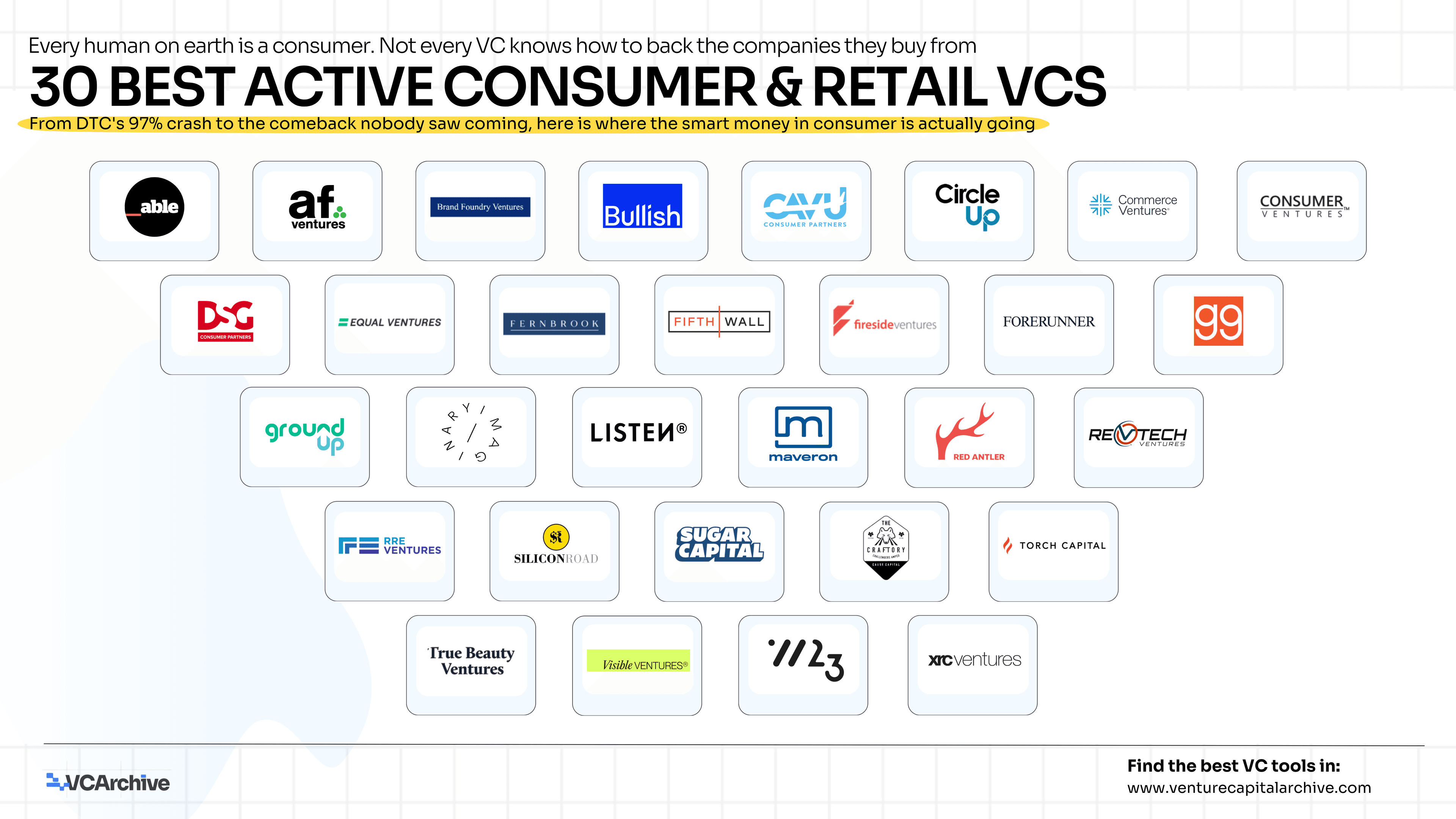
The 30 funds on the VCA list of the best active consumer and retail VCs in 2026 represent exactly that. Firms ranging from New York DTC specialists to Singapore-based emerging market platforms, from retail AI accelerators in Atlanta to sustainability-focused growth funds in London. Collectively, they cover every stage from pre-seed through growth, every major consumer category, and every geography where the next generation of consumer brands is being built.
If you are a founder in this space, or an LP trying to understand where consumer category expertise lives in the current market, this list is the most complete picture available of the funds that are genuinely active, genuinely specialist, and genuinely worth approaching.
30 Best Active Consumer & Retail VCs in 2026








Rows per page