New Venture Funds - June 2026
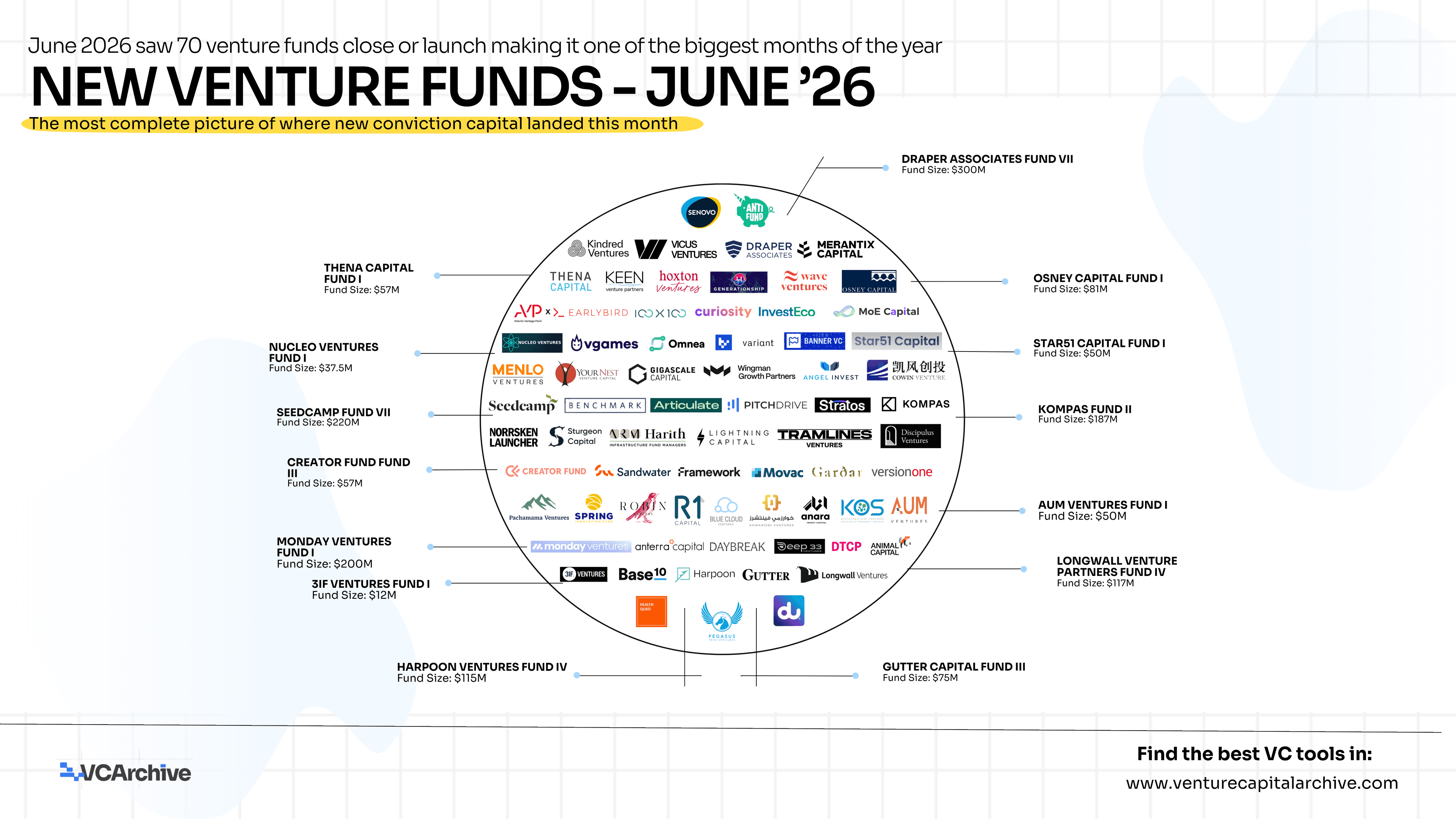
I track new fund launches every month. It is one of those habits you develop when you spend enough time trying to understand where capital is actually forming, not where people say it is forming.
June 2026 was different. Not because of the volume, though 70 funds in a single month is genuinely the busiest we have seen since February. Different because of what the composition tells you about where this industry is collectively placing its bets right now.
Let me walk through what I actually noticed.
Defence tech crossed a line this month
I have been watching defence tech creep into the venture conversation for three years.
In 2023 it was still edgy. In 2024 it was acceptable. In 2025 it became fundable. In June 2026 it became consensus.
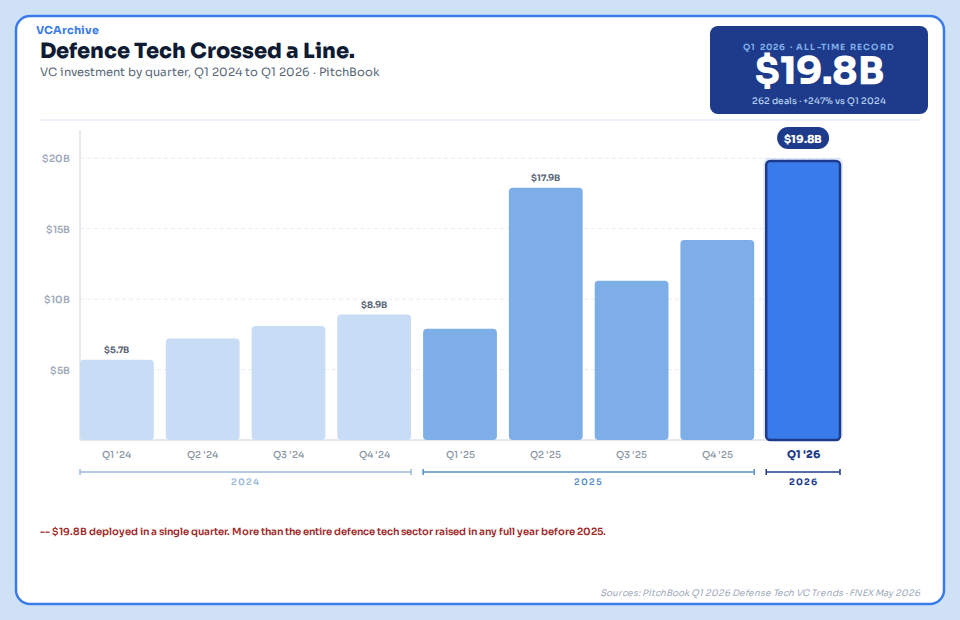
The numbers tell you why. Defence tech companies have already surpassed 2025's full-year funding record of $9.6 billion, with more than $14.6 billion invested in the sector in the first five months of 2026 alone. In Q1 2026, VCs deployed a record $19.8 billion into defence tech across 262 deals, compared to $5.7 billion in Q1 2024.
June's fund launches reflect that conviction at every stage:
- A $572 million growth platform in Munich for late-stage dual-use and autonomous systems
- A dedicated defence and security fund in London targeting NATO-aligned European markets
- A seed-stage dual-use specialist in Tel Aviv
- A national security focused vehicle in San Diego
- A drone and autonomous systems fund in Oslo
What is interesting is not that these funds exist. It is that they all launched in the same month. That kind of simultaneous movement does not happen randomly. It happens when LP appetite and GP conviction converge at exactly the same moment.
One note of caution worth holding:
At Fortune's Brainstorm Tech conference in June, Anduril's CEO Brian Schimpf answered the bubble question with a nuanced but decisive yes, noting that successful companies always attract capital chasing that success with increasingly risky behaviour. The category is real. The opportunity is real. Not every defence tech startup in June's cohort will be.
AI is no longer a thesis. It is the water.
Something quietly shifted this year in how funds talk about AI.
A year ago, having AI in your mandate was a positioning choice. Today it is table stakes. Nearly every fund that launched in June has AI somewhere in its focus areas, not as a headline bet but as the assumed operating environment.
This matters more than it sounds. When AI was a dedicated thesis, it concentrated capital into pure-play AI funds. When it becomes infrastructure, the baseline assumption of how every company in every sector gets built, it changes how all the other capital on this list behaves.
A few examples from June's cohort alone:
- The agrifood fund in Amsterdam backing food systems companies using machine learning for supply chain optimisation
- The health fund in London investing in digital health platforms built on AI diagnostics
- The enterprise software fund in Berlin focused on applied AI for industrial applications
None of these are AI funds. All of them are shaped by AI.
AI startups attracted 33% of global venture capital last year, with seed-stage AI startups receiving valuations about 42% higher than non-AI peers. If you are building something that is not at least adjacent to the category, you are competing for the remaining 67% with everyone else in the same position. The math makes the positioning choice fairly obvious.
The funds nobody is writing about
Here is what gets lost every time someone publishes a monthly fund roundup: the small, specific, deliberately contrarian vehicles that do not move the needle on total capital deployed but often matter most to early-stage founders.
June's cohort had several worth noting:
- The university spinout specialist: A London fund backing deep tech, biotech, quantum, and robotics companies emerging from academic research. The sourcing advantage here is real. Most institutional VCs cannot efficiently access spinout deal flow, and the ones that can often undervalue early technical risk.
- The solo GP: A San Francisco vehicle with $2.7 million and a very specific enterprise infrastructure thesis. Easy to dismiss. Often exactly the right first check for a founder who needs a partner, not just capital.
- The impact vehicle: A London fund deploying into financial inclusion, agritech, health, and education across underserved markets. Overlooked by most. Deeply relevant to a specific type of founder building in a specific set of geographies.
- The animal welfare fund: Genuinely contrarian. Genuinely interesting. The kind of thesis that in five years will either look prescient or quaint, and right now has almost no competition.
The best fundraisers I have watched do not go after the largest fund on the list. They go after the fund whose thesis most precisely matches what they are building. Sometimes that is a $500 million platform. Sometimes it is a $2.7 million solo GP who has spent three years thinking about exactly the problem you are solving.
The geography shift deserves more attention than it gets
Look at where June's funds are headquartered:
Oslo. Helsinki. Kuala Lumpur. Riyadh. Mexico City. Cluj-Napoca. Mumbai. Singapore. Wellington.
These are not satellite offices of San Francisco funds. They are locally rooted vehicles building genuine investment infrastructure in markets that have matured enough to support it. A few specifics:
- A Malaysian fund deploying across Southeast Asian fintech and healthcare
- A Saudi fund focused on regional enterprise software and e-commerce
- A Romanian fund backing health, manufacturing, energy, and defence across CEE
- A New Zealand fund investing in enterprise software, cybersecurity, and life sciences from Wellington
Each of these exists because the founder and LP ecosystems in their home markets have developed to a point where local capital infrastructure is not just possible but necessary. International funds cannot serve these markets well from a distance. They do not have the relationships, the pattern recognition, or the speed. Local funds do.
The hottest sectors in mid-2026 are fintech, space tech, AI-adjacent software, cyber, defence tech, and selected healthtech, along with startups in rising markets outside old VC hubs. The geographic diversification of June's launches is the supply-side response to exactly that demand signal.
What 70 funds in one month actually means
The temptation when you see a number like 70 is to read it as a signal about overall market health. More funds equals more optimism, right?
I am not sure it is that simple. What 70 funds in June tells me is that the market is specialising faster than it is either expanding or contracting.
The distribution is the real story:
- A $2 billion institutional platform and a $2.7 million solo GP both found enough LP conviction to close in the same month
- Growth-stage defence vehicles and pre-seed consumer funds launched simultaneously
- Oslo and Wellington and Riyadh all produced new fund managers in the same 30 days
That range reflects a venture ecosystem concentrating at the top into AI mega-rounds and large defence platforms, while simultaneously fragmenting at the edges into increasingly specific theses that the mega-funds cannot serve.
The market is open again, but not generous, broad, or forgiving. Founders who win right now show discipline: clean IP, a simple category story, careful burn, and a believable liquidity route matter more than big claims or vanity metrics.
That has been true in every market cycle. June 2026 is no different. What is different is the speed of the filter. With AI now embedded in most due diligence workflows, undifferentiated companies get screened out faster than ever. You need to know exactly what you are and exactly why the fund you are approaching is the right fit before you send the first message.
Before you open the list
The 70 funds below are 70 different articulations of conviction. Some of that conviction will be wrong. Some of it will generate the best returns of the decade. The work is figuring out which fund's thesis most closely matches what you are building, and then earning the right to be part of it.
New Venture Funds - June 2026












Rows per page
More from Dario Villena
View author profile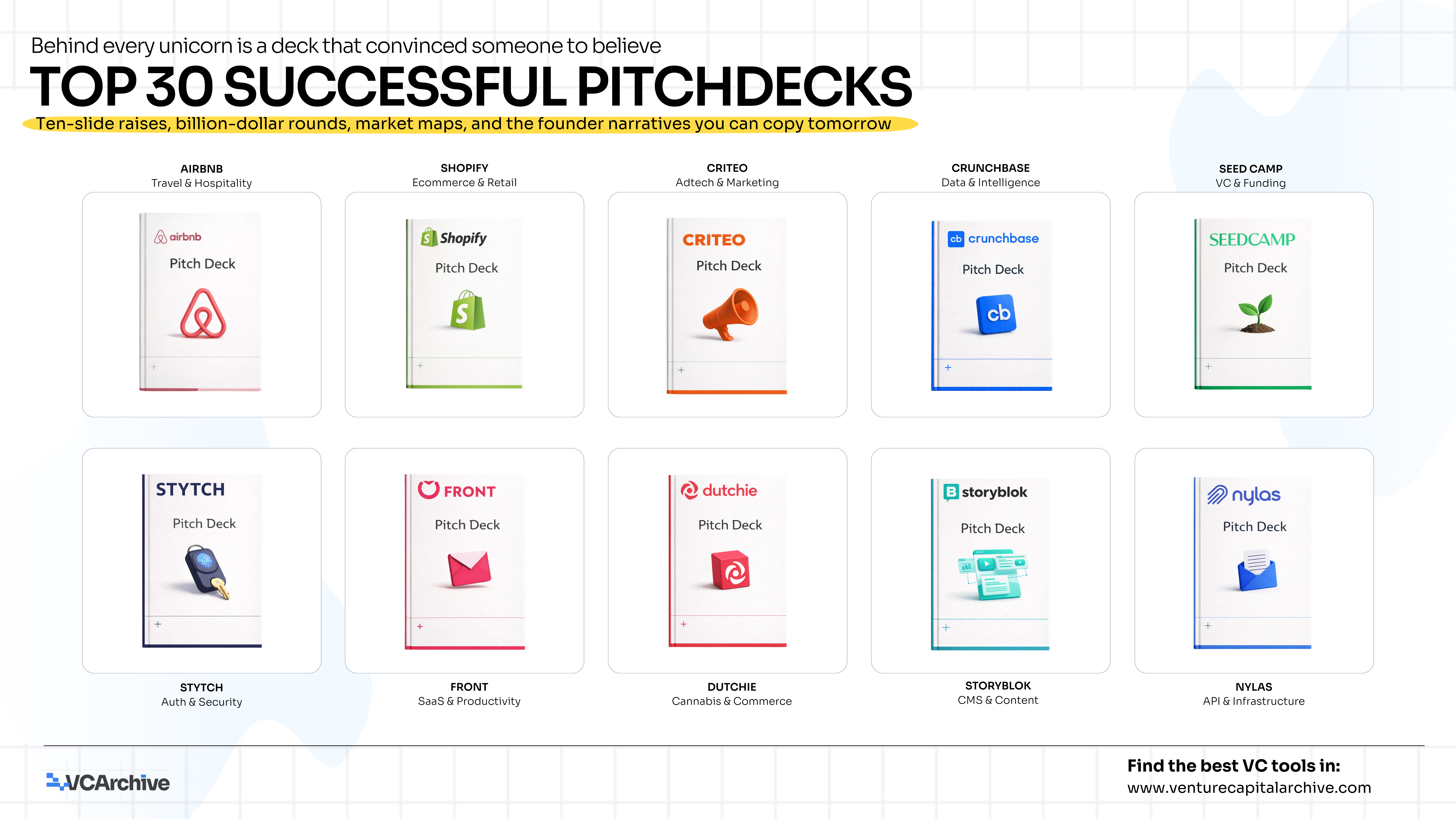
Top 30 Startup Pitch Decks to Model Yours On
The difference between a "no" and a $120M Series C often comes down to a few slides. Here are 30 that got the yes
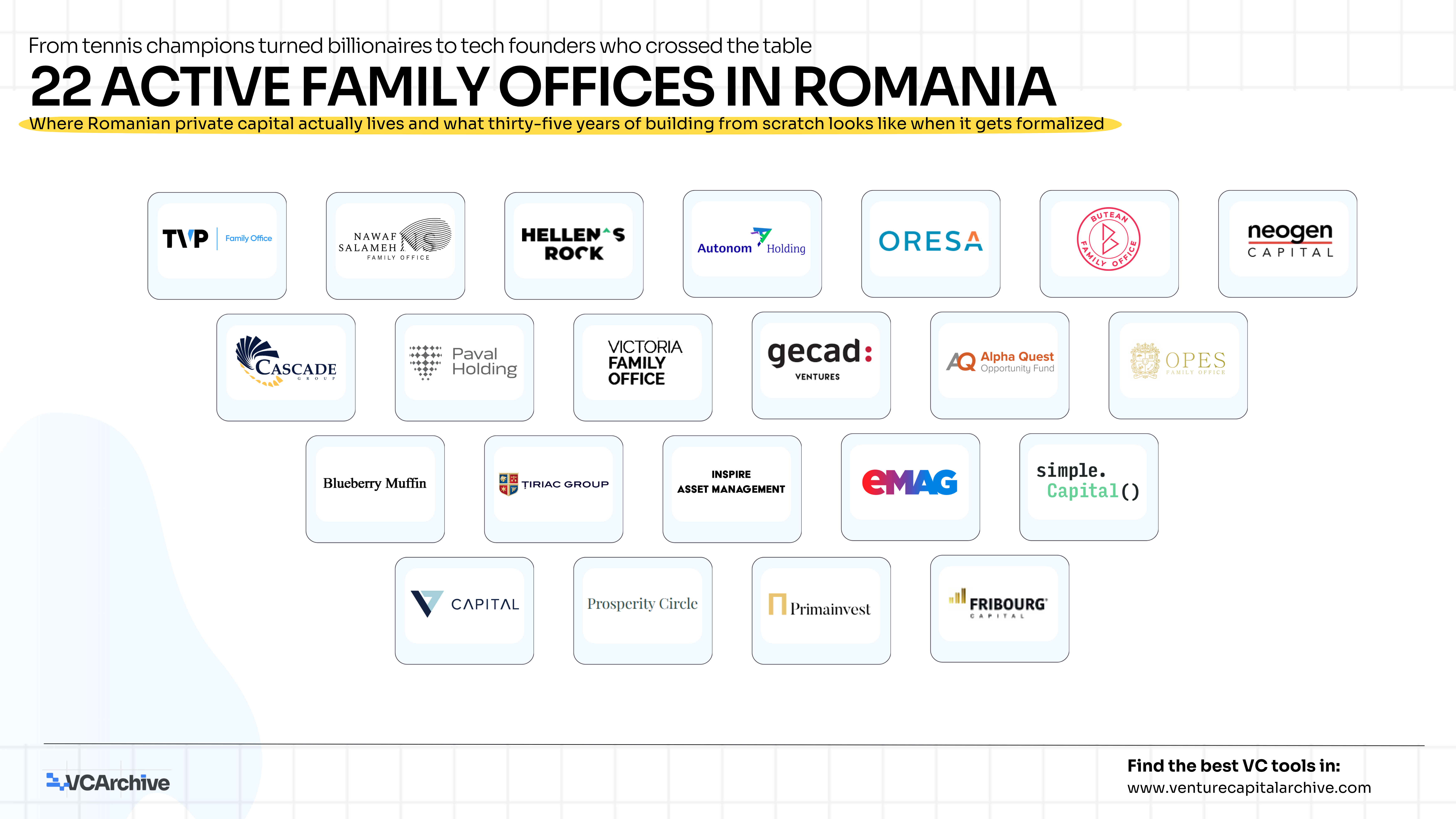
22 Active Family Offices in Romania
The country that gave the world Dracula and the first electric street lighting built its billionaires the same way. In the dark, faster than anyone expected.

New Venture Funds - July 2026
67 funds. One NBA player. One war zone. One $49 billion platform. And a market that has completely stopped having a single story.