Top 30 Startup Pitch Decks to Model Yours On
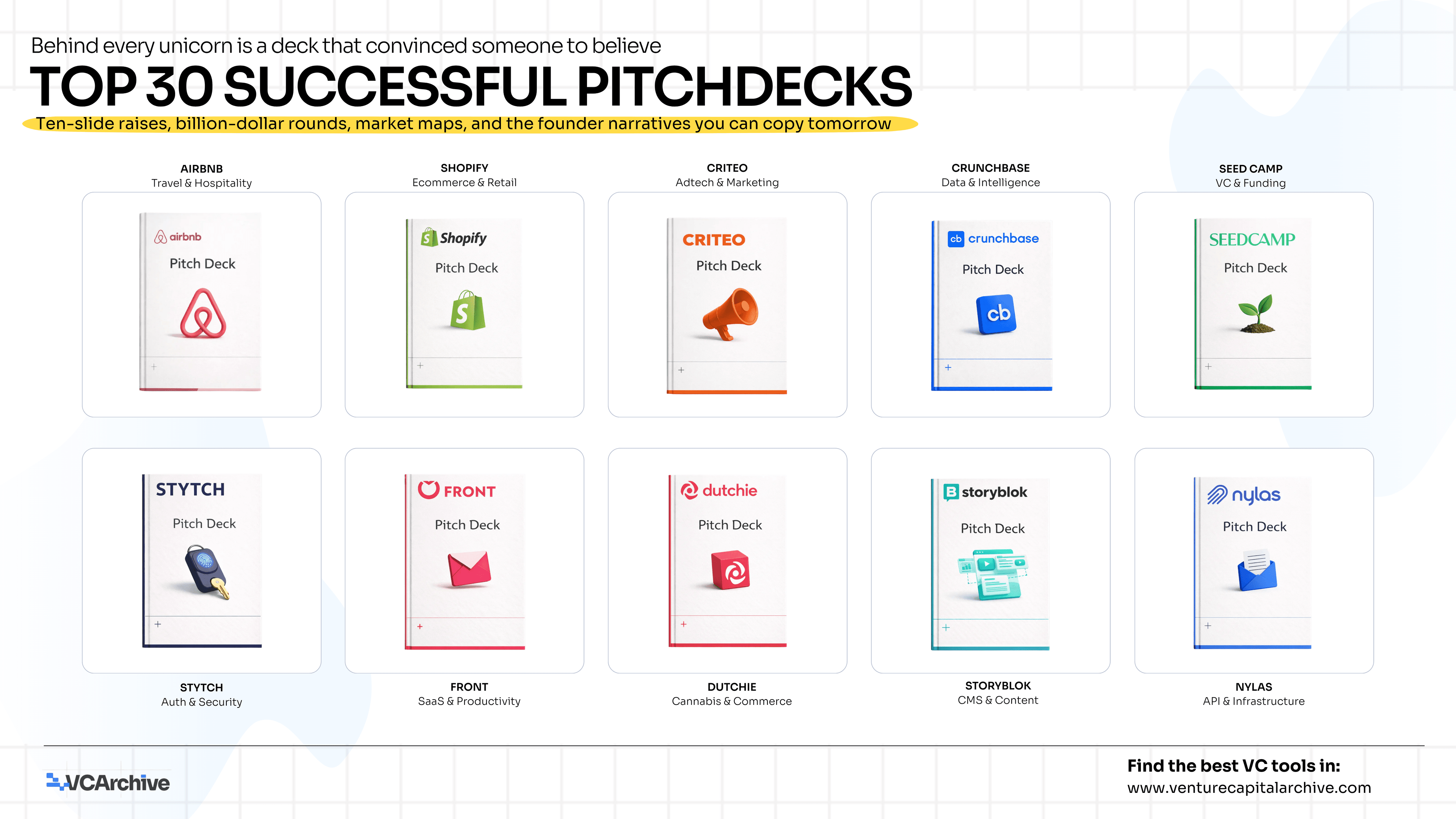
1. Airbnb
Industry: Marketplace / Travel & Hospitality
Round: Seed, $600K
Year: 2008
The deck that launched a thousand imitators. Airbnb raised $600K from Sequoia and Y Ventures with a presentation famous for its brutal simplicity, especially the business model slide that spelled out a 10% commission on every booking. It validated demand by pointing to existing behavior on Craigslist and Couchsurfing, proving people already wanted affordable, local stays. A masterclass in problem-first storytelling and showing rather than telling.
2. Finbourne
Industry: Fintech / Asset Management
Round: Series B, $74M
Year: 2024
Finbourne raised $74M from Highland Europe and ABN AMRO Ventures for its cloud-native financial data platform, LUSID. The deck pitches deeply technical infrastructure to conservative institutional investors by focusing on scalability, data integrity, and replacing legacy black-box systems with an open, API-first architecture. A strong reference for anyone selling platform-as-a-service into a regulated, complex market.
3. Morty
Industry: Proptech / Mortgage
Round: Series B, $25M
Year: 2021
Morty raised $25M at a $150M valuation to bring the offline mortgage process online. The deck leans on its lender-agnostic model, positioning Morty as the homebuyer's advocate, and strategically targets purchase loans over easier refinancing to capture long-term customer value. A clean example of pitching transparency and automation as a moat against legacy institutions.
4. Criteo
Industry: Adtech / Performance Marketing
Round: IPO, $250M+
Year: 2013
Used during Criteo's run-up to its NASDAQ IPO, this deck tells the story of a small French startup becoming a global performance-advertising leader. It sells a complex machine-learning engine by anchoring on the outcome investors care about: measurable sales, not impressions. A great template for explaining algorithmic products through market scale and pay-for-performance economics.
5. Passionfroot
Industry: Creator Economy / SaaS
Round: Pre-Seed, $3.3M
Year: 2021
Passionfroot raised $3.3M from Creandum, with Accel and top angels, to build a no-code storefront for creators. The deck nails category creation, framing the shift from the passion economy to the creator business, and bundles fragmented tools (CRM, invoicing, scheduling) into a single solo stack. Also a standout for its high-quality visual design.
6. Vybe
Industry: AI / Software Development
Round: Seed, $10M
Year: 2025
Vybe raised $10M from First Round Capital riding the vibe coding wave, where anyone can prompt AI to build internal tools. The deck tackles the friction points of early AI app development (auth, security, SSO) and reframes a developer tool as something for the whole company. A sharp modern example of a strong "Why Now" narrative.
7. Concept Ventures
Industry: Venture Capital (LP Deck)
Round: Pre-Seed Fund, $63M
Year: 2022
A rare look at how a VC fund pitches itself to LPs. Concept Ventures raised its $63M pre-seed fund, anchored by a $38M commitment from the British Business Bank. The deck quantifies value-add, leans on a 71% portfolio graduation rate, and shows how fund theses and track records are constructed. Essential reading for emerging fund managers.
8. Ledgy
Industry: Fintech / Equity Management
Round: Series B, $22M
Year: 2022
Ledgy raised $22M from NEA and Sequoia to solve equity management across fragmented European jurisdictions. The deck moves buyers away from error-prone spreadsheets toward a single source of truth, and showcases product-led growth across 2,500 companies in 45 countries. A masterclass in pitching a back-office tool as a cultural multiplier.
9. Seedcamp
Industry: Venture Capital (LP Deck)
Round: Fund V, $99M
Year: 2020
Seedcamp closed an oversubscribed $99M Fund V mid-pandemic. The deck moves beyond returns to sell an ecosystem: the Seedcamp Nation of 1,000+ founders and 100+ LPs, four unicorns at the time (Revolut, Wise, UiPath, Hopin), and heavy follow-on support. A template for institutional-grade fund reporting and network-driven storytelling.
10. Uncaged Innovations
Industry: Deeptech / Biomaterials
Round: Seed, $5.6M
Year: 2024
Uncaged raised $5.6M to build high-performance sustainable leather from grain proteins. The deck sells hard science by leading with commercial validation, most notably a partnership with Jaguar Land Rover, to prove product-market fit in a conservative industry. A strong blueprint for pitching deeptech and materials breakthroughs as scalable, cost-competitive alternatives.
11. Protecto
Industry: AI Security / Data Privacy
Round: Seed, $4M
Year: 2024
Protecto raised $4M for an enterprise privacy guardrail for LLMs and agentic AI. The deck competes against giants like AWS and Microsoft by owning niche performance metrics: 99.9% detection accuracy across 200+ data types and 50+ languages, without breaking AI context. A useful model for pitching a middleware security layer that unblocks AI adoption in regulated industries.
12. Shopify
Industry: Ecommerce / SaaS
Round: Post-IPO / Growth Strategy
Year: 2016
Released just after its 2015 IPO, this deck maps Shopify's shift from web-store builder to full commerce operating system. It sells a multi-sided ecosystem (social selling, POS, Shopify Plus) and a flywheel where merchant success drives Shopify's own revenue. The definitive lesson in scaling a single product into a platform of platforms with net-negative churn.
13. Nylas
Industry: API Infrastructure / Developer Tools
Round: Series C, $120M
Year: 2021
Nylas raised a $120M Series C from Tiger Global for the infrastructure that lets developers embed email, calendar, and contacts with a single integration. The deck sells a behind-the-scenes product by quantifying the operational savings and time-to-market it unlocks. A key reference for the build-vs-buy narrative and pitching API infrastructure.
14. NatCap
Industry: Nature-Tech / Climate-Tech
Round: Series A, $3M
Year: 2023
NatCap raised $13M, backed by André Hoffmann and Norrsken, for a platform that measures corporate impact on natural capital. The deck translates complex ecological data into a clear financial risk narrative that resonates with CFOs and institutional investors, riding mandatory disclosure regulation like TNFD. A template for leading a new ESG category on data accuracy.
15. Bind (now Surest)
Industry: Insurtech / Healthcare
Round: Series B, $105M
Year: 2020
Bind raised a $105M Series B for on-demand health insurance with no deductibles or coinsurance. The deck sells radical cost clarity and backs it with hard traction: an eight-fold enrollment jump and an 83% app engagement rate. A strong example of consumerizing a complex B2B service and proving a new category is real, not theoretical.
16. Front
Industry: SaaS / Productivity
Round: Series C, $59M
Year: 2020
Front raised $59M from a syndicate including Stewart Butterfield and Eric Yuan for its collaborative shared-inbox platform. The deck opens with a personal founder "Why" before diving into standout retention numbers (137% net dollar retention). A benchmark for balancing emotional storytelling with rigorous data and pitching a category-defining vision.
17. Crunchbase
Industry: Data Intelligence / SaaS
Round: Series C, $30M
Year: 2020
Crunchbase raised $30M from OMERS Ventures to pivot from passive directory to active prospecting platform. The deck uses an iceberg visual to dramatize the untapped private-company data market and analogous positioning to help investors grasp the concept fast. A great lesson in narrative-led pitching that moves past vanity metrics to a sharp "Why Now."
18. Softr
Industry: No-code / SaaS
Round: Series A, $13.5M
Year: 2022
Softr raised $13.5M from FirstMark to let non-technical users build apps and portals on top of Airtable. The deck pitches a horizontal tool through high-value vertical use cases and proves virality, reaching 35,000 teams in a year. A clean case study in product-led growth and turning a simple entry point into a full ecosystem.
19. Dutchie
Industry: Cannabis Tech / Ecommerce
Round: Series B, $35M
Year: 2020
Dutchie raised $35M from Thrive Capital for the e-commerce and POS backbone powering legal dispensaries. The deck flaunts a first-mover moat, powering 25% of North American dispensaries and $2.3B in annualized GMV. A premier example of vertical SaaS winning a regulated market by solving compliance hurdles horizontal players ignore.
20. Instamojo
Industry: Fintech / Payments
Round: Seed
Year: 2012
Instamojo raised its seed round from 500 Startups and Blume Ventures by making it as easy to sell online in India as sharing a link. The deck introduces the payment link concept as a simplification layer over complex gateways, aimed squarely at small sellers and freelancers. A textbook example of friction reduction and a user-first wedge into a high-trust industry.
21. Catch
Industry: Fintech / Healthtech
Round: Series A, $12M
Year: 2021
Catch raised $12M from Crosslink, Khosla, and Kindred to build portable benefits for 60M+ US freelancers. The deck defines the portable benefits category and pitches a B2C2B model where a direct creator relationship becomes a wedge into marketplaces. A masterclass in warm, human-centric brand storytelling against cold, bureaucratic incumbents.
22. Twine
Industry: Marketplace / Creative Economy
Round: Seed, $1.1M
Year: 2017
Twine raised $1.1M to connect companies with creative freelancers in design, music, and film. The deck shows a supply-first path to marketplace liquidity, growing to 175,000 creatives before chasing demand, plus an organic growth engine of 41,000 localized landing pages. A blueprint for staging a two-sided marketplace and data-driven go-to-market.
23. Stytch
Industry: Identity / Authentication
Round: Series B, $90M
Year: 2021
Stytch raised a $90M Series B at a $1B valuation from Coatue, Benchmark, and Thrive for its passwordless authentication platform. The deck sells a technical product through business outcomes (higher conversion, lower fraud) and leans on founder-market fit from the team's Plaid roots. A strong reference for a category-killing strategy against a legacy incumbent like Auth0.
24. clare&me
Industry: Healthtech / AI / Mental Health
Round: Series A, $4M
Year: 2024
clare&me raised $4M, led by YZR Capital, for an AI voice bot supporting anxiety and mild depression. The deck pitches a deeply sensitive product through scientific rigor: a clinical LLM trained by psychotherapists, a Charité Berlin partnership, and a 92% call completion rate. A benchmark for founders in the regulated medical-AI space balancing ambition with trust.
25. Exakt Health
Industry: Healthtech / Medtech
Round: Seed, $2.4M
Year: 2024
Exakt Health raised $2.4M for a certified medical-device app delivering personalized physiotherapy to runners. The deck grounds a consumer health app in clinical credibility (CE certification) and shows a B2B2C engine via an insurance partnership giving 300,000 policyholders free access. A tight example of de-risking growth through distribution partnerships.
26. Beelinguapp
Industry: EdTech / Language Learning
Round: Seed, $1.1M
Year: 2020
Beelinguapp raised $1.1M after reaching 3.5M downloads with zero marketing spend. The deck sells a differentiated parallel-text reading method and a highly efficient freemium model, targeting the intermediate plateau where apps like Duolingo lose users. A clean proof that organic virality and a unique pedagogy can carve a niche against billion-dollar incumbents.
27. Ooomf (later Crew)
Industry: Marketplace / Gig Economy
Round: Seed, $2.1M
Year: 2014
Ooomf raised $2.1M with backing from Naval Ravikant and Atlas Ventures, pivoting from app-discovery tool to a premium vetted developer network. The deck sells a quality-first moat: high-ticket projects averaging $8,000 and a strict 5% acceptance rate, against Upwork's race to the bottom. A great example of curation scaling as effectively as open-market competition.
28. ShopMy
Industry: Influencer Marketing / Social Commerce
Round: Series B, $18.5M
Year: 2024
ShopMy raised $18.5M from Inspired Capital for an all-in-one platform giving influencers digital storefronts and brand collaborations. The deck charts explosive growth (40,000+ creators, 800+ brands like Estée Lauder) and frames its moat as high-intent traffic that converts far better than social ads. A sharp look at professionalizing the creator economy through a double-sided OS.
29. Storyblok
Industry: CMS / Headless
Round: Series B, $47M
Year: 2022
Storyblok raised $47M from Mubadala Capital and HV Capital as the first headless CMS built for both developers and content creators. The deck defines a category by making a technical architecture shift accessible through a visual editor, the exact pain point rivals ignored. Backed by 74,000 projects and customers like Adidas, it's a strong lesson in editor-first competitive strategy.
30. Tracebit
Industry: Cybersecurity / Threat Detection
Round: Seed, $5M
Year: 2024
Tracebit raised $5M from Accel for deception-as-code, letting teams deploy honeypots across cloud infrastructure in minutes. The deck attacks a real problem (alert fatigue and noisy tools) and sells a high-fidelity signal with a developer-first go-to-market via Terraform and Slack. A clear blueprint for finding product-market fit in a crowded security landscape by reducing complexity.
Now go see them for yourself. Click any deck below to open the full slide-by-slide breakdown and start building yours.
Top 30 Successful Pitchdeck Examples
Great pitch decks aren't just pretty slides. They're arguments that convinced investors to write real checks. This list brings together 30 of the best, from category-defining classics like Airbnb, Shopify, and Criteo to fresh 2024–2025 raises like Vybe, Tracebit, and clare&me, spanning every stage from pre-seed to IPO and sectors from fintech to AI to healthtech. And because every one is the real deck founders used to raise, paired with the round, amount, and lead investor behind it, you're not guessing what worked. Use them to model your own deck, borrow proven slide flows, and understand what actually resonates with investors.
Airbnb's deck was used to raise $600k in Seed funding from Sequoia Capital and Y Ventures. At the time, the company operated in the Travel and Hospitality industry with a focus on "booking rooms with locals rather than hotels." The deck is famous for its simplicity, particularly its "Business Model" slide which clearly stated they would take a 10% commission on every transaction—a straightforward path to a projected $200M in revenue. It effectively validated the market by highlighting existing behaviors on platforms like Craigslist and Couchsurfing, proving that the desire for affordable, local experiences was already established.
Beelinguapp's deck was used to secure a $1.1M Seed round in December 2020, led by Joyance Partners and EquityPitcher Ventures. Operating in the Language Learning and EdTech industry, Beelinguapp differentiates itself through "parallel-text" reading. The deck highlights a massive organic growth story, reaching 3.5 million downloads with zero marketing spend prior to the round. The core product insight is based on the "Natural Method"—allowing users to read and listen to stories in two languages side-by-side. The deck showcases a highly efficient freemium subscription model and details their expansion into 14 languages, targeting the "intermediate plateau" where traditional gamified apps (like Duolingo) often lose user engagement.
Bind's deck was the driving force behind their $105M Series B funding round in 2020, which was fully subscribed by existing investors including Ascension Ventures and UnitedHealthcare. Operating in the Health Insurance and Insurtech industry, Bind introduced an "on-demand" model that radically simplified health benefits by completely eliminating deductibles and coinsurance. The deck reveals a core strategy focused on "cost clarity," allowing members to see certain, upfront prices for treatments and providers through a user-friendly app before they seek care. By using data to steer members toward higher-value providers, the platform demonstrated a 10-15% cost savings for employers and an eight-fold increase in enrollment between 2019 and 2020, proving that transparency in healthcare leads to more efficient consumer behavior.
Catch's deck was the foundation for their $12M Series A funding round in 2021, led by Crosslink Capital with participation from Khosla Ventures and Kindred Ventures. Operating in the Fintech and Benefits industry, Catch addresses the massive gap in the "social safety net" for the 60+ million freelancers and contractors in the US. The insights highlight a shift from employer-tied benefits to a personal, portable benefits platform where users can manage health insurance, retirement (401k), and tax withholding in one place. The deck emphasizes their "Auto-Withholding" engine, which automatically sets aside a percentage of every paycheck for taxes and savings, effectively acting as a digital HR department for the modern, independent worker.
clare&me's deck was the centerpiece of their €3.7M funding round in August 2024, led by YZR Capital with participation from Kodori Ventures, Material Ventures, and Antler. Operating in the Healthtech and Generative AI industry, the Berlin-based startup has developed an automated AI-driven audio bot designed to support individuals dealing with anxiety and mild depression. The insights highlight their development of the world's first Clinical Large Language Model (CLLM), which is specifically trained by psychotherapists to provide evidence-based Cognitive Behavioral Therapy (CBT) through voice-only and multimodal interactions. The deck emphasizes their clinical validation through partnerships with Charité Berlin, showing significant improvements in patient symptoms and a 92% call completion rate.
Concept Ventures' deck was used to raise their £50M institutional pre-seed fund, which included a significant £30M cornerstone commitment from the British Business Bank. Operating as the UK’s largest dedicated pre-seed fund, the firm targets startups in the Work, Play, and Learning sectors. The deck emphasizes their "Outsider" mentality and a data-led approach to evaluating founder personality rather than just CVs, leading to a 71% graduation rate for their portfolio companies. The fund targets 60+ startups over four years with check sizes ranging from £100k to £600k.
Criteo’s deck was utilized during the company's transition toward its $250M+ IPO on NASDAQ in late 2013. Operating in the Advertising Technology sector, the deck illustrates Criteo's evolution from a small French startup to a global leader in personalized performance display ads. The "Key Insights" center on their proprietary machine learning engine, which analyzed real-time shopping data to predict consumer intent. By focusing on "Post-Click" sales rather than just impressions, Criteo demonstrated a measurable ROI for e-commerce clients. The deck highlights their massive scale—observing over $200 billion in sales transactions annually at the time—and their "pay-for-performance" business model.
Crunchbase's deck served as the foundation for their $30M Series C funding round, led by OMERS Ventures with participation from existing backers like Emergence and Mayfield. Operating in the B2B Information Services industry, the company used this deck to signal its pivot from a passive directory to an active "prospecting platform." The insights highlight a massive "unseen" market opportunity in private company data, symbolized in the deck by an iceberg visual. It details their transition into a personalized discovery engine (Crunchbase Pro) that uses machine learning to alert sales and investment teams about high-growth signals, such as new funding rounds or leadership changes, effectively moving the product from a research utility to a core sales-enablement tool.
Dutchie's deck was the catalyst for their $35M Series B funding round in 2020, led by Thrive Capital with participation from Howard Schultz and Casa Verde Capital. Operating in the Cannabis Technology industry, Dutchie provides an all-in-one e-commerce and point-of-sale (POS) backbone for dispensaries. The deck reveals a massive "first-mover" advantage, highlighting that they powered online ordering for over 25% of all dispensaries in North America at the time. A core insight is their control of the "transactional layer"—processing over $2.3B in annualized GMV—while facilitating a safe, stigma-free shopping experience that mirrors traditional e-commerce giants like Shopify, but specifically tailored to the complex regulatory and compliance needs of the legal cannabis market.
Exakt Health's deck was the primary tool for securing a €2.2M Seed funding round in September 2024, led by Barmenia Next Strategies (BNS) with participation from ESB Invest, Backbone Ventures, and Auxxo. Operating in the Digital Health and Sports Medicine industry, the Berlin-based startup offers a certified medical device app that provides personalized physiotherapy and injury prevention plans specifically for runners. The insights highlight their transition from a purely reactive rehabilitation tool to a proactive, AI-based running training platform that dynamically adjusts to a user's injury risk and fitness level. The deck emphasizes their massive distribution advantage through a partnership with Barmenia insurance, giving 300,000 policyholders free access, and their goal to scale from 200,000 to over one million users within 18 months.
Finbourne’s deck supported a £55M Series B funding round, led by Highland Europe and ABN AMRO Ventures. The company operates in the Investment Management Operations industry, providing a cloud-native data management platform (LUSID) designed to simplify complex financial data. The insights highlight a shift from legacy "black box" systems to an open, API-first architecture that provides a "Golden Source" of data for asset managers and hedge funds. It details how their platform handles multi-asset portfolios, real-time valuation, and accounting, addressing the critical industry need for operational efficiency and reduced systemic risk in global capital markets.
Front's deck was used to raise a $59M Series C funding round in early 2020, led by high-profile investors including a syndicate of tech executives like Stewart Butterfield (Slack) and Zoom's Eric Yuan. Operating in the SaaS and Productivity industry, Front reimagines email as a collaborative, shared-inbox platform for teams. The deck highlights an incredible 137% net dollar retention and a user base of over 5,500 customers at the time. A core insight of the presentation is its unconventional opening—a personal "Why" from the founder—before diving into the data. It centers on the "connectivity gap" where individual email silos hinder team efficiency, positioning Front as the "multiplayer" version of communication that integrates directly with 50+ business apps to turn the inbox into a central hub for operations and customer success.
Instamojo's deck ka istemal unke Seed funding round ke liye kiya gaya tha, jise 500 Startups aur Blume Ventures ne support kiya tha. Fintech aur E-commerce industry mein kaam karte huye, Instamojo ne ek bahut badi samasya ko hal kiya: India mein digital products aur services bechna utna hi aasan banana jitna ek link share karna. Deck ke insights dikhate hain ki unhone complex payment gateways ke muqable ek "simplification layer" taiyar ki, jahan merchant ko bina kisi technical knowledge ke sirf ek URL share karke payment receive karne ki suvidha mili. Unka focus chote sellers aur freelancers par tha, jiske liye unhone "Payment Links" ka naya concept pesh kiya, jo social media aur WhatsApp par asani se share kiya ja sake.
Ledgy’s deck was the centerpiece of their $22M Series B funding round, led by New Enterprise Associates (NEA) with participation from Sequoia Capital. Operating in the Fintech and HR Tech industry, the deck addresses the extreme complexity of managing equity across multiple European jurisdictions. The insights highlight a move away from "error-prone spreadsheets" toward a centralized "source of truth" that aligns founders, investors, and employees. The deck emphasizes their double-digit monthly growth and their expansion to over 2,500 companies across 45 countries, showcasing a product that automates the labor-intensive tasks of granting, signing, and storing equity contracts while integrating seamlessly with major HRIS platforms like Workday and Personio.
Morty’s deck was instrumental in securing a $25M Series B funding round, bringing their total valuation to $150M at the time. Operating in the Real Estate and Mortgage industry, Morty positions itself as a digital-first mortgage marketplace that automates the traditionally manual, offline home-buying process. The deck focuses on their unique "lender-agnostic" model, which allows homebuyers to compare and close loans entirely online while acting as the consumer's advocate. Key insights from the presentation highlight their focus on "Purchase Loans"—a more complex market segment than refinancing—as a strategic entry point to capture long-term customer lifetime value and expand into a full-stack home financing solution.
NatCap's deck was central to their £10M Series A funding round, which included backing from investors such as André Hoffmann and Norrsken VC. Operating in the Nature-Tech and Sustainability industry, the company provides a data-driven platform that helps organizations measure and manage their impact on "natural capital" (biodiversity, soil health, and ecosystem services). The insights reveal a shift toward rigorous, science-based reporting as global regulations—such as the TNFD (Taskforce on Nature-related Financial Disclosures)—become mandatory. The deck highlights their unique integration of satellite data, ground-level monitoring, and proprietary ecological models to provide a holistic "nature risk" score, allowing corporations to de-risk their supply chains and meet net-zero and nature-positive commitments.
Nylas’s deck was used to raise a massive $120M Series C funding round led by Tiger Global Management, bringing their total valuation closer to unicorn status at the time. Operating in the Developer API and Enterprise Software industry, Nylas provides the critical infrastructure that allows developers to integrate email, calendar, and contacts into their applications with a single integration. The deck highlights the "connectivity gap" in modern software, where developers waste thousands of hours building and maintaining custom integrations for legacy providers like Outlook and Gmail. By offering a universal API, Nylas enables companies to unlock rich communications data and build work automation features in a fraction of the time, serving a global market of over 80,000 developers and enterprises like Upwork and Ceridian.
Ooomf's deck was the foundation for their $2.1M Seed round in 2014, led by Atlas Ventures (Fred Destin) with participation from high-profile angels like Naval Ravikant and firms including BOLDstart and iNovia. Operating in the Freelance Marketplace industry, Ooomf effectively pivoted from an app-discovery tool to a premium, vetted network connecting high-end mobile and web developers with quality projects. The insights reveal a "Quality-First" moat; while platforms like Upwork were mired in price wars and "race-to-the-bottom" bidding, Ooomf focused on high-ticket projects (averaging $8,000) and a rigorous 5% acceptance rate for talent. The deck highlights a powerful 30% month-over-month growth and a transaction-based revenue model taking a 15% fee, proving that curation could scale just as effectively as open-market competition.
Passionfroot’s deck was used to raise €3M in Pre-Seed funding, led by Creandum with participation from Accel and several high-profile angels. Passionfroot operates in the Creator Economy and SaaS industry, specifically building a "no-code storefront" for creators. The deck identifies a critical shift in the market: creators are becoming independent media companies but are overwhelmed by the "back-office" administrative burden—handling sponsorships, tracking payments, and managing multiple communication channels. The core insight is the creation of a "solo stack"—a centralized platform that combines CRM, project management, and automated invoicing.
Protecto's deck was used to secure a $4M Seed funding round led by Together, with participation from Better Capital and FortyTwo.VC. Operating in the AI Security and Data Privacy industry, Protecto provides an enterprise-grade "privacy guardrail" solution for LLMs and agentic AI workflows. The insights center on their proprietary masking and tokenization engine, which boasts a 99.9% detection accuracy for over 200 sensitive data types (PII, PHI) in 50+ languages. Unlike generic redaction tools that "break" AI context, Protecto preserves semantic integrity, allowing models to process protected data without losing performance. The deck highlights their unique Context-Based Access Control (CBAC), which makes real-time unmasking decisions based on user identity and specific AI intent.
Seedcamp's deck was used to close their heavily oversubscribed £78M Fund V, which was raised in the midst of the COVID-19 pandemic. As Europe’s leading seed fund, Seedcamp focuses on backing world-class founders at the pre-seed and seed stages across sectors like Fintech, AI, and Healthtech. The deck highlights the firm's transition from a "micro-fund" to an institutional powerhouse with an unmatched track record, including four unicorns at the time (Revolut, Wise, UiPath, and Hopin). A core insight of the presentation is the power of the "Seedcamp Nation"—a network of over 1,000 founders and 100+ institutional LPs (including British Patient Capital and Legal & General) that provides immediate follow-on capital and operational support. The fund's strategy involves leading or co-leading rounds with checks ranging from £100k to £500k, while reserving significant capital for follow-on investments up to Series B.
Shopify's deck was released in January 2016, shortly after their 2015 IPO, to outline their strategy for dominating the Omni-channel Commerce industry. At this stage, the company was shifting from being a "web-store builder" to a comprehensive commerce operating system. The insights highlight their focus on a multi-sided ecosystem: providing high-growth merchants with tools for social selling (Facebook, Pinterest), physical retail (Shopify POS), and advanced enterprise needs (Shopify Plus). The deck emphasizes their massive scale—powering over 200,000 merchants and processing billions in Gross Merchandise Volume (GMV)—while showcasing a "flywheel" effect where merchant success directly drives Shopify's subscription and merchant services revenue.
ShopMy's deck supported their $18.5M Series B funding round in early 2024, led by Inspired Capital with participation from Mighty Capital and Swat Equity Partners. Operating in the Creator Economy and E-commerce industry, ShopMy provides an all-in-one platform that allows influencers to create digital storefronts and directly collaborate with brands. The insights reveal a shift from simple "affiliate links" to a comprehensive CRM for creators, enabling them to track performance, manage brand partnerships, and build deep catalogs of recommended products. The deck highlights an explosive growth trajectory—reaching over 40,000 creators and 800+ brand partners like Estée Lauder and Tatcha—while processing hundreds of millions in GMV. Its core moat is the "high-intent" nature of its traffic, which converts at significantly higher rates than traditional social media ads.
Softr's deck was the catalyst for their $13.5M Series A funding round in early 2022, led by FirstMark Capital with participation from Atlantic Labs. Operating in the No-code and Low-code Development industry, Softr positions itself as the easiest platform for non-technical users to build custom business apps, internal tools, and client portals. The deck highlights their "Lego-like" modular building experience that requires zero learning curve, primarily by turning Airtable data into functional web applications. Key insights from the presentation showcase their rapid organic growth—reaching over 35,000 teams and 5,000 paying customers within a year—and their vision to become "data source agnostic," expanding beyond Airtable to integrate with Google Sheets, SQL databases, and APIs to empower the world's 1 billion knowledge workers.
Storyblok’s deck was instrumental in raising their $47M Series B funding round in 2022, led by Mubadala Capital and HV Capital. Operating in the Content Management System (CMS) industry, Storyblok differentiates itself as the first "Headless CMS" built specifically for both developers and content creators. The insights highlight a massive market shift from traditional, rigid monolithic systems (like legacy WordPress) to decoupled architectures that allow content to be delivered anywhere—from websites and mobile apps to VR and IoT devices. The deck showcases their unique "Visual Editor," which solves the biggest pain point in headless systems: the lack of a real-time preview for non-technical editors. With over 74,000 projects created and customers like Adidas and T-Mobile, the deck proves that they have solved the "collaboration gap" in modern web development.
Stytch’s deck was the primary vehicle for their $90M Series B funding round, led by Coatue with participation from Benchmark, Thrive, and Index, valuing the company at $1B. Operating in the Developer Tools and Cybersecurity industry, Stytch provides an API-first platform designed to eliminate the need for passwords. The insights center on the massive friction caused by traditional login methods—where 75% of users drop off during a password reset. By offering a modular "toolkit" of magic links, biometrics, and SMS passcodes, Stytch enables developers to embed secure, frictionless authentication in minutes rather than months. The deck also highlights their acquisition of Cotter to bolster their no-code capabilities, aiming to modernize the "1990s-era" authentication landscape for 3,500+ developers.
Tracebit’s deck was the centerpiece for their $5M Seed funding round in early 2024, led by Accel with participation from Tapistry (formerly Angelic Ventures) and prominent cybersecurity angels. Operating in the Cybersecurity and Threat Detection industry, Tracebit focuses on "deception-as-code." The insights highlight a massive problem: traditional cloud security tools create too much "noise," making it impossible to spot real intruders. Tracebit allows DevOps and security teams to automatically deploy "honeypots"—fake assets like databases or credentials—across their cloud infrastructure in minutes. If an attacker touches these, it triggers a 100% accurate alert. The deck showcases how their API-first approach integrates with tools like Terraform and Slack, moving deception from a "niche luxury" to a core part of the modern security stack.
Twine’s deck was used to raise a $1.1M (£900k) Seed round, which included investments from Chris Mairs, Jeremy Silver, Stephen Pankhurst, and the Greater Manchester Combined Authority. Operating in the Creative Freelance Marketplace industry, Twine connects companies with creative professionals in design, music, and film. The deck highlights a massive market gap where SMEs spend 32% of their marketing budgets on content but struggle to find reliable audio-visual talent. Key insights from the presentation showcase their "Phase 1" success of growing the supply side to 175,000 registered creatives across 169 countries. Their business model relies on a 20% commission from completed projects, emphasizing trust-building through user ratings and project milestones to prevent platform circumvention.
Uncaged Innovations' deck supported a successful $5.6M Seed funding round in July 2024, co-led by Green Circle Foodtech Ventures and Fall Line Capital. Operating in the Plant Textiles and Biomaterials industry, the company has developed the world's first platform for making high-performance sustainable leather from grain proteins at scale. The deck details how their technology replaces animal-based collagen with structural plant proteins to create a material that mimics the physical properties of traditional leather without the environmental cost. Key insights highlight their strategic partnership with Jaguar Land Rover and their transition to full-scale production, targeting the disruption of the luxury automotive and fashion supply chains.
Vybe’s deck was instrumental in securing $10M in Seed funding in late 2025, led by First Round Capital. Operating in the AI-Assisted Software Development industry, Vybe addresses the rise of "vibe coding"—a workflow where developers and non-technical operators use natural language to prompt AI to build functional internal tools. The deck focuses on solving the friction points of early AI app development, such as data connectivity (API auth), security risks, and SSO integration. By positioning itself as a collaborative platform for "personal software," Vybe allows teams to generate custom, secure applications for internal use cases that integrate directly with existing stacks.
More from Dario Villena
View author profile
30 Best Active PropTech VCs in 2026
Every building you have ever been in was designed, built, managed, and financed using technology that has barely changed since the fax machine was invented. That is finally, genuinely changing.
22 Active Family Offices in Romania
The country that gave the world Dracula and the first electric street lighting built its billionaires the same way. In the dark, faster than anyone expected.

New Venture Funds - July 2026
67 funds. One NBA player. One war zone. One $49 billion platform. And a market that has completely stopped having a single story.