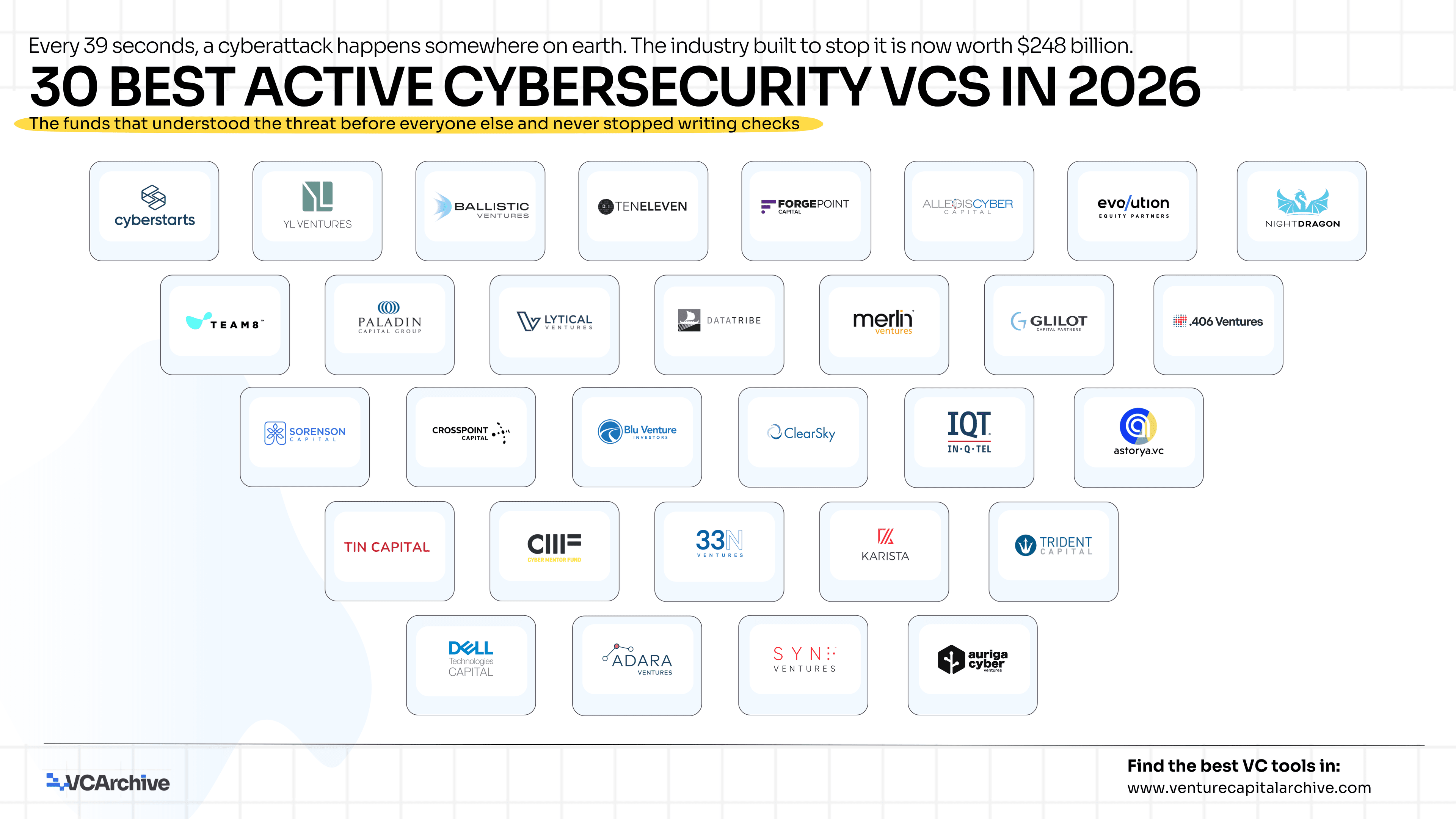
30 Best Active Cybersecurity VCs in 2026
The market nobody can afford to ignore
Global cybercrime is projected to cost the world $10.8 trillion by 2026. If it were an economy, it would rank behind only the US and China.
That number is not a vendor's marketing slide. It is the operating backdrop against which every company, hospital, power grid, and government institution makes security decisions every single day. And it is why cybersecurity has become the most reliably funded category in enterprise technology.
The global cybersecurity market is projected to reach $248 billion in 2026, growing at 14.2% annually through 2028. VC investment in cybersecurity reached $18.7 billion in 2025 and is projected to hit $22.3 billion in 2026 - a 19% year-over-year increase.
78% of business and technology executives plan to increase cyber spending in 2026. Not maintain. Increase. In a macro environment where every other budget line is being scrutinized, security is getting more money. That dynamic makes cybersecurity one of the most durable investment categories available.
Three things reshaping how capital flows in this market
AI broke both sides of the equation simultaneously
AI has made defenders faster autonomous SOC operations compressing mean-time-to-respond from hours to seconds, AI-native threat detection catching what signature-based tools miss. But AI has also made attackers dramatically more capable. Deepfakes have created an identity authenticity crisis. Adversarial AI probes for vulnerabilities at a pace no human red team can match.
AI-native security is the fastest-growing cybersecurity subsector at 47% year-over-year growth, with $4.1 billion in total funding. The funds that built AI-native security theses two years ago now have the most relevant portfolios in the category.
The perimeter dissolved. Platform consolidation followed
Zero trust architecture is no longer theoretical. It is the operating model every serious enterprise is building toward, and it requires rebuilding security infrastructure almost from scratch. Identity and access management plus security operations drew the most capital in 2025. Endpoint and network security saw weaker standalone VC interest as companies shifted toward broader platforms, reducing venture backing in single-solution tools.
The implication: point solutions are getting squeezed. Platform bets are getting rewarded.
Regulation became a tailwind, not a headwind
GDPR enforcement actions rose 34% in 2025. NIS2 came into force across EU member states. SEC disclosure rules require material breach reporting within four business days. When a breach creates regulatory liability and mandatory public disclosure, security stops being something you buy when budget permits and becomes something you invest in before the regulator asks why you did not.
What the funding data actually says about where we are
Cybersecurity VC activity in Q1 2026 saw deal value hold near $5 billion despite deal count falling to its lowest quarterly level since 2018. Deal value rose 23% year-over-year while transaction count declined by a similar margin.
More money. Fewer deals. That is the most important sentence in this market right now.
Investors are prioritizing companies with strong revenue traction, clear paths to exit, and defensible differentiation, particularly those leveraging AI. Pre-money step-ups averaged 1.99x, rewarding companies that clear the bar for follow-on funding.
The exit market is validating the thesis from above. Alphabet's $32 billion acquisition of Wiz pushed cybersecurity exit value to a record $32.9 billion in Q1 2026 alone. ServiceNow bought Armis for $7.8 billion. Thoma Bravo bought Darktrace for $5.5 billion. The strategic buyers are willing to pay extraordinary premiums for companies that own a critical security category and the funds that backed those companies at seed and Series A are generating the returns that define the next generation of cybersecurity investment platforms.
Why domain expertise is not optional in this category
Most VC categories reward generalist pattern recognition. Cybersecurity is genuinely different.
The threat landscape changes faster than any analyst can track from a distance. Evaluating whether a new approach to threat detection is novel or just repackaged endpoint security requires technical depth that reading pitch decks does not build. The customer relationships that matter - CISOs, security operations teams, government procurement offices, are earned through years of domain-specific credibility, not through a general enterprise software network.
Israel-linked cybersecurity companies are unusually visible in the global funding dataset, with Cyera, Wiz, Cato Networks, Armis, Fireblocks, Island, Orca Security, and Axonius forming a major funding cluster.
That Israeli concentration reflects something specific: mandatory military service in elite intelligence units produces technologists with offensive security expertise and adversarial thinking that is almost impossible to develop outside that context. The funds with deep roots in that ecosystem evaluate Israeli security companies from the inside - a structural advantage that no amount of capital substitutes for.
The same logic applies to the funds built by former intelligence community professionals in Washington DC, former CISOs in Silicon Valley, and national security veterans across the list. These are not investors who decided cybersecurity was a good market. They are security professionals who became investors.
What founders building in this space need to know
The market is not closed to new companies. It is increasingly closed to undifferentiated ones. A few things that separate the founders who close rounds from those who do not:
Domain credibility is the first filter, not the deck
The investors at the top firms on this list have evaluated hundreds of security companies. They will know within five minutes whether you understand adversarial thinking or whether you have read two reports and built a slide. What moves them is not the market size slide, it is your ability to explain exactly how an attacker would try to defeat your product.
Enterprise budget alignment matters more than category novelty
Startup activity in 2025 concentrated heavily on red teaming, penetration testing, and AI-enabled SOC automation. This distribution leaves room for additional innovation targeting cloud configuration challenges and network vulnerability management categories with high enterprise budget priority and limited dedicated startup formation.
Know whether you need a specialist or a generalist
The dedicated cyber funds on this list have networks, portfolio synergies, and CISO relationships that a generalist VC simply cannot replicate. If your company is building core security infrastructure, a specialist fund's warm introduction to the right enterprise buyer is often worth more than the check itself.
Stage matching saves months
Seed-stage deals average $4 to 6 million. Series A rounds average $20 to 40 million. Growth rounds consistently exceed $100 million. Approaching a growth-stage fund with a pre-revenue company, or a seed specialist with a $50 million ask, signals immediately that you have not done the work.
Stop guessing which funds are actually active in cybersecurity. The 30 that are, and what they back are right below.
30 Best Active Cybersecurity VCs in 2026











Rows per page
More from Dario Villena
View author profile
Top 30 Startup Pitch Decks to Model Yours On
The difference between a "no" and a $120M Series C often comes down to a few slides. Here are 30 that got the yes
22 Active Family Offices in Romania
The country that gave the world Dracula and the first electric street lighting built its billionaires the same way. In the dark, faster than anyone expected.

New Venture Funds - July 2026
67 funds. One NBA player. One war zone. One $49 billion platform. And a market that has completely stopped having a single story.