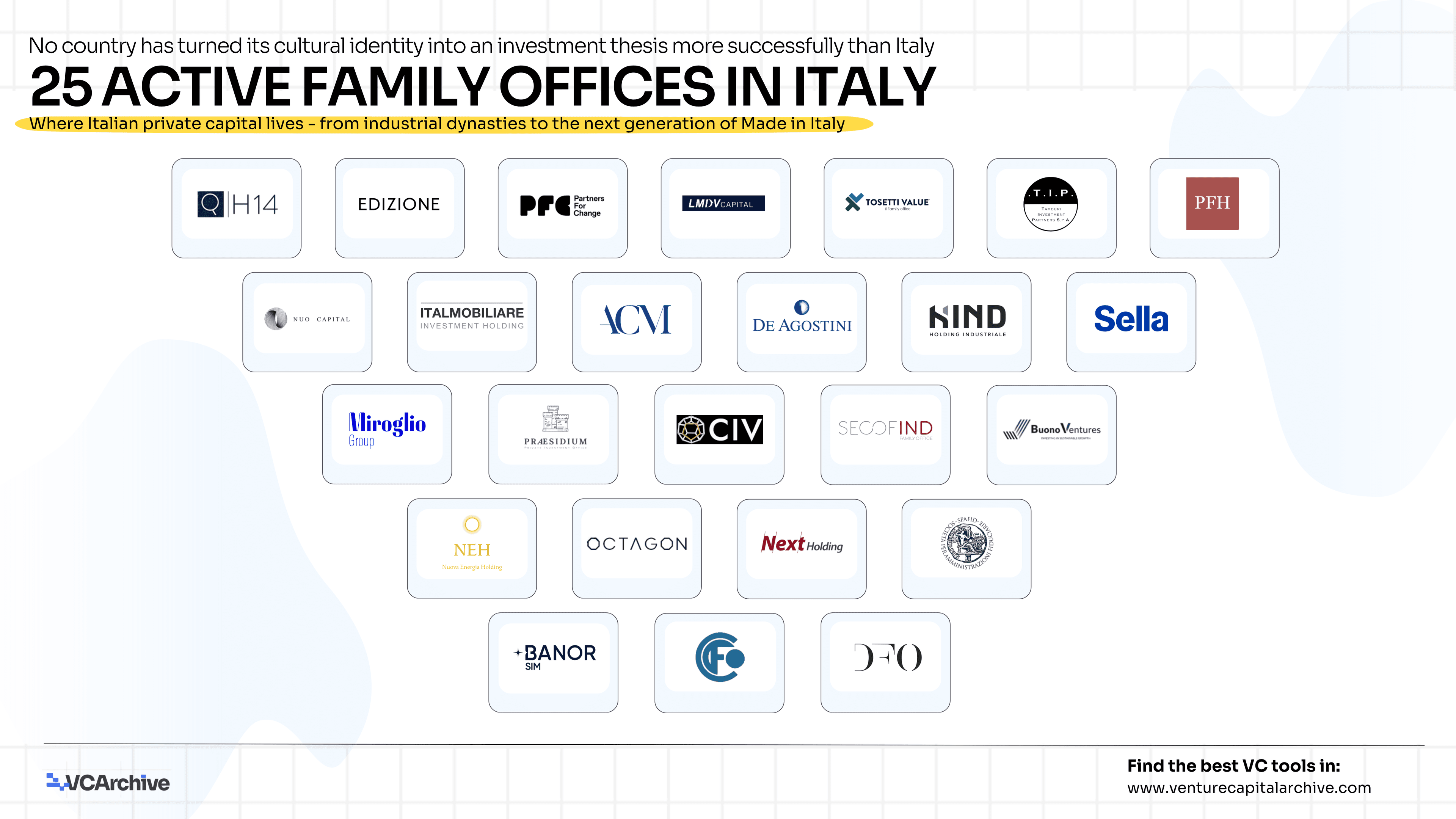
25 Active Family Offices in Italy
Start with the pizza. It tells you something nobody expects.
Pizza was invented in Naples in the late eighteenth century as street food for the poor. It was cheap, fast, and required no cutlery. Today it is consumed approximately five billion times a year across the planet, has its own UNESCO Intangible Cultural Heritage designation, and has spawned a global industry worth hundreds of billions of dollars.
The Margherita variety - tomato, mozzarella, basil, the colours of the Italian flag was supposedly created in 1889 for Queen Margherita of Savoy by Neapolitan pizzaiolo Raffaele Esposito. Whether or not that story is entirely accurate, the structure of it is very Italian: something humble, something local, something made with extraordinary care for raw ingredient quality, elevated through craftsmanship into something that the entire world wants.
Now apply that logic to everything else Italy has ever produced.
Pasta originated as peasant food and became the world's most universally consumed carbohydrate. Gelato began as a court luxury and became a global dessert category. Ferrari started in a small Emilia-Romagna workshop and became the most powerful automotive brand on earth. Prada began as a leather goods shop in Milan and became a cultural institution. The pattern is identical every time: something deeply local, made with obsessive attention to quality, refined over generations until it becomes the global standard.
That pattern is also, it turns out, exactly how Italian families build and manage wealth.
The numbers that stop people in their tracks
Italy ranks eighth in the world for investable financial wealth, with a total wealth of approximately $6.9 trillion in 2024. Italy is home to about 517,000 millionaires and 2,600 super-rich with assets over one hundred million dollars. BCG predicts an average annual growth of 6.5% until 2029, with financial assets potentially reaching $9.455 trillion.
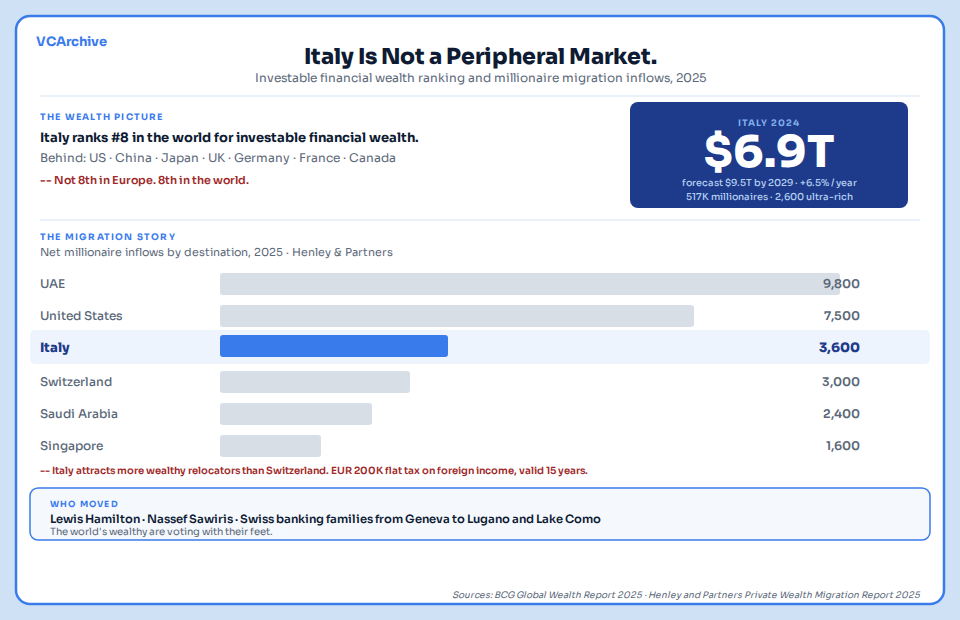
Eighth in the world. Not eighth in Europe. Eighth in the world, behind the US, China, Japan, the UK, Germany, France, and Canada. A country most international investors still casually categorize as a peripheral European market manages almost $7 trillion in investable financial wealth and is growing it at 6.5% annually.
And then there is the migration story, which is even more striking.
Italy now ranks third worldwide for new millionaire residents, trailing only the UAE and the United States. Approximately 3,600 high-net-worth individuals relocate to Italy annually, surpassing Switzerland, a country synonymous with financial stability and discretion.
Switzerland. Italy is attracting more wealthy relocators than Switzerland. That sentence would have seemed absurd fifteen years ago. Today it reflects a policy-driven, lifestyle-reinforced, genuinely compelling offer to global private wealth: a flat annual tax of €200,000 on all foreign income, valid for fifteen years, combined with what is arguably the highest density of cultural, culinary, and architectural excellence per square kilometer of any country on earth.
Lewis Hamilton moved to Milan. Swiss banking families relocated from Geneva to Lugano and Lake Como. Egyptian billionaire Nassef Sawiris chose Italy. The world's wealthy are voting with their feet, and they are voting for Italy.
What Italian family capitalism actually means
There is a phrase that appears in serious discussions of Italian business that almost never makes it into international coverage: "Family Capitalism." It describes a specific model of economic organization that is deeply embedded in Italian economic culture and that produces outcomes in terms of brand longevity, product quality, and multi-generational wealth, that more dispersed ownership structures consistently struggle to replicate.
Giovanni Ferrero's business philosophy focuses on long-term sustainability and the maintenance of a private, family-owned structure, allowing for strategic agility without the pressures of quarterly public reporting. His success is a testament to the power of Italian Family Capitalism and its ability to scale to a truly global level while maintaining strict quality standards and brand integrity.
Ferrero is the clearest example but not the only one. Consider what Italian family capitalism has produced:
- The Ferrari family and one of the most recognized brands in human history, still majority family-controlled
- The Del Vecchio family and Essilor Luxottica, which controls how most of the world corrects its vision
- The Benetton family and Edizione, one of Europe's most sophisticated infrastructure and consumer investment platforms
- The Prada family and a fashion house that has shaped global aesthetics for decades
- The Agnelli family and a dynasty that has spanned automotive, media, real estate, and football across a century
These are not companies that happened to be founded by families and then professionalized into institutional structures. They are businesses where the family is the strategy, where the long-term orientation, the quality obsession, and the unwillingness to compromise for short-term results are structural features of family ownership rather than accidental byproducts of it.
The three things that make Italian family offices genuinely distinctive
They invest in what they understand at an almost cellular level.
Italian family offices do not diversify into categories they cannot evaluate with operational depth. The families that built wealth in fashion invest in fashion. The families that built wealth in food invest in food and beverage. The families that built wealth in industrial manufacturing invest in industrial manufacturing.
Private wealth capital invested €1.1 billion in Italian commercial real estate in 2024, a 68% year-over-year increase, with private investors deploying approximately €660 million in Q1 2025 alone, capturing 24% of total investment volumes, their highest market share in recent years.
That real estate concentration is not random. Italian families have been accumulating, developing, and managing real estate for centuries. They understand Italian property markets with a granularity that foreign institutional investors can never replicate from a distance. When Italian private capital pours into real estate at this rate, it is not following a trend. It is exercising an advantage.
They treat Made in Italy as an investment thesis, not a marketing slogan.
The phrase "Made in Italy" is worth an estimated $300 billion annually in premium pricing across fashion, food, furniture, and automotive categories globally. Italian family offices that focus on consumer, luxury, and lifestyle sectors are not just backing good companies. They are investing in a brand that has been built over centuries and that commands one of the most durable price premiums in global commerce.
The families behind NUO Capital, LMDV Capital, Miroglio, and Tamburi Investment Partners understand something about the Made in Italy premium that no McKinsey report can fully capture: it is not about the label. It is about the accumulated credibility of generations of Italian craftspeople who refused to cut corners even when cutting corners would have been more profitable.
They are extraordinarily patient in ways that listed market investors find incomprehensible.
Italy's renowned fashion and luxury sectors are represented by families whose wealth reflects both their legacy and their ability to navigate complex global markets. These families balance tradition with modernization, investing in innovation and sustainability while maintaining the heritage that created their competitive advantage.
Patient does not mean passive. The Benetton family's Edizione has been one of the most active infrastructure investors in Europe over the past two decades. Italmobiliare has been systematically building and acquiring food and packaging businesses for generations. De Agostini has been reinventing itself from a publishing house into a global gaming and financial services platform without losing the discipline that the publishing heritage instilled.
Patience in Italian family capital is not the absence of activity. It is the presence of a time horizon that makes different activities rational.
Milan, and everything else
Eighteen of the twenty-five offices on this list are headquartered in Milan. This is not surprising, Milan is Italy's financial capital, its fashion capital, its design capital, and the city that more than any other has served as the bridge between Italian industrial heritage and global capital markets.
But the seven offices outside Milan are worth specific attention precisely because they are not in Milan.
Treviso - the Benetton family's home city, where the knitwear empire was born and where Edizione still anchors its headquarters reflects the Veneto region's extraordinary density of family-owned industrial businesses that have been compounding quietly for generations.
Vicenza - home to Palladio Holding - is the heart of northeastern Italian manufacturing, a region that produces more industrial output per capita than almost anywhere in Europe and where the relationship between family ownership and operational excellence is most clearly visible.
Turin - home to Tosetti Value - is the city that built Fiat, Ferrari, and the Italian automotive industry and that carries a specific kind of industrial seriousness that distinguishes Piedmontese business culture from the more financially oriented culture of Milan.
Biella - home to the Sella family's banking and financial services platform; is a small Piedmontese city that has been a center of Italian textile and banking wealth for centuries, where the Sella family has been compounding financial services expertise across generations.
Alba - home to Miroglio is in the heart of Langhe country, surrounded by Barolo vineyards and white truffle forests, where the relationship between craftsmanship, terroir, and generational investment has been understood for longer than most capital markets have existed.
Each of these cities is a signal. The family that chose to base its capital there did so because that is where it understands the world most deeply.
The fresco and the spreadsheet
The Sistine Chapel ceiling took Michelangelo four years to paint. He is said to have worked lying on his back on scaffolding, ruining his eyesight, arguing with Pope Julius II about money, and producing what most art historians consider the greatest ceiling in human history.
The story is usually told as a testament to artistic genius. It is also a story about patience, about the willingness to do something extraordinarily difficult for an extraordinarily long time because the outcome justifies the investment.
Italian families have been applying that same logic to wealth management for centuries. Not because they read about it in a business school curriculum, but because it is embedded in a culture that treats quality as non-negotiable, time as an ally rather than an enemy, and the family as the most durable competitive advantage available.
Italy ranks eighth in the world for investable financial wealth. BCG predicts growth to $9.455 trillion by 2029. The number of ultra-rich is expected to grow by 3% annually. This is not a market in decline. It is a market in the early stages of being properly discovered by international capital, which means the relationships available now are more valuable than the ones that will be available in five years when everyone else has arrived.
The 25 offices on the VCA list are the most complete picture of where Italian family capital lives in 2025 - who holds it, what they focus on, how they make decisions, and which doors are worth finding before you start your next raise.
25 Active Family Offices in Italy




More from Dario Villena
View author profile
Top 30 Startup Pitch Decks to Model Yours On
The difference between a "no" and a $120M Series C often comes down to a few slides. Here are 30 that got the yes
22 Active Family Offices in Romania
The country that gave the world Dracula and the first electric street lighting built its billionaires the same way. In the dark, faster than anyone expected.

New Venture Funds - July 2026
67 funds. One NBA player. One war zone. One $49 billion platform. And a market that has completely stopped having a single story.