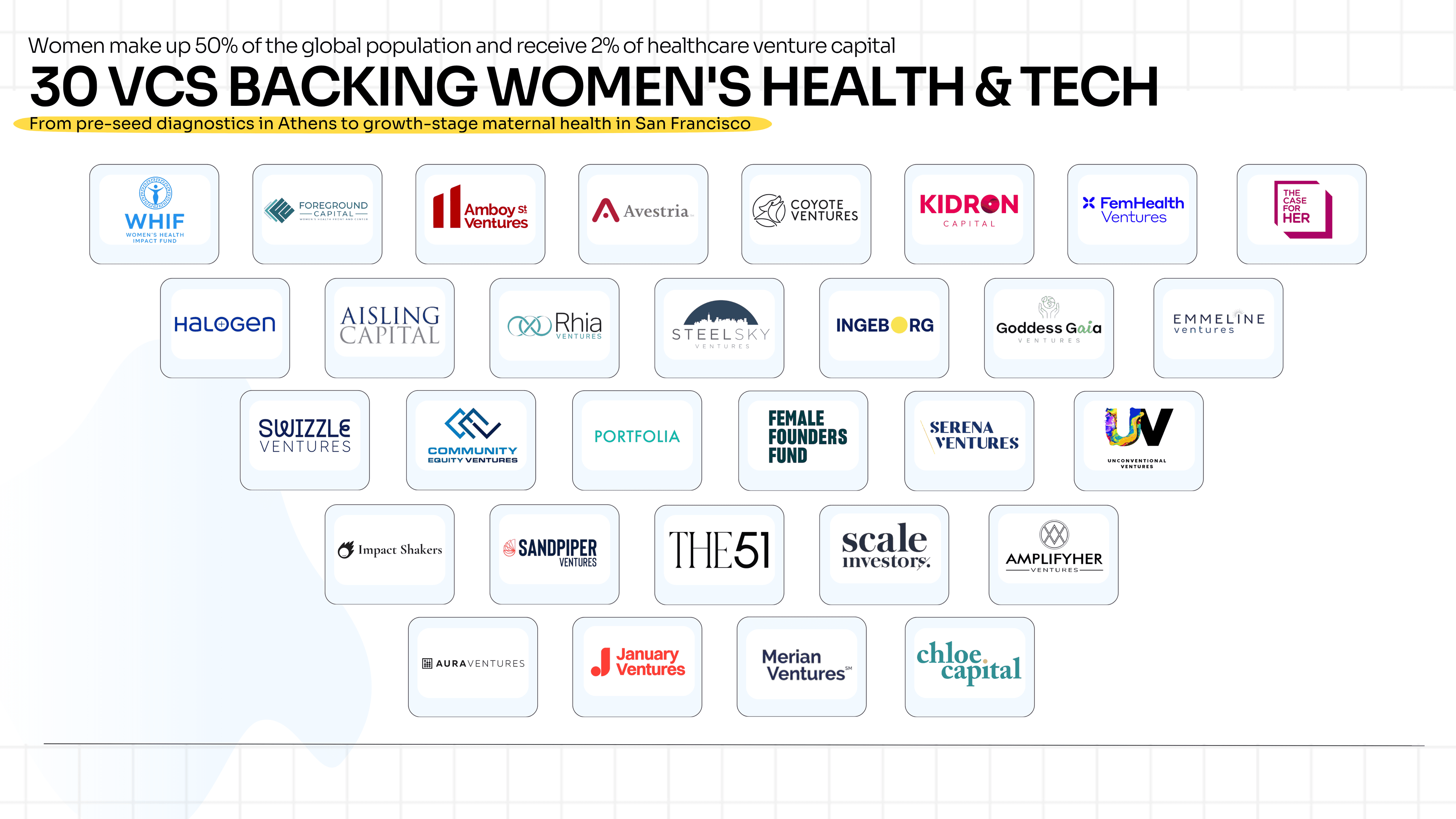
30 VCs Backing Women's Health & Tech
40x return on research investment. 2% of healthcare VC. We have been doing the math wrong for a long time.
The women's health funding gap is not a pipeline problem. It is a perception problem. And the market is finally starting to correct it.
[embedded image]
There is a statistic that stops most people cold the first time they encounter it. Investing $350 million in women's health research generates $14 billion in economic returns. A 40x multiplier. And yet femtech still receives only approximately 2% of total healthcare venture capital.
We are not talking about an emerging, unproven category here. We are talking about a market serving 50% of the global population, with over $100 billion in tracked exits from 2000 to 2025, and a 55% year-over-year funding increase in 2024 that still left it at 2% of healthcare VC. That is not a niche. That is a structural market inefficiency of extraordinary size and it is hiding in plain sight.
The part that nobody talks about loudly enough
Here is something that surfaced in an SVB report earlier this year and deserves more attention than it got.
"People are, well, I don't invest in women's health. You actually do. I've seen your portfolio. You just don't know it." - Megan Scheffel, Head of Life Science and Healthcare, Silicon Valley Bank, 2026
That quote is not an accusation. It is a diagnosis. Women's health is so embedded in the broader healthcare market that a meaningful portion of investment in therapeutics, diagnostics, digital health, and oncology is effectively women's health investment, it just never gets categorized that way. Which means the 2% figure is probably already an undercount. And it means the investors who actively, deliberately build expertise in this category have an advantage that the market has not yet fully priced.
Where the money is actually going right now
[embedded image]
In tracked women's health exits from 2000 to 2025. The returns are not theoretical.
The headline numbers look encouraging. The composition underneath them is more complicated. Capital is concentrating at the very top into a small number of breakout companies, while the vast majority of the market - seed and Series A companies building the next generation of women's health infrastructure, remains chronically underfunded. Only 16% of femtech deals in 2024 exceeded $50M. Those five deals took two thirds of all the money.
That bifurcation creates a specific kind of opportunity. The white space is not at the top where the mega-rounds are happening. It is in the earlier stages where most founders are still trying to find a first believer who genuinely understands what they are building.
The founding team paradox and why it matters
All-female founding teams
105 femtech companies raised $408M collectively in 2022. Average raise: $4.6M per startup.
All-male founding teams
57 femtech companies raised $731M collectively in 2022. Average raise: $9.2M per startup.
Over 70% of European femtech companies have at least one female founder. Only 10% of venture capital in the sector has gone to those companies since 2014. A sector built entirely around women's health needs is more generously funded when the founding team has no lived experience of those needs.
That is not a coincidence. It is a reflection of where decision-making power in venture capital still sits. The funds on this list were built, in large part, as a structural response to exactly that pattern.
The sub-sectors moving fastest right now
1- Menopause finally became investable
Menopause tops the femtech sub-sector momentum ranking, with VC up 9% over three years to $104M in 2025 and its first unicorn. This affects 100% of women who live long enough to experience it, roughly 1 billion people globally and was considered too unsexy to fund for most of venture capital's history. That is changing.
AI-powered diagnostics broke through in 2025
Ataraxis AI raised $20.4M for breast cancer detection. Visby Medical raised $55M for STI testing. Emm raised $9M for menstrual biosensing. The combination of wearable data, improved imaging, and machine learning is creating diagnostic capabilities for conditions that have been chronically underdiagnosed for decades, often because they were never adequately researched.
Endometriosis got its largest-ever therapeutic investment.
Gesynta Pharma raised $31.5M in 2025 for a non-hormonal treatment for a condition affecting an estimated 190 million women worldwide, many of whom waited an average of seven to ten years for a diagnosis. The investment is finally starting to reflect the scale of the unmet need.
The geography gap nobody is solving yet
North America captured 92.83% of disclosed femtech dollars in the past 12 months, from 56.52% of deals. Europe had 21.74% of deals and 4.19% of capital. Latin America and Africa had no qualifying disclosed equity rounds at all.
Women's health needs do not concentrate in North America. The funding does. That gap between global need and concentrated capital is both the most uncomfortable statistic in this market and the clearest signal of where the next decade of opportunity lies for founders building in underserved markets and for the funds willing to follow them there.
One more thing before the list
US women's health VC saw a $1.2 billion pullback in 2025. Early indications suggest a rebound in 2026 as a new wave of seed and Series A companies prepares to emerge. The dip reflects the sector's focus on therapeutics and care delivery, making it less susceptible to AI investment hype and setting the stage for more stable, long-term growth.
That is the context worth holding when you look at the 30 funds below. They did not build their investment identity around this category because it was fashionable. They built it because the opportunity is real, the exits are proven, and the funding gap that makes most of the industry uncomfortable is exactly the kind of inefficiency that patient, specialist capital is designed to exploit.
For any founder building in women's health, femtech, or the broader tech and care economy serving women, this list is the most complete picture of where genuinely committed capital lives in 2026. Not the funds that might consider this space. The ones that chose it deliberately and built the expertise to back it properly.
30 VCs Backing Women's Health & Tech







Rows per page
More from Dario Villena
View author profile
25 Active Family Offices in Luxembourg
Luxembourg did not create great wealth. It became the place great wealth comes when it outgrows everywhere else.
30 Best Active DeepTech VCs in 2026
Real deep tech takes ten years to matter and most investors are not willing to wait that long. These 30 are.

Top 25 VC & Startup Influencers You Should Be Following
The thought leaders worth turning notifications on for