30 Best Active Crypto & Web3 VCs in 2026
Let's start with something that happened in 1994.
A Netscape engineer named Marc Andreessen shipped a piece of software called Mosaic. It was a browser — a way to navigate something called the World Wide Web that almost nobody had heard of and almost no serious person thought would amount to much. The established financial press was dismissive. Banks were uninterested. Most of the technology industry considered it a curiosity.
Twenty years later, every business on earth had a website, every consumer had a smartphone, and the companies built on that infrastructure were the most valuable in human history.
The parallel to crypto is not perfect. No parallel ever is. But the structural resemblance is uncomfortable to ignore for anyone who remembers what people said about the internet in 1994 and what they are saying about blockchain in 2026.
The Web3 market is projected to grow from $3.47 billion in 2025 to $29.97 billion by 2031, at a compound annual growth rate of 43.21%. Blockchain is shifting from proofs of concept to core enterprise systems. Layer-2 networks have removed critical cost barriers. Zero-knowledge proofs are unlocking privacy-preserving use cases that were impossible two years ago.
This is not a speculative asset class anymore. It is infrastructure. And infrastructure, once it reaches a certain level of maturity, tends to be very difficult to uninvent.
The numbers that matter and the ones that mislead
The crypto market has a measurement problem. Total market capitalization is the number everyone quotes and the number that means the least. A token price going up tells you about sentiment. It tells you almost nothing about whether the underlying technology is becoming more or less useful to the world.
The numbers that actually matter are different.
Decentralized exchanges now account for 35% of all crypto trading volume. Over $250 billion in assets are held in non-custodial wallets. DAO treasury holdings exceeded $25 billion in total assets. The number of DAO participants surpassed 7 million worldwide.

These are not price metrics. They are adoption metrics. They tell you that real people are using decentralized infrastructure to do real things with real money, in ways that bypass the intermediaries they used to depend on. That shift does not reverse easily. Once a developer builds on a protocol, once a user trusts a non-custodial wallet with meaningful savings, the switching cost back to centralized alternatives grows with every month that passes.
Crypto VC funding reached $11.5 billion in 2024, with Q4 alone seeing $3.5 billion across 416 deals, a 46% quarter-over-quarter increase. After the crypto winter of 2022 to 2023, Web3 entered a new phase characterised by institutional adoption, regulatory clarity, and infrastructure maturity.
Crypto venture funding topped $19 billion by mid-October 2025, with capital concentrating around a smaller number of high-conviction firms. The tourist money left. The conviction capital stayed. The 30 funds on this list are the conviction capital.
Three things that changed everything
The FTX moment clarified, it did not kill
In November 2022, FTX collapsed in one of the most spectacular corporate frauds in financial history. The obituaries were immediate and confident. Crypto was over. The institutions were leaving. The founders were fleeing. The asset class was finished.
The 2021 to 2022 fundraising boom flooded Web3 with startups racing to capture newly forming markets. The correction that followed was brutal but clarifying. What emerged from the wreckage was a leaner, harder, more technically serious industry. The projects that survived were the ones with genuine technology, genuine utility, and genuine communities. The ones that did not survive were the ones that had only price momentum.
The funds on this list mostly saw it coming. They kept writing checks through the winter. And their portfolio companies emerged stronger for having been tested.
Regulation went from enemy to enabler
For most of crypto's history, regulators were the villain in the story. Securities laws were unclear. Enforcement was arbitrary. The institutional capital that would have flooded into the space held back because compliance was impossible.
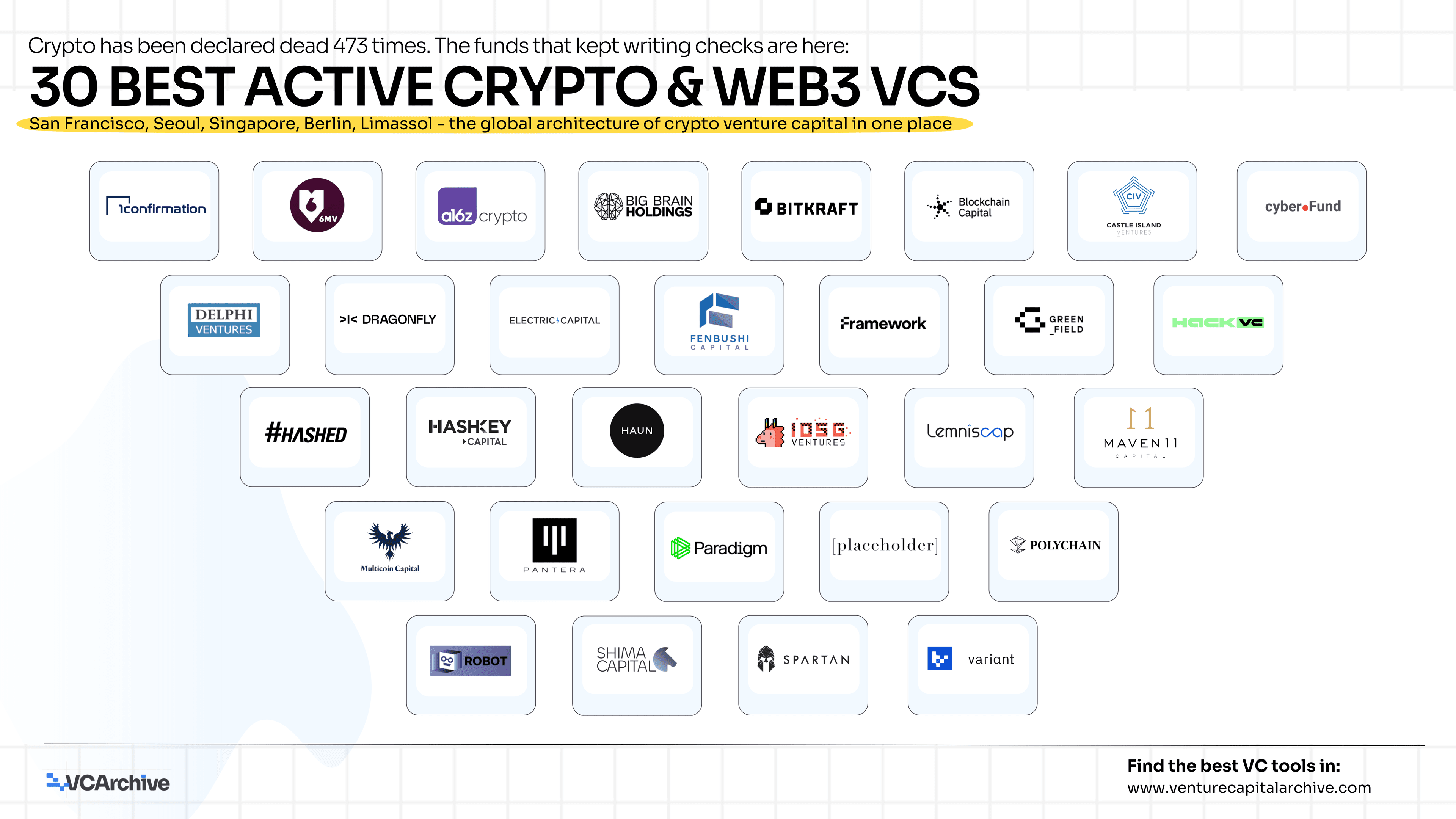
That dynamic has shifted substantially. Stronger regulatory frameworks in G20 economies are now pushing spending from piloting budgets into mainstream IT allocations. Institutional players are deploying blockchain for real-time settlement, tokenized assets, and digital identity. The funds on this list spent years navigating regulatory uncertainty. The ones still active in 2026 built compliance competency as a competitive advantage. Haun Ventures, founded by former federal prosecutor and a16z partner Katie Haun, built regulatory expertise into its investment thesis from day one. Castle Island Ventures in Boston has been articulating the Bitcoin infrastructure opportunity to institutional audiences for years before most institutions were listening.
AI and crypto found each other
The convergence of artificial intelligence and blockchain infrastructure is the most interesting development in either category since the last major cycle. The intuition is simple: AI systems that need to operate without centralized control, that need verifiable outputs, that need to transact at machine speed without human intermediaries, need decentralized infrastructure to do it on.
AI agents raised $1.39 billion in funding in 2025, marking a 9.4% increase over the prior year, reflecting how AI is becoming essential for data analysis, automation, and creating more secure and personalized Web3 environments.
Paradigm, Multicoin, Dragonfly, Hack VC, and Cyber Fund all have explicit AI times crypto theses. This is not trend-chasing. It is a genuine technical convergence that the most thoughtful investors in both categories have been writing about for two years.
What the geography of this list tells you
Crypto is the most genuinely global asset class ever created. It has no natural home country, no regulating authority with jurisdiction over all of it, and no single cultural context that shaped its development. The funds on this list reflect that.
San Francisco and New York dominate by number. Paradigm, Polychain, Multicoin, a16z crypto, Blockchain Capital, Robot Ventures, 1confirmation, Haun Ventures, Framework Ventures, Hack VC, Electric Capital, Shima Capital - the Bay Area and New York corridor has the deepest pool of crypto-native capital anywhere on earth.
But the Asian funds are arguably more important to the next cycle than their AUM suggests.
Hashed in Seoul owns the Korean Web3 ecosystem in a way that no outside fund can replicate. Korea has one of the highest per-capita rates of crypto ownership in the world and a developer community that has built some of the most significant protocols in the space.
HashKey Capital in Hong Kong operates at the intersection of institutional Asian finance and crypto infrastructure, with a $500 million Digital Asset Treasury fund and exchange operations that give it unique market intelligence.
Fenbushi Capital in Shanghai has been shaping Chinese blockchain investing for nearly a decade, with a network in Chinese developer communities that predates most Western funds' awareness that those communities existed.
Big Brain Holdings and IOSG Ventures and Spartan Group in Singapore reflect the city-state's emergence as the most crypto-friendly regulatory jurisdiction in Asia, with a concentration of Web3 talent and capital that rivals San Francisco on a per-capita basis.
Maven 11 in Amsterdam, Greenfield Capital in Berlin, Lemniscap and Cyber Fund in Limassol - the European presence on this list is not accidental. Asia-Pacific is projected to grow at a 45.90% compound annual growth rate through 2031, and European regulatory frameworks are creating new pathways for institutional crypto adoption that did not exist three years ago.
The theses that separate the best from the rest
Not all crypto funds are the same. The differences in thesis are as important as the differences in AUM, and for a founder deciding who to approach, understanding them matters enormously.
The infrastructure thesis is where Paradigm, Polychain, Electric Capital, and Hack VC live. These funds believe that the most durable returns come from owning the rails, the Layer 1 protocols, the zero-knowledge proof systems, the modular blockchain infrastructure, rather than the applications built on top of them. Polychain Capital projects reported return multiples like 760x for Solana and 130x for Uniswap, backing the thesis that infrastructure ownership at the earliest stages generates the category's best returns.
The application and consumer thesis is where Variant, Delphi Ventures, 6th Man Ventures, and Big Brain Holdings operate. These funds believe that crypto's next decade is about making decentralised applications genuinely useful to non-technical users consumer wallets, onchain gaming economies, creator platforms, social applications where ownership is native rather than bolted on.
The Bitcoin-native thesis is its own category entirely. Castle Island Ventures in Boston has built the definitive institutional case for Bitcoin infrastructure payments rails, Lightning Network, on-chain analytics, stablecoin infrastructure, in ways that treat Bitcoin not as a speculative asset but as the settlement layer for a new financial system.
The gaming and entertainment thesis sits at an intersection that most traditional VCs struggle to understand. BITKRAFT Ventures in Denver has built the most credible multi-stage gaming and Web3 gaming fund in the industry, with investments spanning esports, game studios, GameFi infrastructure, and the AI tools that will power the next generation of interactive entertainment. GameFi remains the most active sector in Web3, recording 4.66 million daily unique active wallets in Q3 2025, the largest share of Web3 engagement globally.
What founders building in this space need to know
The 2026 crypto fundraising environment has one defining characteristic: fewer deals, larger checks. In 2025, a total of 1,179 Web3 VC deals were closed, representing a 29.6% decline year over year, despite total capital invested reaching comparable levels to the 2021 to 2022 boom.
That split means something very specific for founders. The volume of small seed checks going to undifferentiated projects has collapsed. The availability of large checks for genuinely differentiated ones has not. The funds on this list are not making fewer investments because they have lost conviction in the category. They are making fewer investments because they have developed enough pattern recognition to know exactly what they are looking for.
What are they looking for?
- Technical depth that is genuinely hard to replicate, not a fork of an existing protocol with a new token
- A clear answer to the question: why does this need to be onchain?
- A founding team that understands the regulatory environment they are operating in, not one that is hoping it will be resolved before they have to think about it
- A go-to-market strategy that does not depend entirely on token price appreciation to create the appearance of product-market fit
The funds that will write you the most useful check are not necessarily the ones with the largest AUM. They are the ones whose thesis most specifically matches what you are building, whose portfolio companies are most directly relevant to your challenges, and whose partners have the deepest relationships in the specific ecosystem you are trying to break into.
The 30 funds that never stopped believing
The internet did not die in the 2000 dot-com crash. It matured. The companies that survived it became the most valuable in history. The investors who kept writing checks through the winter became legends.
Crypto has had its crash. Several of them, in fact. The strongest tailwinds in 2026 are in stablecoins, RWA tokenization, crypto-AI convergence, and institutional-grade infrastructure - the exact categories that the most sophisticated funds on this list have been building toward for years.
The 30 funds below collectively manage north of $45 billion in assets, back founders from pre-inception through growth across every major blockchain ecosystem, and represent the most concentrated pool of domain expertise in Web3 investing on earth.
For any founder building in this space, whether in DeFi, gaming, infrastructure, stablecoins, or the emerging AI times crypto convergence, this list is the most complete map of where the serious capital lives and what it is actually looking for in 2026.
30 Best Active Crypto & Web3 VCs in 2026









Rows per page
More from Dario Villena
View author profile
30 Best Active Agentic AI VCs in 2026
The shift from AI that assists to AI that acts autonomously is the biggest investment theme of 2026 and these 30 funds are at the centre of it
What a Mentor Would Tell You Before Your First VC Pitch
A practical guide to understanding how venture capital works, from LP capital and investor incentives to fundraising and relationships.
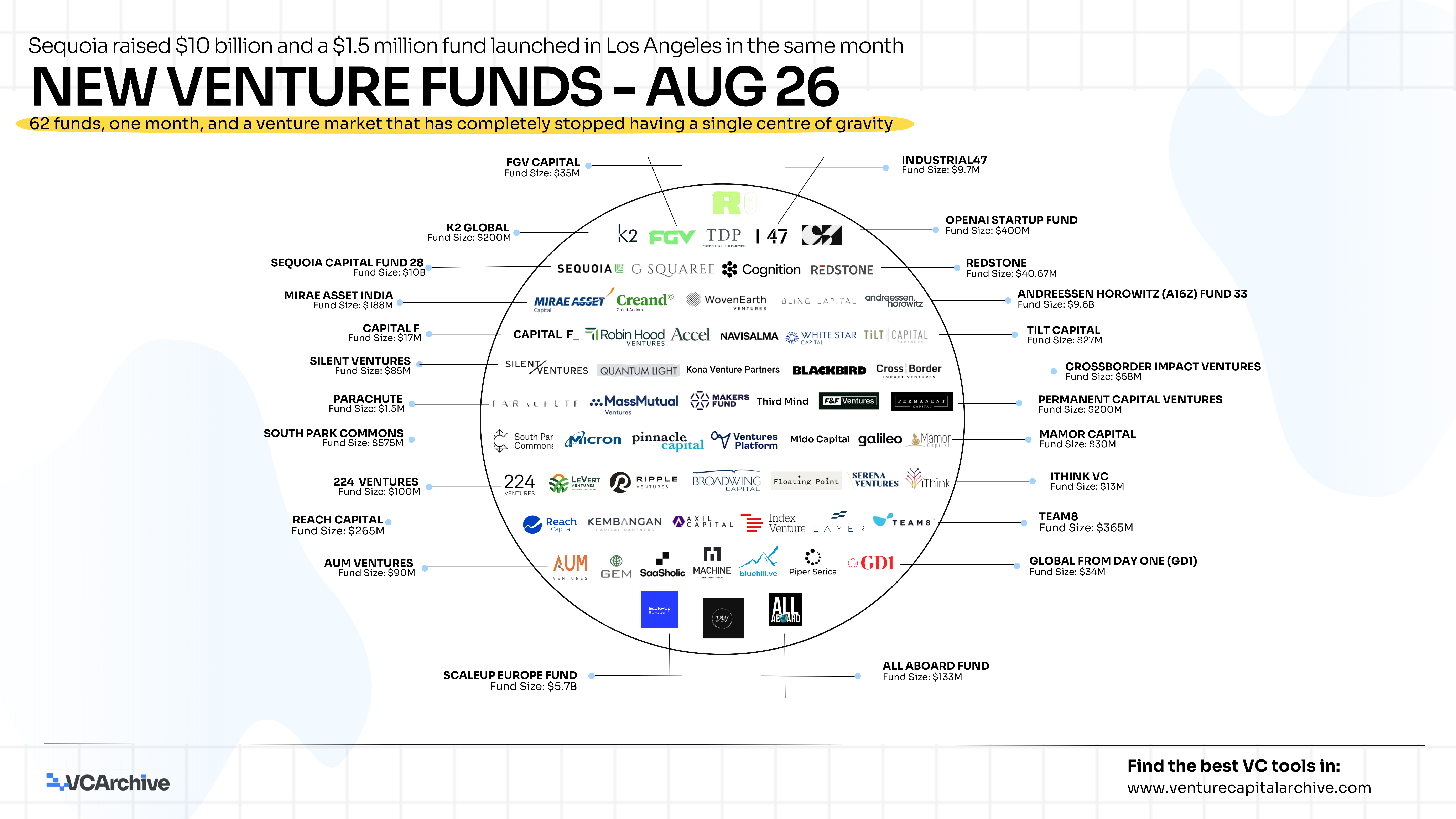
New Venture Funds - August 2026
a16z closed $9.6 billion. A Brussels solo GP closed $10 million. The OpenAI Startup Fund closed $400 million. All in August 2026.