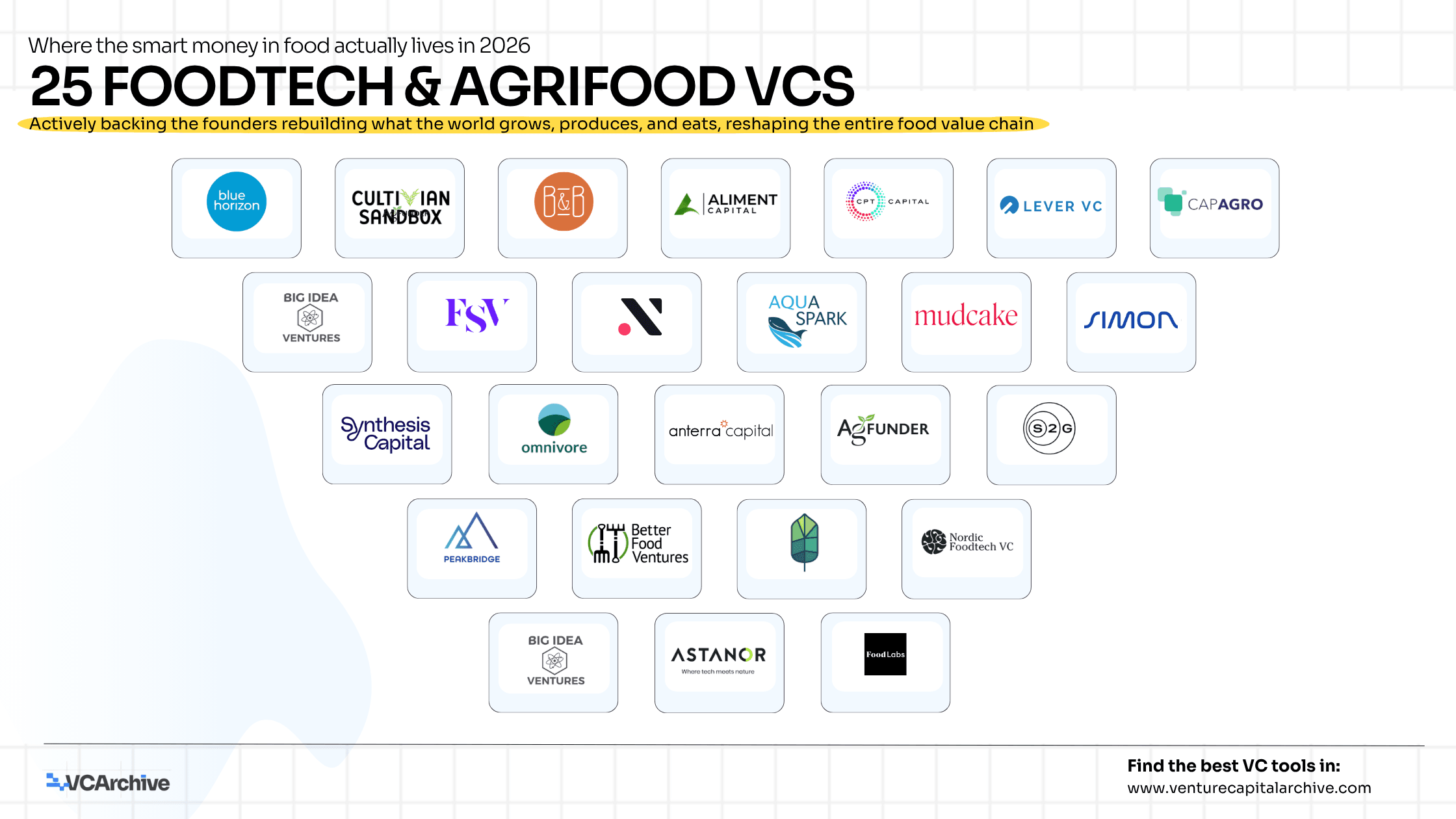
25 active FoodTech & AgriFood VCs Shaping 2026
The market is brutal right now. That's actually good news for you.
The first half of 2025 saw just $5.1 billion in global agrifoodtech investments, a 37% drop from the previous year, the lowest total since 2015 (VCA Annual Report 2025). The tourists have left. The generalist funds that parachuted into alt-protein because it was hot are gone. What remains are 25 firms that have built their entire identity around this sector and that changes everything about how you should pitch.
These investors don't need convincing that food systems matter. They need convincing that you are the right team, at the right moment, with the right proof. That's a much more specific problem and a much more winnable one if you walk in prepared.
Before you pitch anyone on this list, know this.
Investors are more selective than ever, prioritizing proven business models, measurable impact, and scalable solutions. But what each of those words means varies wildly depending on who's sitting across the table.
These 25 funds are not one category. They break into at least four distinct investor types:
The pure scientists. They want to see IP, yield data, cell lines, and fermentation outputs. Walk in with a consumer narrative and no hard science and you'll get a polite pass before you finish your first slide.
The systems thinkers. They see the entire food value chain as their portfolio. Pitch them a standalone product without showing where it connects upstream and downstream, and you've already lost the room.
The regional specialists. Their LP relationships, corporate networks, and regulatory expertise are concentrated in specific geographies. Pitching a Nordic-focused fund on a US market opportunity isn't just a mismatch, it signals you didn't do basic research.
The early-stage builders. They don't need your metrics yet. What they need to believe in is you. Sending a polished 40-slide deck to one of these funds is actually the wrong move, it shows you don't understand what stage they play at.
Read the portfolio before you read pitch deck tips. The companies a fund has already backed tell you more about what they want to hear than anything on their website.
Geography is a filter, not a footnote.
Most founders treat investor location as logistics. These funds treat it as a thesis. A pivotal trend for 2025 is the increasing focus of VC funding on emerging markets such as Africa, Latin America, and South Asia (VC Lab 2.0). If your company has genuine roots in one of those markets, local relationships, regulatory access, distribution infrastructure, that is not a weakness to explain away. It is the headline. Lead with it. It is the one thing a well-funded competitor probably doesn't have.
Impact is no longer the back of the deck.
For a meaningful portion of these 25 firms, impact measurement isn't a values statement, it's a reporting obligation to their LPs. That changes what they need from you in a first meeting. Carbon figures, land use data, smallholder farmer reach, water reduction per unit of production for the right funds on this list, these aren't nice-to-haves. They're the first conversation.
The founders who understand this don't treat impact as a constraint. They build it into the model and then walk in with the numbers to prove it.
"Over 60% of agriculture VC funds target sustainability-focused and tech-driven startups. Of the more than $1 billion invested in Q1 2025, the bulk is flowing toward sustainability-centric themes - a trend that shows no sign of reversal."
The pitch that actually works right now.
You can't just be incrementally better. The question of how you de-risk while going three or four times faster is becoming a real topic for the industry (KPMG). That's not a quote about ambition. It's a quote about capital efficiency. The funds still deploying in this market are not looking for the boldest vision. They're looking for the tightest proof of de-risking at every stage.
A few things that separate the founders who are closing rounds from the ones who aren't:
1/ They show revenue before anyone asks. Not pilots. Not LOIs. Actual recurring revenue with retention data behind it.
2/ They bring the scientist to the meeting. If your moat is technical, the partner needs to feel that in the room, not just read it in an appendix.
3/ They know the fund math. Fund size, ownership target, check size that makes sense for both sides. Asking a $15M fund for a $10M check isn't bold. It's a signal that you haven't done the work.
4/ They reference the LP base. Not as flattery but as strategy. Knowing who anchors a fund's capital, and showing how your company could leverage those relationships, is something almost no founder does. It is almost always the thing that gets you a second meeting.
The founders raising in this market are not the loudest in the room. They are the most prepared. That preparation is the only edge that reliably works.
Stop pitching the wrong funds. The 25 that are actually writing checks in agrifood right now are waiting for you below, with everything you need to approach them the right way.
25 active FoodTech & AgriFood VCs Shaping 2026






Rows per page