The Games Venture Capital Plays
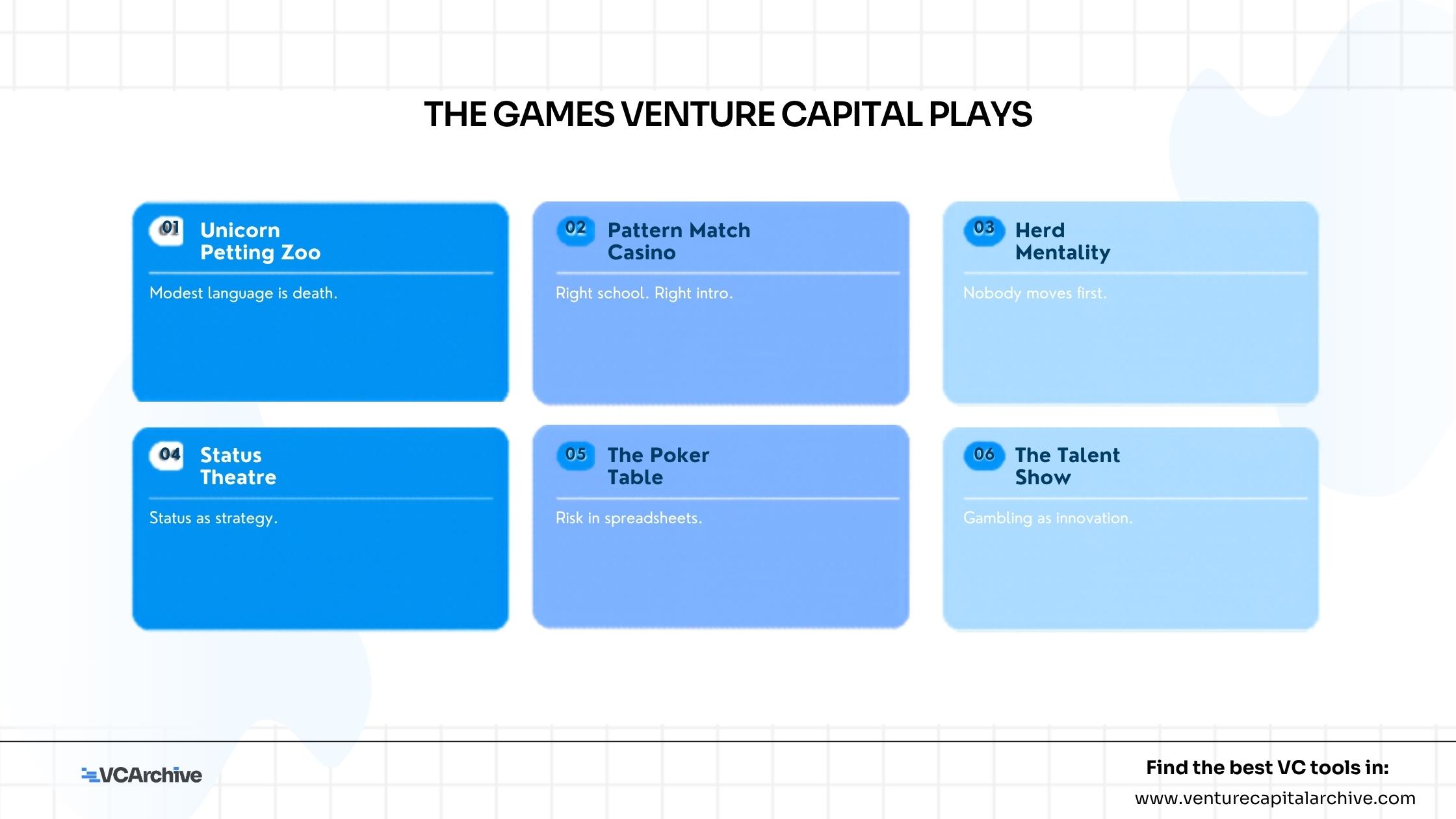
A humorous field guide to the theatre, rituals, and tiny magic tricks of startup finance
Venture capital is one of the strangest games in modern capitalism.
It presents itself as patient capital for brave founders building the future. Sometimes it is. At its best, venture capital funds difficult ideas before banks, governments, or traditional investors would dare touch them. It gives young companies oxygen, credibility, advice, networks, and the chance to attempt something genuinely ambitious.
But venture capital also has its own theatre.
It has costumes, slogans, rituals, ranking systems, secret languages, public ceremonies, and private games. It is not merely money looking for returns. It is money performing intelligence. It is status pretending to be strategy. It is risk wrapped in spreadsheets, optimism wrapped in legal terms, and sometimes gambling dressed as innovation policy.
The founder who enters this world too innocently may think they are simply raising capital.
They are not.
They are entering the casino, the cathedral, the dating app, the talent show, the poker table, the popularity contest, and the shark tank all at once.
Here are some of the games venture capital plays.
1. The Unicorn Petting Zoo
This is the game where every startup must pretend it is not merely a business, but a future unicorn.
A normal business makes money. A unicorn rearranges the global economy before morning tea.
Founders quickly learn that modest language is death. You cannot say:
“We are building useful workflow software for a specific industry.”
You must say:
“We are creating the category-defining operating system for the future of human coordination.”
The venture capital world loves scale, and fair enough. Venture capital depends on outlier returns. A fund cannot survive on a collection of pleasant, sensible, moderately profitable businesses. It needs monsters. It needs rockets. It needs companies that can return the fund.
So every pitch deck slowly develops a horn.
The problem is that not every animal is a unicorn. Some are excellent horses. Some are camels, built to survive difficult markets. Some are hardworking oxen that can pull entire industries forward. But the petting zoo only wants magical creatures.
So the founder dresses the horse as a unicorn.
The investor nods.
Everyone knows.
Nobody says it.
2. Total Addressable Make-Believe
The TAM slide is one of the great performance arts of venture capital.
TAM means Total Addressable Market. In theory, it answers a useful question: how large could this opportunity become?
In practice, it often becomes a fantasy map.
A founder selling software to regional accounting firms may suddenly claim exposure to the entire global professional services market, then the global enterprise software market, then perhaps “all human decision-making,” which is worth, according to the slide, several trillion dollars and a small moon.
The game works like this:
First, take a large existing market.
Second, draw a circle around it.
Third, claim your product will participate in that market.
Fourth, make the font bigger.
The danger is not that large market thinking is wrong. It is not. Ambition matters. But sloppy TAM thinking creates lazy strategy. It confuses “a market exists” with “we can access it.” It confuses “people spend money in this area” with “people will spend money on us.” It confuses “the ocean is big” with “we own a boat.”
A better question is not just, “How big is the market?”
It is:
What specific pain do we solve?
Who feels it urgently?
Who has the budget?
Who can approve the purchase?
What existing behaviour are we replacing?
Why now?
Why us?
But those questions are harder to fit beside a giant number with a dramatic arrow.
3. The FOMO Flamethrower
FOMO is one of venture capital’s most powerful fuels.
Fear Of Missing Out.
The founder says:
“We already have strong interest from several top-tier funds.”
This may mean one investor replied to an email with, “Interesting, let’s circle back.”
The investor says:
“We are moving quickly.”
This may mean, “We have not yet decided whether we care.”
Both sides play the game. The founder tries to create scarcity. The investor tries to avoid looking too eager while quietly checking whether anyone else important is interested.
The FOMO Flamethrower works because venture investing is deeply social. Nobody wants to miss the deal everyone else wants. Nobody wants to be the person who passed on the next Canva, Atlassian, Stripe, Airbnb, or whatever sacred startup name is being invoked that week.
So the market becomes emotional.
Investors say they invest in fundamentals, but social proof matters. A respected investor entering a round can change the entire temperature of the deal. A founder can go from “too early” to “oversubscribed” in a week, not because the business changed, but because the room changed.
This is not always irrational. Good investors can provide useful signal. But FOMO can also turn diligence into theatre. People stop asking, “Is this a good company?” and start asking, “Why does everyone else seem excited?”
That is not investing.
That is musical chairs with term sheets.
4. The Warm Intro Lottery
In ordinary life, if someone has a good idea, you might expect them to be judged on the idea.
In venture capital, they are often judged first on who introduced them.
The warm intro is the unofficial passport of startup finance. A founder introduced by a respected operator, investor, accelerator, or previous founder enters through the front door. A cold email may enter through the side window, or not at all.
To be fair, investors are flooded with pitches. Filtering is necessary. Trust networks save time. But the warm intro game has a darker side: it can confuse access with merit.
A founder from the right university, city, accelerator, company, or social network may appear more “investable” before the business has even been understood. Meanwhile, someone outside the network may have a better product, deeper insight, and more grit, but no social bridge into the castle.
The result is a capital market that says it loves disruption while sometimes operating like a private school reunion.
This game has a funky little contradiction at its heart:
Venture capital says it wants outsiders who see the world differently.
Then it asks who they know on the inside.
5. Pattern Matching Karaoke
Venture capitalists often talk about pattern recognition.
Pattern recognition can be valuable. Experienced investors see many companies. They notice recurring signals: strong teams, weak markets, fake traction, dangerous churn, pricing problems, timing issues, distribution advantages, founder resilience.
But pattern recognition can become pattern matching karaoke.
That is when investors sing along to the familiar tune without checking whether the song actually fits.
“This founder reminds me of X.”
“This market feels like Y.”
“This is Uber for Z.”
“This is the Shopify of something.”
“This is the operating system for the modern whatever.”
The danger is that yesterday’s patterns become today’s blindfolds.
A new company may not look like the last great company. A new founder may not sound like the last famous founder. A new market may begin in a place investors do not usually look. A genuinely original idea may appear strange, narrow, boring, or unscalable at first.
Pattern recognition becomes dangerous when it rewards similarity more than truth.
The lazy version of this game is not really thinking. It is just humming familiar startup songs in a Patagonia vest.
6. The Vision Fog Machine
Every startup needs a vision.
Without vision, a company becomes a task list with invoices. Vision gives direction, courage, meaning, and coherence. It helps people endure hard things.
But venture capital often encourages founders to turn the fog machine up too high.
The product is not a product. It is a platform.
The platform is not a platform. It is infrastructure.
The infrastructure is not infrastructure. It is a movement.
The movement is not a movement. It is a paradigm shift.
The paradigm shift is not a paradigm shift. It is the inevitable future of civilisation.
At some point, everyone in the room is coughing on dry ice.
The Vision Fog Machine allows weak specifics to hide inside grand language. It can make a half-built product sound like a planetary event. It can make uncertainty feel like destiny.
The trick is not to reject vision. The trick is to connect vision to operational truth.
What exists now?
What works now?
What do customers use now?
What are they paying for now?
What must be built next?
What evidence supports the claim?
A founder with vision and discipline is powerful.
A founder with vision and no discipline is just operating a smoke machine in a PowerPoint nightclub.
7. The Traction Treadmill
Traction is the proof that the market cares.
The problem is that the definition of traction keeps moving.
At first, investors ask for an idea.
Then a prototype.
Then users.
Then paying users.
Then revenue.
Then recurring revenue.
Then retention.
Then expansion.
Then enterprise customers.
Then faster growth.
Then better margins.
Then proof the company can scale without exploding.
This is not entirely unfair. Companies mature. Evidence should improve over time. But founders often discover that the finish line moves every time they approach it.
The investor says:
“Come back when you have more traction.”
The founder comes back.
The investor says:
“Great, but now we need to see repeatability.”
The founder comes back again.
The investor says:
“Great, but now we need to see whether this can scale.”
Eventually the founder is no longer building a company. They are running on a treadmill in front of people holding clipboards.
The hard truth is this: some investors use traction as a genuine diligence standard. Others use it as a polite no. The founder needs to learn the difference.
“Come back later” sometimes means “you are early.”
Sometimes it means “I do not want to say no clearly.”
Founders should respect useful feedback, but they should not live forever in someone else’s waiting room.
8. The Valuation Balloon Animal Show
Valuation is where finance becomes sculpture.
In normal business, valuation might be tied to revenue, profit, assets, cash flow, or comparable transactions.
In venture capital, especially early-stage venture capital, valuation can become a balloon animal.
A bit of market size here.
A twist of founder pedigree there.
A puff of growth rate.
A squeeze of competitive tension.
A sprinkle of AI.
Suddenly, a dog becomes a dragon.
Valuation is not meaningless. It reflects expectations, risk, ownership, bargaining power, and future potential. But in frothy markets, it can detach from reality and become a social artefact.
High valuations feel good. They create headlines. They validate founders. They impress employees. They make previous investors look clever.
But they also create a trap.
A company that raises at an inflated valuation must grow into it. If it does not, the next round becomes painful. Down rounds damage morale, cap tables, investor confidence, and sometimes the founder’s control.
The valuation balloon animal is fun at the party.
Less fun when it pops in the boardroom.
9. The Optionality Octopus
Investors love optionality.
They want the right to invest later. They want to watch the company, stay close, get updates, join the round if it becomes hot, and avoid committing too early.
This is rational from the investor’s perspective. Why take risk today if you can wait for more evidence tomorrow?
But from the founder’s perspective, the Optionality Octopus can become exhausting. Many arms. Many coffees. Many “keep us posted” conversations. Many people hovering near the company without actually helping.
The founder mistakes attention for commitment.
The investor gets information, proximity, and future choice.
The founder gets calendar fatigue.
This game is subtle because it feels positive. The investor is friendly. They are interested. They ask smart questions. They may even be helpful. But unless there is a cheque, a clear process, or meaningful support, the founder must be careful.
Not every warm conversation is momentum.
Sometimes it is just an octopus collecting options.
10. The Strategic Value Treasure Hunt
Some investors offer more than money.
They offer strategic value.
Networks. Hiring support. Customer introductions. Fundraising help. Governance. Market knowledge. Operator experience. Brand signal. Emotional support. War stories from the trenches.
Some of this is real. A great investor can be transformative. They can open doors, sharpen thinking, protect the founder from avoidable mistakes, and bring calm judgment during chaos.
But “strategic value” can also become a treasure hunt where the treasure is mostly imaginary.
The pitch sounds grand:
“We are hands-on.”
“We support founders deeply.”
“We have an incredible network.”
“We help with enterprise sales.”
“We can introduce you to everyone.”
Then the investment closes.
The founder asks for introductions.
The investor says:
“Absolutely. Let me think about who makes sense.”
Three months pass.
A newsletter arrives.
The founder discovers the strategic value was mostly a logo, a Slack channel, and an annual founder dinner where everyone discusses burnout under soft lighting.
Founders should ask investors direct questions before taking money:
What specifically have you done for companies like mine?
Which customers have you helped portfolio companies reach?
Can I speak to founders you backed where things went badly?
How do you behave when growth slows?
How do you help between rounds?
The real test of an investor is not how they behave during the courtship.
It is how they behave when the music stops.
11. The Board Seat Beanbag
The board seat is presented as governance.
Sometimes it is. Good boards improve companies. They create accountability, discipline, strategic clarity, and better decision-making.
But in some venture-backed companies, governance becomes performance seating.
The board meeting becomes a ritual in which everyone pretends the dashboard explains the company, the forecast explains the future, and the action items explain the chaos.
The Board Seat Beanbag game happens when investors want influence without responsibility. They want a say in strategy, hiring, spending, fundraising, and exit timing, but they may not always have deep enough context to understand the operational consequences.
The founder is told:
“Think bigger.”
Then:
“Control burn.”
Then:
“Hire faster.”
Then:
“Extend runway.”
Then:
“Dominate the market.”
Then:
“Why is customer acquisition cost rising?”
At its worst, the board becomes a room where contradictory advice is delivered with great confidence by people who do not have to execute it on Monday morning.
At its best, the board is a serious instrument of stewardship.
The difference is whether the people around the table are there to help govern the company, or merely to protect their position in the cap table.
12. The Exit Mirage
Venture capital begins with the end in mind.
That end is usually an exit: acquisition, IPO, secondary sale, or some other liquidity event.
This matters because venture capital is not just investing in businesses. It is investing in return pathways. A wonderful company that never produces liquidity may be less attractive to a VC than a riskier company that might sell for a billion dollars.
This creates the Exit Mirage.
Founders are encouraged to build enduring companies, but also to become acquirable. They are told to think long-term, but also to hit the milestones that support the next round. They are told to build for customers, but also to build a story the capital markets can understand.
The exit is always shimmering in the distance.
A strategic buyer might appear.
An IPO window might open.
A bigger platform might need this capability.
A roll-up might happen.
A global player might enter the category.
A banker might say something encouraging over lunch.
The risk is that the company starts optimising for imagined future buyers instead of present customer value.
A good exit is the consequence of building something valuable.
A bad strategy is building something that only looks valuable from far away.
That is not a company.
That is a mirage with a data room.
13. The Founder Hero Costume
Venture capital loves founders.
Not just competent founders. Hero founders.
The founder must be visionary but coachable. Intense but stable. Obsessed but balanced. Ambitious but humble. Confident but not arrogant. Data-driven but instinctive. Technical but commercial. Product-minded but sales-capable. Mission-led but financially ruthless.
In other words, the founder must be a mythological creature with a clean cap table.
The Founder Hero Costume is the performance founders wear to appear investable. They learn the language. They sharpen the story. They compress doubt. They turn exhaustion into conviction. They present uncertainty as sequencing.
This is understandable. Investors are backing people as much as products.
But the costume can become dangerous. Founders may feel unable to admit weakness, confusion, burnout, or mistakes. They may perform certainty when they need help. They may keep scaling the story because the market rewards the performance.
The best investors can see beneath the costume.
They do not need founders to be superheroes.
They need them to be honest, resilient, intelligent, adaptable, and serious.
A cape is optional.
Cash discipline is not.
14. The AI Glitter Cannon
Every era has its magic word.
For a while it was blockchain. Then Web3. Then metaverse. Then creator economy. Then climate tech. Then AI. Tomorrow it will be something else with a white paper and a conference in San Francisco.
The AI Glitter Cannon is the game where a normal product receives a fashionable coating and suddenly appears more fundable.
A search bar becomes AI-native discovery.
A dashboard becomes an intelligence layer.
Automation becomes agentic workflow orchestration.
A rules engine becomes autonomous reasoning infrastructure.
A spreadsheet with ambition becomes a machine-learning platform.
To be clear, AI is genuinely powerful. It will reshape software, labour, knowledge work, operations, and decision-making. Many AI companies will matter.
But because the technology is real, the glitter cannon becomes even more tempting. Everyone wants to stand near the sparkle.
The serious question is not, “Does this use AI?”
The serious questions are:
Does AI materially improve the product?
Is there proprietary data?
Is there a workflow advantage?
Can the system be trusted?
Does it reduce cost, improve quality, or create a new capability?
Is there a defensible business underneath the sparkle?
Glitter is not a moat.
Sometimes it is just glitter.
15. The Pivot Polka
The pivot is a noble startup tradition.
A company tries one thing, learns, changes direction, and finds a better path. Many great companies emerged from pivots. Adaptation is strength.
But in venture capital theatre, the pivot can become a dance move used to keep the story alive.
The founder says:
“We discovered a larger opportunity.”
This may mean:
“The original idea did not work.”
The investor says:
“This is a smart strategic repositioning.”
This may mean:
“We are hoping the next version justifies the last cheque.”
Again, pivots are not bad. Refusing to pivot can be fatal. But constant pivoting can hide lack of insight. A company can become addicted to new narratives. Every six months, a new market. A new buyer. A new category. A new deck. A new explanation for why the old explanation was merely a bridge to the new explanation.
At some point, the company is not pivoting.
It is spinning.
A good pivot is grounded in learning.
A bad pivot is storytelling with motion sickness.
16. The Due Diligence Treasure Cave
Due diligence is necessary.
Investors should examine the company before investing. They should understand the product, market, team, customers, financials, legal risks, competition, and technical foundations.
But diligence can become a cave with no exit.
The founder sends documents.
Then more documents.
Then updated documents.
Then a model.
Then a revised model.
Then customer references.
Then technical architecture.
Then legal history.
Then cohort analysis.
Then pipeline detail.
Then a breakdown of pipeline by source, stage, confidence, probability, buyer mood, moon phase, and whether Mercury is in retrograde.
A serious investor needs information.
But an unserious process can drain a founder’s time without producing a decision.
The worst version is diligence as free consulting: the investor extracts market knowledge, competitive intelligence, customer insight, and product strategy, then disappears into the mist.
Founders should not be paranoid, but they should be disciplined.
A proper diligence process has scope, sequence, timeline, and decision points.
An endless diligence process is not diligence.
It is spelunking with your company’s confidential information.
17. The Portfolio PowerPoint Parade
Once a startup joins a portfolio, it enters another game: the investor’s own storytelling machine.
The company is now part of a portfolio narrative.
The fund may showcase it in newsletters, annual meetings, LP updates, conference panels, social media posts, and carefully designed ecosystem diagrams.
The startup becomes evidence of the fund’s thesis.
This can be useful. Publicity helps. Credibility helps. Association with a strong investor can open doors.
But founders should remember that investors also have customers: their limited partners. A VC fund must raise money too. It must show that it has access to exciting companies, strong theses, emerging categories, and future-defining opportunities.
So the founder pitching investors may later find themselves being gently used in the investor’s pitch to other investors.
The PowerPoint Parade is not necessarily bad.
It is just worth understanding.
In venture capital, everyone is raising from someone.
18. The Grand Moral of the Circus
The point is not that venture capital is bad.
That would be too simple.
Venture capital has funded extraordinary companies. It has backed technologies that would not have survived traditional financing. It can reward courage, speed, invention, and scale. For certain types of companies, it is exactly the right instrument.
But it is an instrument with a particular logic.
It wants scale.
It wants speed.
It wants outliers.
It wants liquidity.
It wants stories that can become markets.
It wants companies that can grow large enough to justify the risk profile of the fund.
That logic is not neutral. It shapes founder behaviour. It shapes company design. It shapes language, incentives, hiring, pricing, governance, and exit pathways.
Founders need to understand the game before they play it.
Not cynically. Clearly.
They should know when investors are serious and when they are collecting options. They should know when advice is useful and when it is merely fashionable. They should know when a valuation is helpful and when it becomes a trap. They should know when to tell a bigger story and when to protect the truth of the business.
The best founders do not reject the game.
They learn it without becoming consumed by it.
They take the money if it serves the mission.
They avoid the money if it bends the company into the wrong shape.
They listen to investors without outsourcing judgment.
They build for customers, not just for rounds.
They remember that capital is a tool, not a personality.
Because in the end, the most important game is not the venture capital game.
It is the company-building game.
And that one is not won by the funniest deck, the warmest intro, the largest TAM, the loudest buzzword, or the sparkliest AI glitter cannon.
It is won by creating something real, useful, trusted, durable, and valuable.
Everything else is just theatre with a term sheet.
This article was originally published on Medium by Julian Origliasso and has been sourced here for educational purposes
More from Julian Origliasso
No other articles from this author yet. Visit their profile.