The Future of Venture Capital Is Not Concentration.
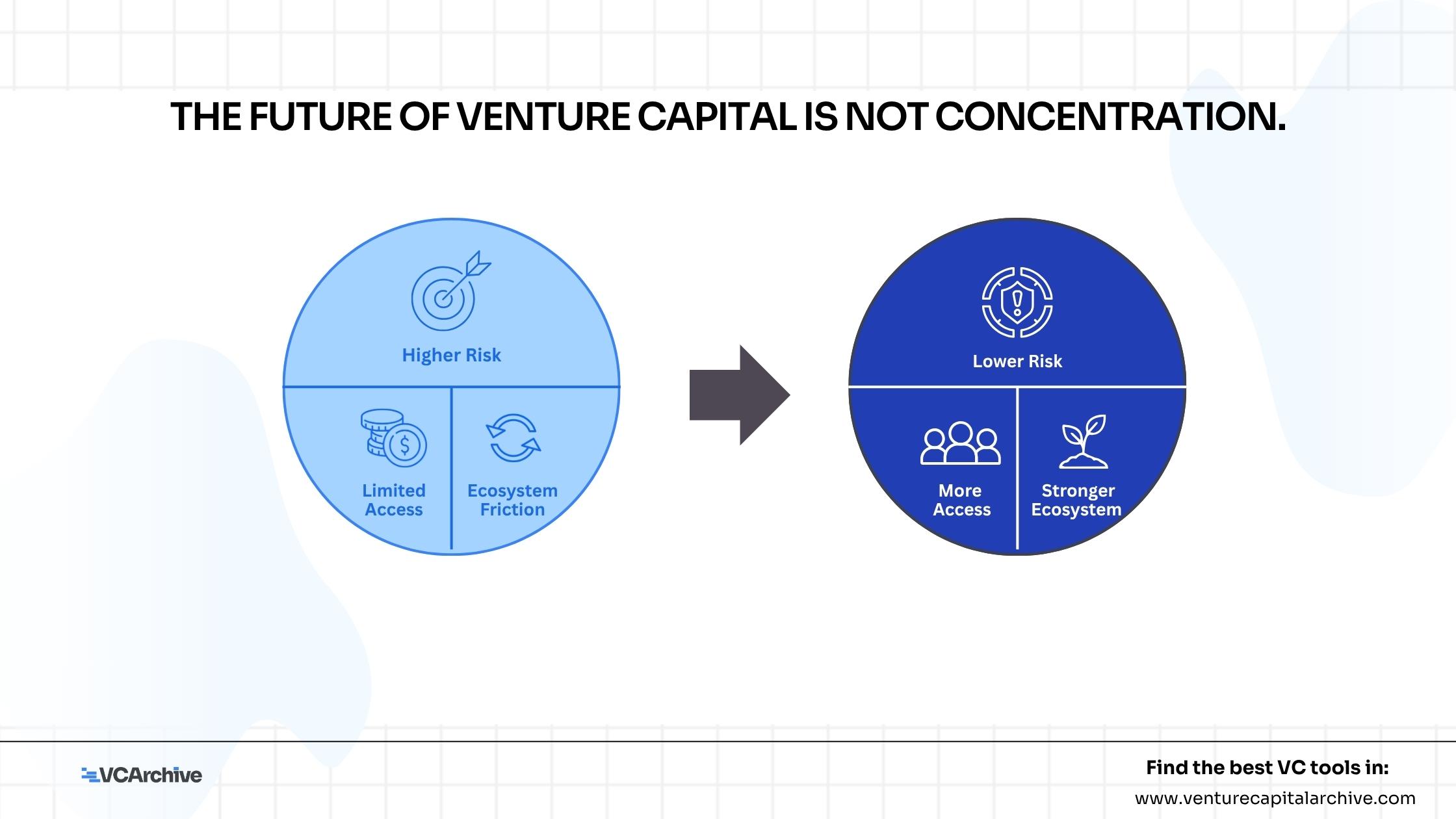
It Is Separation.

In a recent LinkedIn Post, Nicolai Rasmussen has diagnosed venture capital’s structural failure with unusual precision. The math is broken, the returns don’t justify the risk, and the asset class needs to change. He is right on all three counts. But the prescription most funds will reach for — concentration, studio-style control, fewer bigger bets — is the wrong operation for the right diagnosis.
Where Nicolai Is Absolutely Right
Let us start with what the data actually says. Venture capital, as an asset class, demands a return somewhere north of 20% per annum to justify what LPs are absorbing: a decade-plus lockup, illiquidity that would embarrass any other institutional allocation, and a risk profile that by definition concentrates in the highest-failure-rate stage of company building.
The reality, as Rasmussen documents it from lived experience managing five funds at Morph Capital and from years of LP analysis alongside his colleague Thorbjørn Rønje, is a long tail of funds sitting at 1x DPI seven or eight years in. The well-performing outliers might reach 2.5–3x MOIC — translating to net IRR in the low-to-mid teens. Below the hurdle rate. Below what the risk demands. Below what any clear-eyed LP should accept.
Capital raised from a position of proof is worth more than capital raised from a position of hope. The same logic applies to fund returns.
The root cause, Rasmussen argues, is structural passivity. Funds take small positions, maintain arm’s-length relationships with portfolio companies, and wait for the market to do the work they should be doing. His conclusion — that the winning model involves larger ownership, deeper involvement, and closer proximity to what venture studios and private equity actually do — is directionally correct.
His best-performing fund contained two build cases. 6x MOIC. 43.3% IRR. That is not a coincidence. That is the data telling you something.
The Mistake Most Funds Will Make
The problem is the obvious interpretation of Rasmussen’s thesis will lead the majority of funds in exactly the wrong direction.
If the lesson is “be more like a studio”, the implementation will look like this: fewer companies, larger cheques, internal operating teams, deeper involvement at board and operational level. And while some of these instincts are healthy in isolation, the combined effect creates a different kind of structural problem.
The studio model is not a fund model.
Studios are built around operational leverage — internal teams, shared infrastructure, continuous involvement from the earliest moments of company formation. They require a fundamentally different organisational design, a different LP relationship, a different cost structure, and a different risk profile. Attempting to retrofit this onto an existing fund architecture is not evolution. It is a category error that introduces operational complexity, LP friction, and mandate confusion simultaneously.
Concentration, specifically, carries its own dangers. Fewer bets means each bet carries more weight. More weight means more pressure. More pressure, in a high-failure-rate asset class, means more catastrophic downside scenarios when things go wrong — as they will. Diversification is not a weakness of the VC model. It is the structural response to irreducible uncertainty about which bets will hit.
The answer to passive investing is not to become an operator. It is to build a layer between the capital and the execution.
The Better Answer: Separation, Not Transformation
The model that actually solves Rasmussen’s diagnosis does not require the fund to become something it was not designed to be. It requires something to be added alongside it.
The distinction matters enormously. Not replacement. Not transformation. Augmentation.
Two systems. One flywheel.

The fund stays exactly as it is: a capital allocation vehicle designed to take diversified positions across a portfolio, manage LP relationships, and return capital. That is what it is good at. That is what it should keep doing.
What sits alongside it — the execution layer — is the structural innovation. This is the mechanism through which the fund actually shapes outcomes, rather than observing them from a distance and hoping the founder figures it out.
The execution layer does four things that passive fund participation cannot:
– It reduces risk before it compounds. Most portfolio company problems are not discovered at the board meeting where they become undeniable. They begin as early-stage execution failures — a product that was built for the wrong user, a go-to-market motion that lacks repeatability, a hiring decision that cost two quarters of momentum. An execution layer that is structurally embedded in the delivery process sees these problems in real time, not retrospectively.
– It extends runway without deploying more capital. Startups fail, more often than the narrative admits, not because they run out of money but because they run out of time before they run out of money. Execution inefficiency — rework, bad hires, missed milestones — is the principal runway destroyer. A well-designed execution layer accelerates delivery, reduces rework, and makes the existing capital go further. That is DPI-relevant even before a liquidity event.
– It gives the investor genuine visibility. The information asymmetry between founder and fund is one of the most underappreciated structural problems in venture. Founders control the narrative. Quarterly updates are selections, not pictures. An execution layer that operates inside the delivery process — through structured Tickets, milestone acceptance criteria, and real-time progress tracking — gives the investor access to what is actually being built, not what is being reported.
– It turns a network into an engine. Every fund says it adds value through its network. Almost none of them can demonstrate it in a measurable way. The network-as-value-add promise is informal, inconsistent, and impossible to audit. An execution layer that structures expert involvement — defined deliverables, verified outcomes, measurable impact — transforms passive network access into active, accountable contribution.
Why Separation Is the Design Principle
The reason this model works — and the reason studio attempts to solve the same problem often fail at scale — is separation.
The fund and the execution layer must be structurally distinct. Not loosely separated. Not “related but independent”. Cleanly ring-fenced, with clear governance at each layer.
This matters for three reasons:
- LP clarity. LPs invest in a fund with a defined mandate. Operational complexity that bleeds into the fund vehicle creates conflicts, increases cost, and raises questions about what, precisely, they are invested in. A separate execution layer keeps the fund clean and the mandate coherent.
- Scalability. An execution layer that is embedded in the fund cannot scale independently. One that operates alongside it — with its own infrastructure, its own governance, its own operator relationships — can serve multiple funds, multiple portfolios, and multiple geographies without requiring the fund to grow in proportion.
- Specialization. Running a fund well and running execution infrastructure well are different skills. The general partners who are excellent at pattern-matching early-stage companies, managing LP relationships, and making allocation decisions are not necessarily the same people who should be scoping Tickets, managing fractional operators, and tracking milestone delivery. Separation allows each layer to be staffed, governed, and optimised for what it is actually doing.
The funds that win the next cycle will not be the ones who turned themselves into studios. They will be the ones who plugged themselves into execution infrastructure they did not have to build.
The Pre-Seed Problem Rasmussen Doesn’t Name
There is a dimension of the structural failure Rasmussen identifies that his post does not fully surface — and it is the one that, if corrected, has the most leverage on the returns problem he is describing.
The failure of venture capital returns is not, at its deepest level, a fund-structure problem. It is a pre-seed sequencing problem.
Most portfolio companies enter their seed rounds underprepared. Not because the founders are not talented, and not because the idea is not strong, but because the infrastructure to build execution-grade proof before the round does not exist in a governed, accessible form. Founders arrive at the raise having spent three to six months chasing capital — burning runway, making do with junior hires, and pitching from a position of potential rather than proof.
The “too early” rejection that VCs deliver so routinely is not a judgement on the idea. It is a judgement on the absence of execution evidence. And the cycle this creates — founders need proof to raise, but need the raise to build proof — is the principal reason seed rounds take longer, close on worse terms, and produce the kind of early-stage company that will eventually sit in a fund’s portfolio as a 1x DPI problem at year seven.
The execution layer, applied upstream of the fund’s investment, is the structural fix for this sequencing failure. Founders who arrive at the raise with shipped milestones, paying customers, and a team that has already delivered — and delivered with skin in the game — are not presenting potential. They are presenting proof. And proof closes rounds faster, on better terms, with more investor confidence.
That is not incidental to the returns problem. It is the single highest-leverage point in the VC value chain.
What This Means in Practice
At Execution Capital, this is precisely the model we have built — not as a theory, but as operational infrastructure.
The GNPL (Grow Now, Pay Later) model gives early-stage founders access to senior fractional operators — CTO, CMO, CFO, GTM leads — through a blended 30% cash / 70% equity structure using Venture Capital Interests (VCIs™). The result: approximately 70% less cash burn, without compromising on execution quality.
Every piece of work is scoped as a Ticket: a defined deliverable, acceptance criteria, a timeline, and a settlement event triggered only on verified delivery. No milestone delivered, no payout. The operators are not consultants billing hours. They hold equity-linked positions tied directly to the value they help create.
The VCIs™ are issued at the ecosystem portfolio level — ring-fenced, governed, separate from the core cap table. This keeps the founder’s equity structure clean, gives operators a credible and non-speculative stake in the outcome, and creates the kind of governance trail that investors can audit and trust.
This is the execution layer. It sits alongside the fund — not inside it. It operates upstream of the round — not after it. And it produces exactly what Rasmussen’s analysis demands: portfolio companies that arrive at the raise with proof, not hope.
The Real Shift
Rasmussen is correct that the next generation of funds will be more involved in their portfolio companies’ outcomes. The data demands it. The LP market, as it matures and becomes more sophisticated about what venture capital actually delivers versus what it promises, will demand it even more loudly.
But the winning answer is not to turn VCs into operators. It is to connect them to execution systems that do the operational work they cannot, and should not, try to do themselves.
Capital allocation and execution infrastructure are different disciplines. The funds that recognise this — and separate them cleanly — will outperform the ones that try to merge them into a single, structurally confused vehicle.
The math is broken. Rasmussen is right about that. But the fix is not concentration.
It is separation.
This article was originally published on Medium by Kevin Monserrat and has been sourced here for educational purposes.
More from Kevin Monserrat
No other articles from this author yet. Visit their profile.