
How Startups Grow: The Art (and Science) of Startup Marketing
Great Product, No Growth — What’s Missing?
In the startup world, having a fantastic product doesn’t guarantee success. Marketing isn’t just an accessory — it’s the essential bridge between your product and the customers who need it. While early-stage startups often focus on building their product, they can’t afford to neglect their marketing systems.
Key Data:
- 42% of startups fail because of a lack of market demand or poor communication of their value (CB Insights).
Effective Startup Growth Methods
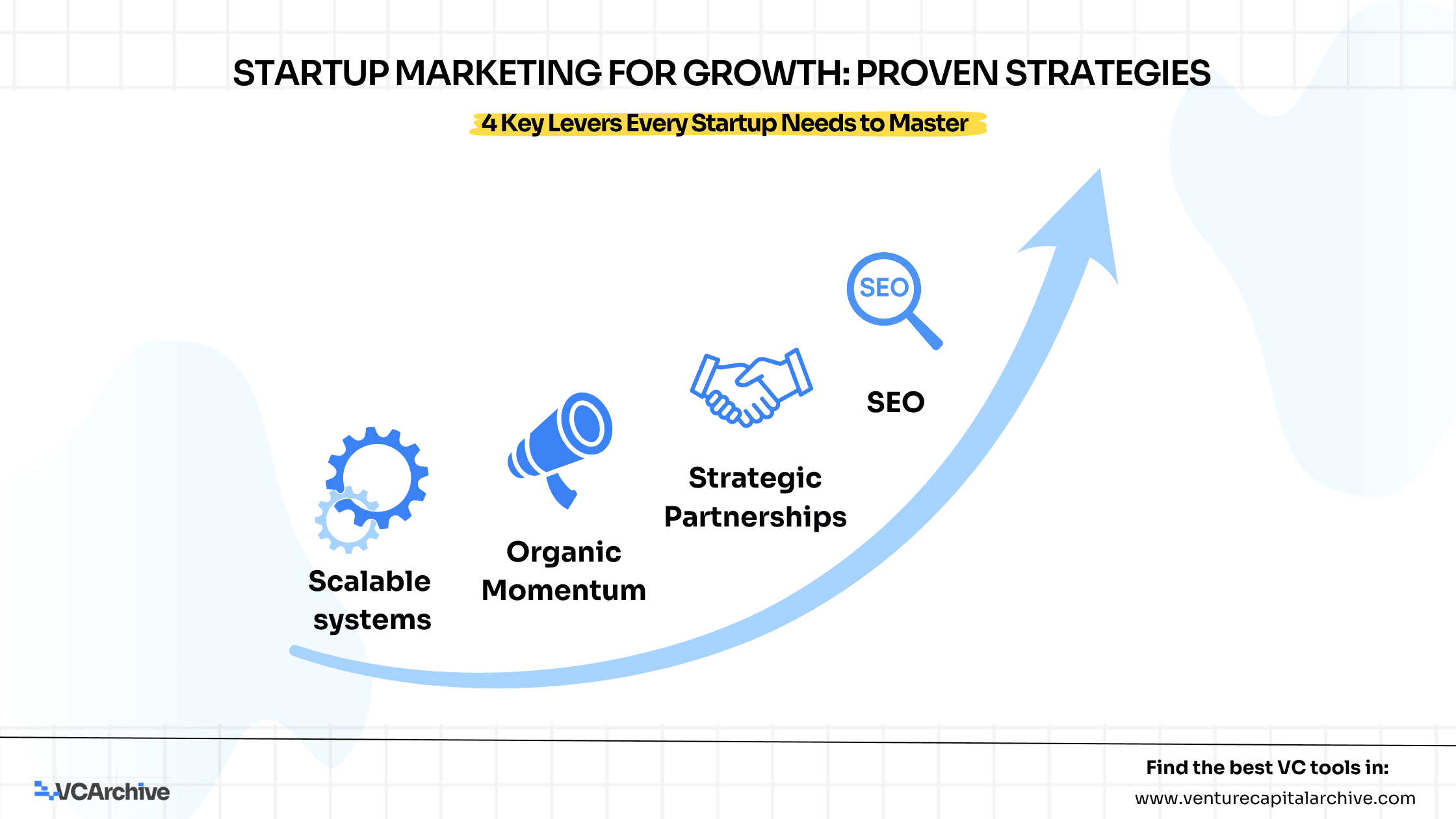
1. Growth Systems, Not Hacks
Startups often focus on “growth hacking” as a shortcut to success, but sustainable growth comes from building well-designed systems that scale over time. Effective growth systems require metrics, retention strategies, and acquisition channels that can be replicated and scaled as the startup grows.
For example, Figma didn’t rely on traditional ads. Instead, they focused on product-led growth by creating educational content, integrating with tools already used by their target audience, and building a community around their product. This approach resulted in $749 million in revenue by 2024, 40% market share in design tools, and 48% year-over-year growth.
Key Takeaway: Building scalable systems for acquisition, activation, and retention is crucial for long-term success.
2. The Power of Organic Growth
Marketing channels that grow organically (without significant paid ads) are often the most powerful in the long term. Content marketing, community-driven growth, and social proof all play a massive role in creating momentum without the heavy reliance on paid media.
A case in point is Notion, which grew organically by focusing on community engagement. Users shared templates, tips, and workflows, creating a viral loop that boosted their user base significantly. By 2024, Notion reached 100 million users, with 95% of its growth coming from organic channels. This led to a $10 billion valuation.
Key Takeaway: Building community-driven marketing and providing users with value can lead to exponential organic growth.
3. Partnerships and Collaborations
Startups can scale rapidly through strategic partnerships. Instead of spending money on ads, partnering with other businesses or communities can drive visibility and expand your reach without direct spending.
Look at Airbnb, the company initially partnered with Craigslist to cross-post listings, gaining massive visibility without spending on ads. This strategic partnership helped them raise over $6 billion in funding and reach a $100 billion valuation by 2021.
Key Takeaway: Strategic partnerships can be a high-impact growth method when done correctly, amplifying your product’s exposure.
4. SEO: The Power of Long-Term Growth
Search engine optimization (SEO) is one of the most cost-effective methods for startup marketing. High-quality content, optimized for search engines, can attract organic traffic for months or years after publication. Unlike paid ads, SEO builds compounding value over time.
Many startups overlook SEO, focusing on ads instead. However, businesses that prioritize content marketing and SEO often see consistent, sustainable traffic. Investing in SEO early can lead to steady traffic and long-term growth without recurring costs.
Key Takeaway: Investing in SEO early can pay off long-term by bringing in steady traffic without recurring costs.
Conclusion: Marketing as a Strategic Tool for Scaling Impact
Effective startup marketing isn’t about spending large amounts on ads. It’s about building systems that drive long-term growth. From growth systems to community-driven strategies and strategic partnerships, successful startups are those that understand their market, build authentic trust, and scale efficiently.
This is just the first chapter in understanding how startups grow. In the next edition, we’ll explore four more growth levers that reveal how the best startups turn strategy into scale.
Subscribe to the Venture Capital Archive newsletter to stay ahead and discover more insights from the next wave of startup growth strategies.