Branding for venture capital versus startups
My agency gets these two calls in one week. First, a Series B Software-as-a-Service (SaaS) startup burning through its 18-month runway, desperate to differentiate before its next fundraising round. Then, a mid-sized venture capital (VC) firm managing $500 million, struggling to stand out in a deluge of “value-add investors.”
VCs and startups live in the same ecosystem, attend the same conferences, get the same newsletters, and often, share the same existential dread about standing out. Yet despite their similarities, they follow different rules because they sell different products.
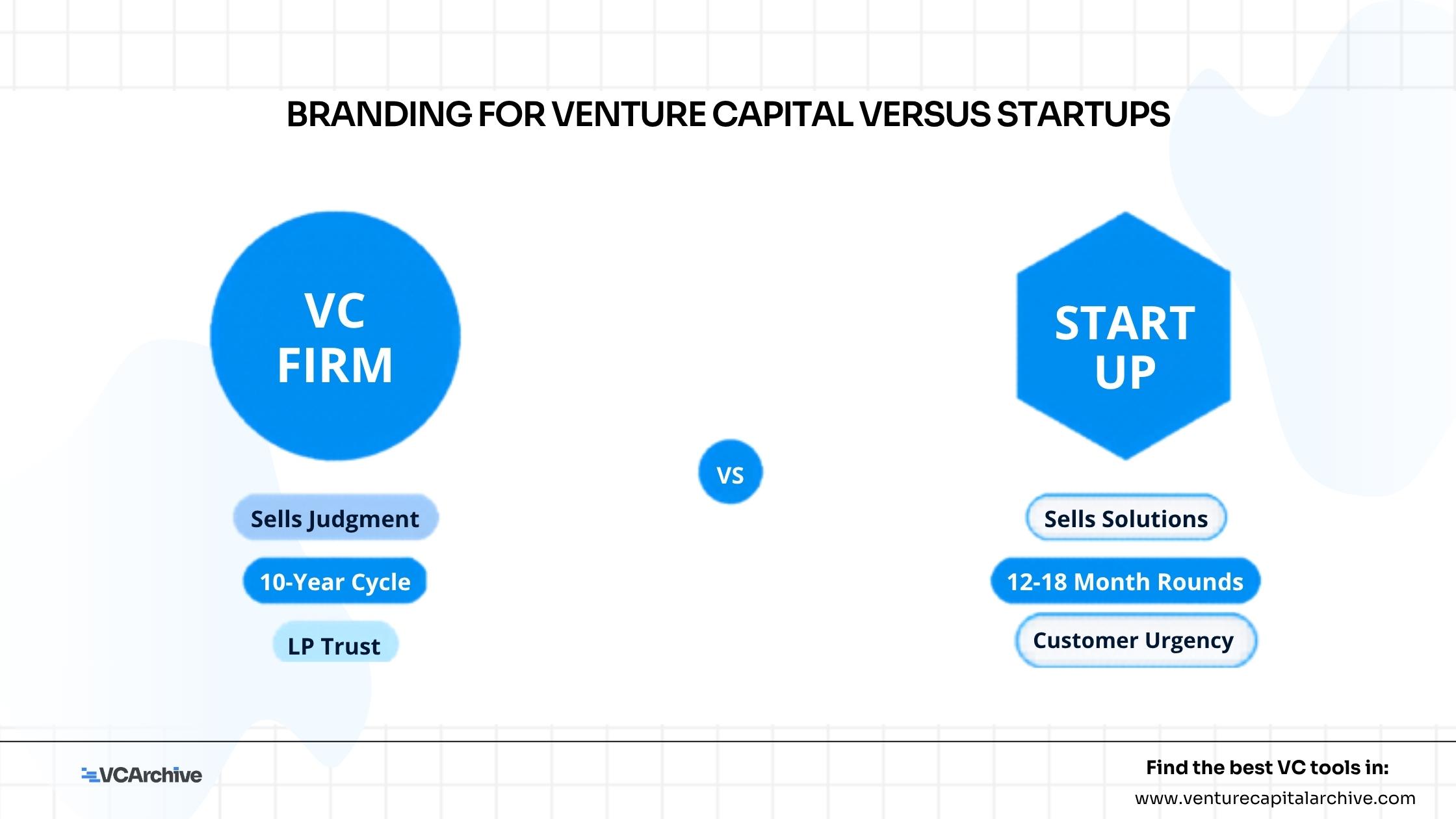
VC firms sell judgment. Their product is their ability to identify and support successful companies and sell to their customers—limited partners (LPs)—who commit for a decade, trusting the firm’s capacity to see what’s around the corner.
Startups, on the other hand, sell ideas made into solutions. Their product solves a real problem for real customers right now.
VC challenges
In VC branding, there’s something no one likes to say: Most VCs sound exactly the same. With fierce competition for the best deal, founders have never had more options. According to the NVCA 2025 Yearbook, 3,111 U.S. VC firms closed 14,320 deals totaling over $215 billion.
When a portfolio company succeeds, how much credit can VCs take? The founder built the company. The team made it run. VCs overclaiming credit look tone-deaf, yet saying nothing makes them (and their value) feel invisible.
Meanwhile, high-impact support like resolving cofounder conflicts or giving brutally honest, business-saving tactical advice happens behind closed doors.
LP relationships take years to cultivate. Staying relevant and maintaining visibility for years without chasing trends requires building brand awareness and authority through content and thought leadership, rather than flash-in-the-pan viral content.
3 VC branding actions
1. Write what’s worth reading
Bessemer Venture Partners’ Roadmaps and state-of-the-cloud reports are essential because they’re useful. Months of research distilled into genuinely valuable frameworks end up on the radars of portfolio companies and competitors.
2. Tell real stories
As a VC, your best marketing is when a founder says: “They made three intros that completely changed our trajectory,” or “They talked us out of a disastrous hire,” or “They were the only ones there for us during our near-death experience.”
Ultimately, your firm’s brand should answer this question: “What will we actually do for founders when things get hard?”
3. Show don’t tell
In short, prove your expertise and value. Do you help founders with recruiting? Show them your recruiting platform. Great with strategy? Publish your frameworks.
Startup branding challenges
A cruel irony: Startups need a sophisticated branding strategy when they can least afford it.
A pre-seed company with $500,000 in the bank and six months of runway must convince customers to trust their vision, employees to leave stable jobs, and investors to wire millions based on a pitch deck and a prototype.
Convincing brand work can include a full website, visual identity and strategy, and a positioning and messaging framework. Most companies have only $20,000 allocated to these aspects, if lucky.
According to CB Insights, 35% of startups fail because the market didn’t need their offer. A fintech startup may launch as “Stripe for crypto,” rebrand as “the infrastructure layer for Web3 payments,” only to pivot again to “embedded finance for vertical SaaS.”
Each pivot fragments brand equity.Agile startups must maintain strategic brand consistency (mission, vision, values) while remaining flexible in other areas (positioning, messaging, product naming).
3 startup branding actions
1. The early-stage founder-led story
In the early stages, founders are the brand. Patrick Collison was Stripe. Brian Chesky was Airbnb. This works because it’s truthful and efficient—founders are creating content anyway, and people are much more likely to back other people rather than faceless committees.
2. One focused message
Mentioning every feature and use case can make some brands forgettable. In contrast, the memorable Slack is “where work happens,” and Notion is an “all-in-one workspace.” Not “an AI-powered collaborative workspace including project management, documentation, and knowledge base features.”
3. Lean into strategy for flexibility
Protect your brand’s fundamental parts (mission, values) fiercely and allow everything else to evolve with growth. Many startups do this backwards, changing their mission statement every six months while clinging to years-old messaging.
VC versus startup branding
Timelines
VCs operate on 10-year fund cycles. By the time Fund III closes in 2032, your brand will need to have demonstrated a decade of consistent performance.
Startups operate on funding rounds, usually with 12 to 18 months between raises. This creates a different kind of pressure: The messaging launched today must drive acquisition now, and yet in six months, your confident brand refresh may be irrelevant.
Metrics
VCs measure brand success through LP commitment rates, inbound deal flow quality, and fund performance. A VC may not know if a campaign worked until their next fundraise three to four years later.
Startups measure brand success through customer acquisition cost, brand awareness, job applications, investor conversion, and sales cycle length. These play out in weeks, not years.
Budgets
In VC marketing, the budget remains consistent year over year because the goal is consistent visibility, not campaign spikes.
Startup marketing budgets look completely different, as front-loaded budgets drive quick awareness and growth. According to DataDab’s SaaS marketing analysis, pre-product market fit companies often spend 100% or more of their revenue on marketing, while post-product market fit startups may decrease it to 30–60%.
Identify your rules
VCs and startups solve the same problem: Building trust in uncertain places. LPs committing $50 million to a VC for 10 years is a sign of trust. Customers bestowing a startup with their data also represents a form of trust. They just prove it differently.
VCs build trust through judgment in exits and returns, while startups use product quality and more immediate customer outcomes. Despite having different timelines, budgets, audiences, proof points, and rules, they operate within the same ecosystem.
So the question is: Do you know where you stand? And which rules are you playing by?
This article was originally published on Fast Company by Daria Gonzalez and has been sourced here for educational purposes
More from Daria Gonzalez
No other articles from this author yet. Visit their profile.