
Bad VC
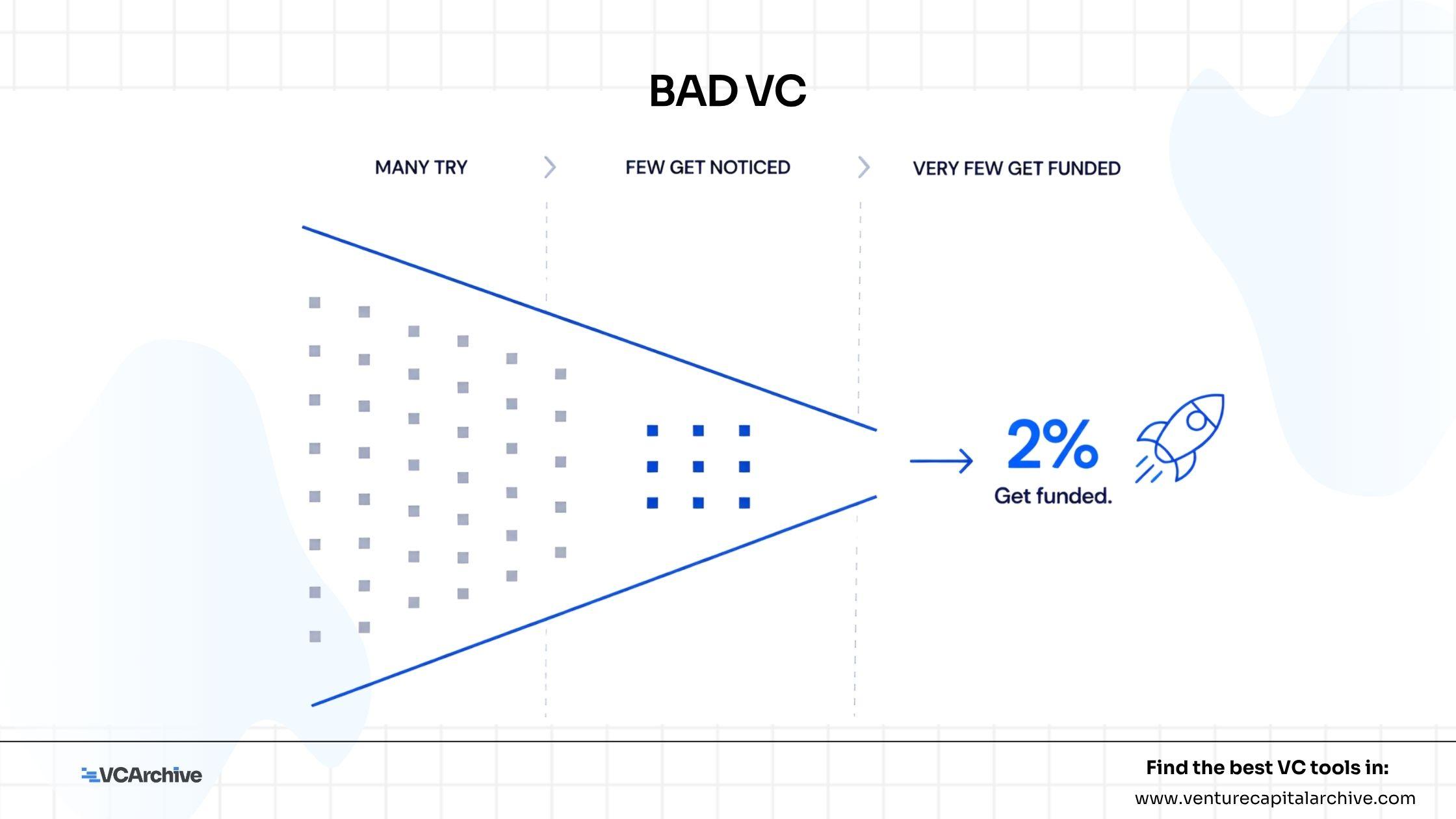
I am writing this on behalf of every entrepreneur who has had the guts to start a business and raise venture capital. Anyone who says that raising money is easy simply has not endured it. There is a notion that Asia is awash with venture capital. We see the headlines that billions are being poured into startups from Beijing to Singapore and everywhere in between. The reality is that most of that venture capital goes into very few late-stage companies that are on a clear path to success. At any given moment, there are hundreds of thousands of startups that need venture capital. However, only 2% will get it. Let me begin by saying that I don’t think every idea or founder deserves to be funded by venture capital. Raising money is a rite of passage and a very important filter in the startup game. That said, why is the process of raising venture capital so miserable?
I estimate that I had at least 150 investor meetings over the life of my startup. That is under 20 per year, so I am being conservative. Although my company raised tens of millions of dollars, more than 95% of investor meetings did not result in an investment. Those are generally the odds most startups face. At a certain stage, my co-founder and I could usually determine whether an investor was serious within a few minutes. Nonetheless, we had a policy that we took 100% of meetings because you never know where one may lead. I saw a lot of bad behavior from investors over the years. This included disappearing after signing a term sheet (you know who you are), sharing confidential documents from our data room with a competitor (you definitely know who you are), and colluding with other investors on price (yeah, I am talking to you). I could list ten more examples of bad VC behavior. However, it’s a seemingly benign characteristic that seems to run deep in so many VCs in Asia. That characteristic is a lack of empathy. Empathy deficiency is what really makes Asia’s venture capitalists special… and not in a good way.
If you ask founders what quality they most value in a shareholder, it’s empathy. Why empathy? Because startups are hard. More days than not are difficult and come with a unique set of challenges. Entrepreneurs need investors that understand that firsthand and will have their back during tough times. Waking up to find out your best engineer has resigned, your product broke overnight, and you can’t pay your rent next month is the norm. Anyone who runs a company knows exactly what I mean. To be truly empathetic, an ideal investor needs to have experienced these trials firsthand. In Asia, we simply have not gone through enough cycles of entrepreneurs having successful exits and then moving to the other side of the table. While we see more entrepreneurs in the US become venture capitalists, it remains uncommon in Asia. When I was in a venture capital meeting, I was usually sitting across the table from a financial investor who had never been in my shoes. Venture capital firms in Asia are teeming with Excel jockeys who ask the same set of unimaginative questions. What sets the good VCs apart from the bad is empathy. Empathy, empathy, empathy.
Your time is not more valuable than ours
We are busy trying to build a business. Don’t waste our time. Sending a WhatsApp to cancel a meeting twenty minutes after the said appointment should have started is not cool. Asking for a meeting then spending it buried in your phone is infuriating. Taking a meeting only to say at the end that you do not invest in my industry is mind-numbing. That would have been so good to know an hour ago. While the investment may be 1% of your portfolio, always remember that it’s 100% of the entrepreneur’s. Time is an entrepreneur’s biggest asset. Be respectful of it. It is no less important than yours.
Get out of the spreadsheet
Let me let you in on a little secret. The startup is not going to execute the five-year forecast you are looking at. Both the startup and the market will go through five iterations by lunchtime. Spend your time on the bigger picture and not row 39 in the spreadsheet. It is incredible how little time is spent in VC meetings actually talking about strategy and opportunity, and instead debating why the LTV discount rate is only 10%. Open your minds and leave the forensics for at least the second meeting.
Make a decision
The vast majority of VC interactions are one-way. You ask for information, you take the information, and then there is a deafening silence. Say yes, no, or maybe. It’s not that complicated. You need to understand the interaction is always on the entrepreneur’s mind, even though it may no longer be on yours. Sending information to a venture capitalist and later wishing you hadn’t is something every entrepreneur can relate to. The regret feels like eating McDonald’s. If you could do it over, you wouldn’t. If I had a dollar for every VC who thinks zero feedback is acceptable, I would have had the biggest liquidity event in Asia. Take the one minute it takes to let the entrepreneur know where you stand. If you don’t, they will never forget it.
In conclusion, the startup you treat like a donkey today could be tomorrow’s unicorn. If you don’t want to be on the sideline watching, then up your empathy game. You can’t fake it. Empathy is everything, so ignore it at your peril. Your industry needs you to do better.
This article was originally published on Medium by Mikaal Abdulla and has been sourced here for educational purposes.
More from Mikaal Abdulla
No other articles from this author yet. Visit their profile.