30 Best Active Space & SpaceTech VCs in 2026
Start with your phone.
Right now, your phone knows exactly where you are. It knows the traffic on your route home, the weather in three hours, whether your flight is delayed, and approximately how much the package on your doorstep weighs. None of that works without space.
The global space economy was valued at $626 billion in 2025 - roughly double its size a decade ago — with the commercial sector accounting for approximately 78% of the total. That number includes satellite communications, Earth observation, navigation, and the infrastructure underneath all of it. But it does not capture the full picture of what space is actually doing to the world economy, because most of what space enables never appears on a space company's balance sheet. It appears on yours. Every time you order something and it arrives on time. Every time a farmer makes a planting decision based on soil data captured from 400 miles up. Every time a cargo ship avoids a storm it saw coming three days before it hit.
Space is not the future of technology. It is the operating system that the present is already running on. Most people just do not know it yet.
How we got here: the cost collapse that changed everything
The story of commercial space is fundamentally a story about what happens when the cost of reaching orbit falls by 95% in a decade.
Launch costs have fallen 95% over the past decade, while satellite constellations continue to expand rapidly. SpaceX completed 134 launches in 2024, capturing over 50% of global commercial launch market share and establishing a pricing ceiling that all competitors must now operate under.
That cost collapse unlocked everything else. When getting to orbit was expensive and rare, only governments could justify the investment. When it became cheap and routine, every industry that depends on data which is all of them, suddenly had a reason to look up.
The industry is now operating at industrial tempo. There were 329 orbital launch attempts globally in 2025, with 321 reaching orbit, and a record 4,517 satellites deployed in the same year. Commercial operators dominated both launch and satellite ownership, reflecting how strongly space has shifted from episodic missions to continuous capacity expansion.
That is not a space story. That is an infrastructure story. And infrastructure stories, when they compound at this scale, produce some of the most durable investment returns in economic history.
The three forces driving the next decade
1. Defence spending is rewriting the economics
Global government space spending hit $135 billion in 2024, with defense applications accounting for 54% of that total and growing faster than civil programs. The US Golden Dome missile defence initiative alone authorised a $25 billion initial investment. ESA's record €26 billion budget for 2026 to 2028 is up approximately 30% from the previous cycle, and NATO member states are increasing sovereign space capabilities at a pace that has no precedent in peacetime.
What this means in practice: space companies that can serve government customers have a revenue base that is durable, growing, and largely immune to economic cycles. The funds on this list that understand how to help a startup navigate government procurement are not just providing capital. They are providing an unfair advantage.
2. The data economy is moving upward
Every major technology trend of the last decade; AI, autonomous systems, precision agriculture, climate modelling, supply chain resilience requires data at a scale and resolution that only satellites can provide. Future projections suggest the global space economy may grow to as much as $2 trillion by 2040, driven by private companies taking the lead on innovation through increased investment and strategic collaboration between commercial and government entities.
The companies building the data infrastructure of the next decade are not all in Silicon Valley. Many of them are building satellites, ground stations, and the processing pipelines that turn raw orbital data into actionable intelligence. That category did not exist as an investable asset class fifteen years ago. Today it is one of the most important.
3. The composition of venture capital in space has fundamentally shifted
Venture capital investment in space companies exceeded $10 billion in 2025, recovering from the post-SPAC correction of 2022 to 2023 and approaching the record levels set during the 2021 boom. But the composition has shifted dramatically. The 2021 cycle was characterised by early-stage SPACs taking pre-revenue companies public at speculative valuations. The 2025 to 2026 cycle is driven by large, late-stage rounds into companies with proven technology, meaningful revenue, and clear paths to profitability.
That shift is the most important signal in the entire dataset. The tourist money left. What remains is conviction capital, funds that understood this category before it was fashionable, that built the domain expertise to evaluate technically complex companies, and that have the relationships to help portfolio companies navigate the particular combination of government, commercial, and international dynamics that define this market.
What most people still get wrong about space investing

Here is the thing that surprises people when they look at this market closely for the first time: the most valuable companies in the commercial space economy are rarely the ones doing the things that get on the cover of magazines.
Rocket launches are dramatic. They are also, increasingly, a commodity. The real value creation is happening in the layers above and below. In the satellites themselves, getting smaller, cheaper, and more capable with every generation. In the ground infrastructure that processes the data they collect. In the downstream applications that turn satellite imagery into insurance pricing models, crop yield predictions, and maritime traffic analysis. In the software that coordinates fleets of spacecraft the way logistics companies coordinate trucks.
Space Capital's Space IQ data closed 2025 with $55.3 billion invested, including $17 billion in Q4 alone across 135 rounds. The acceleration is real. But the sophistication required to identify which companies within that acceleration will generate returns as opposed to which ones will raise large rounds and then struggle to find a profitable business model, is the thing that separates the 30 funds on this list from everyone else.
The founders building in this space face a different set of challenges
Building a space company is not like building a SaaS company. The sales cycles are longer. The technical risks are higher. The regulatory environment spans multiple jurisdictions and requires security clearances that most startup lawyers have never seen. The customer base includes government procurement offices that move on timelines that would make a typical VC's head spin.
And yet the returns, when they come, can be extraordinary precisely because those barriers exist. The moats in this category are real. The switching costs are real. The data advantages compound in ways that software advantages often do not, because satellite data improves with every additional pass over the same geography, and building the ground truth to validate it takes years of operational history that a new entrant simply cannot replicate.
The founders who navigate all of this successfully need investors who have seen the category from the inside. Not investors who read a Morgan Stanley report about the space economy and decided to add an aerospace thesis slide to their deck. Investors who have built satellites, flown fighter jets, run DoD programmes, processed satellite imagery at scale, or at minimum sat on enough boards in this sector to know which failure modes are recoverable and which are fatal.
Where the 30 funds on this list fit into all of this
Every fund on this list made a deliberate decision to build deep expertise in the hardest, most technically complex, most regulatory-intensive, most capital-intensive category in venture capital. Some of them made that decision in 2006, when commercial space was an idea that serious people mostly found amusing. Others made it in 2020, when the cost collapse had already happened but the investment infrastructure to match it was still being built.
What they collectively represent is the most complete picture available of where genuine conviction in this category has been forged and is being actively deployed in 2026.
The list is not a ranking. It is not a curated top-ten of the obvious names. It is the full roster, from the $12 million Washington DC fund betting on dual-use technologies to the $2 billion Menlo Park growth platform making $100 to $400 million concentrated bets on proven industrial tech companies with space exposure. From the first Nordic space fund run by a former Swedish Space Corporation CEO, to the CIA's not-for-profit venture arm, to the former SpaceX VP now writing first checks into European satellite constellations from Munich.
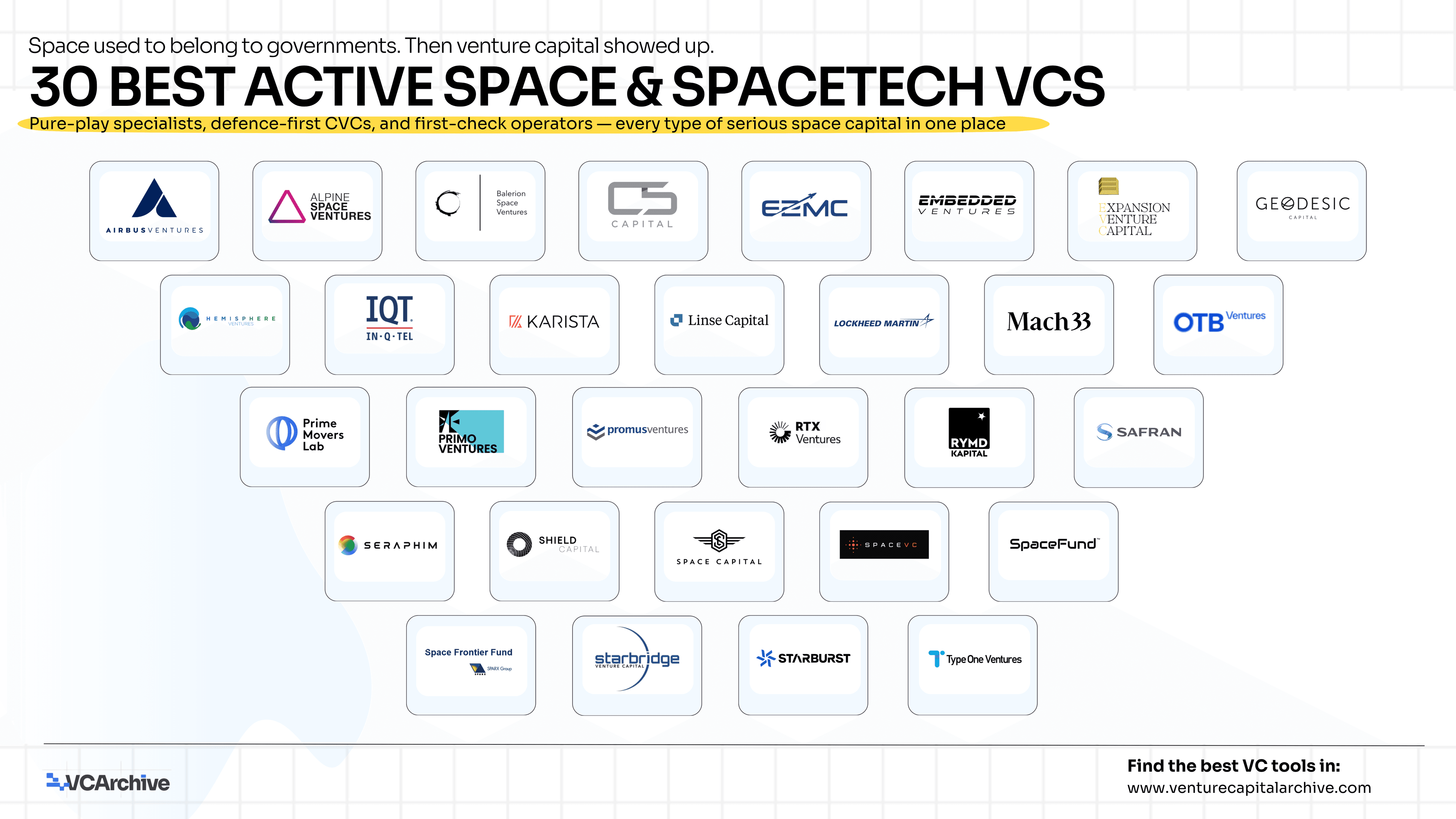
For any founder building in this category or any LP, scout, or ecosystem builder trying to understand where the serious capital lives, the 30 funds below are the starting point. Not because every fund is right for every company, but because knowing the full landscape, understanding the thesis behind each manager, and finding the specific door that fits your specific moment is the only way to raise in a market this specialised.
The space economy is not coming. It is already here, already $626 billion, already doubling every decade, already embedded in every industry that moves, communicates, or depends on knowing where things are.
The only question is who is building the companies at the core of it. The 30 funds below are the ones helping answer that.
30 Best Active Space & SpaceTech VCs in 2026




Rows per page