25 Business Angels Supporting the Next Startup Wave
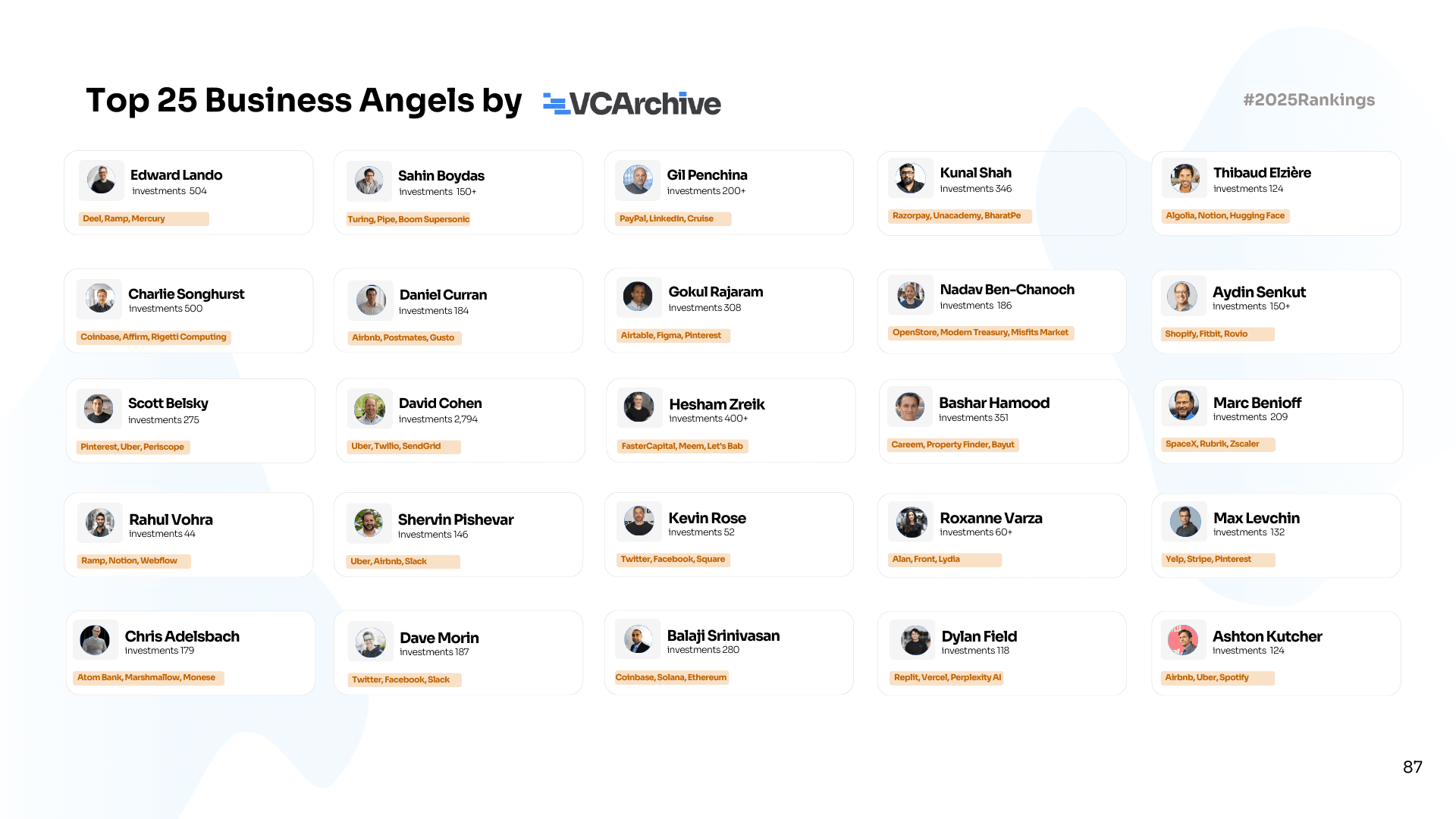
Venture capital raised ~$45B in all of 2025. That's down 75% from the 2022 peak back to levels last seen eight years ago. Meanwhile, $330B was deployed in the same period. Do the math: the industry is running on fumes, spending reserves while the fundraising engine sputters.
In that environment, something quiet has been happening. The angels - the individuals writing $100K to $10M checks out of their own pockets, didn't need to raise a fund. They didn't need LP sign-off. They didn't need a 15-month fundraising cycle. They just... kept investing.
That's the structural advantage nobody talks about enough in 2025.
Why Angel Capital Is Having a Moment
The VCA Annual Report 2025 lays out a market defined by concentration and selectivity:
- First-time fund launches fell 35% YoY - a decade low, as LPs consolidated into proven mega-funds
- Smaller funds (<$250M) continued losing share to $1B+ vehicles where LP capital is gravitating
- Average VC holding period has stretched to 12.3 years, up from 8.5 years in 2019, meaning institutional money is locked up longer than ever
- 52% of 2021-vintage portfolio companies have been stuck without an exit for 4+ years
What this creates is a gap - a real, structural gap at the early stage. The mega-funds are writing $50–500M AI infrastructure checks. The zombie funds can't write anything. The emerging managers can barely close. And the founders building real, non-hyped businesses in seed and pre-seed are left looking for capital from people, not institutions.
That's where the 25 angels on this list live.
The Founder-First Advantage
The most consistent pattern across this year's list isn't geography or sector — it's prior construction. These aren't career investors who learned about startups from a spreadsheet. Almost every name on this list built something first.
A few that illustrate the pattern clearly:
- Rahul Vohra built Superhuman from zero - a product so obsessively crafted it became a cult object among founders. His angel portfolio (Ramp, Notion, Webflow) reflects the same conviction: bet on products that feel magical, spread through PLG, and become indispensable daily workflows
- Thibaud Elzière co-founded Fotolia (acquired by Adobe) and built eFounders, one of Europe's most prolific SaaS studios, producing Algolia, Aircall, and Notion among dozens of others. His investment lens is operational, not financial. He knows what it costs to build a B2B SaaS company because he's done it many times
- Kunal Shah founded CRED and FreeCharge, two of India's most consequential consumer fintech companies. With 346 portfolio companies, he's one of the most active angels in the Indian ecosystem and his check is less about capital than about the signal it sends to other Indian investors
- Dylan Field is still running Figma while actively angel investing in design tools and AI creativity platforms like Replit, Vercel, and Perplexity. His value to a founder isn't just the $100K–$3M check - it's the product intuition of someone who built the design platform that redefined how the world ships software
This pattern matters because the VCA report is explicit: in 2025, the market has shifted from "growth at all costs" to economic proof. Revenue quality, gross margins, and operational leverage now matter more than growth narratives. The angels who built companies through hard stages know what economic proof actually looks like and what's smoke.
Geography Is Becoming an Angel Differentiator
The report shows some of the most interesting early-stage data outside North America:
- MENA is up 145% YoY in VC activity - the fastest-growing region globally
- India is up 56% YoY, with South Asia showing 18% of deals in the $5M–$20M mid-market range - a sign of ecosystem maturation
- European VC outperforms North America on 10 and 15-year net IRR horizons (20.5% vs. 18.0%)
Yet most institutional capital still gravitates to San Francisco and New York. That's exactly where individual angels, with local knowledge, local networks, and no LP geography mandate - have an asymmetric advantage:
- Hesham Zreik (Dubai) has 400+ investments across MENA, Europe, and the US, with a focus on deep tech, AI, and healthtech. He's building in a region where institutional VC is still nascent but sovereign wealth participation is accelerating fast
- Bashar Hamood (Dubai) backs fintech and consumer solutions specifically built for underserved populations across emerging markets, the kind of founder-market-fit that a Sequoia or a16z scout simply can't replicate
- Roxanne Varza runs Station F in Paris, the world's largest startup campus, and backs early European founders from inside the densest startup ecosystem on the continent. Her value isn't the check, it's proximity to 1,000 startups, corporate partners, and the European investor network
- Chris Adelsbach (London) focuses on fintech infrastructure and regulated financial services - a domain where deep regulatory fluency matters more than brand name, and where European banks are systematically looking for innovation
The Ticket Size Signal
One thing the data reveals that doesn't get discussed enough: ticket size tells you a lot about conviction.
Look at the range across this list:

The angels writing $50K–$500K checks are betting on people before products exist. The ones writing $1M–$10M are backing companies that have already demonstrated something. Both have their place but founders need to understand which type of angel they're pitching, because the question being asked is fundamentally different.
What "Active" Actually Means in 2025
The report defines active funds as those deploying capital in the last two years. By that standard, 47.3% of the VC industry is inactive. But angels on this list don't work on that timeline.
What makes the best ones genuinely active isn't just check frequency, it's what they do after the check:
- Scott Belsky (CSO at Adobe, 275 portfolio companies) brings a distribution advantage few angels can match, if he believes in a creative tool, he can route it into Adobe's 30M+ user base
- Balaji Srinivasan (280 portfolio companies) has built one of the most referenced intellectual networks in tech through his writing and podcasting portfolio companies get signal amplification that no LP memo can replicate
- Gil Penchina (200+ investments, 25+ years in VC) pioneered the AngelList syndicate model. His involvement doesn't just mean capital, it means access to a co-investment network that can fill a round quickly
- David Cohen (2,794 portfolio companies via Techstars) has invested in more startups than most institutional funds have seen and his platform offers structured mentorship, peer networks, and brand credibility that a first-time founder actively needs
The Honest Caveat
Not every angel on a "top 25" list is right for every founder. A few things worth knowing:
- Some of the highest-profile names (Benioff, Kutcher, Srinivasan) are better for signal and network than for hands-on operational help. Their portfolios are too large for deep engagement at pre-seed
- The MENA-focused angels (Zreik, Hamood) are exceptional if you're building for emerging markets but add limited value if your GTM is purely North American enterprise
- Angels with product or design backgrounds (Vohra, Field, Belsky) are often most useful for B2C or PLG companies. Less so for deep enterprise or infrastructure plays
The VCA report's observation cuts here too: the market rewards differentiation. The right angel isn't the most famous one. It's the one whose specific scar tissue matches your specific problem.
Detailed profiles of all 25 business angels including ticket sizes, portfolio companies, contact methods, and investment thesis are available at venturecapitalarchive.com.
Research and curation by the Venture Capital Archive team. Data sourced from the VCA Annual Report 2025. All information verified as of 2025.
25 Business Angels Supporting the Next Startup Wave


