25 Active Family Offices in Sweden
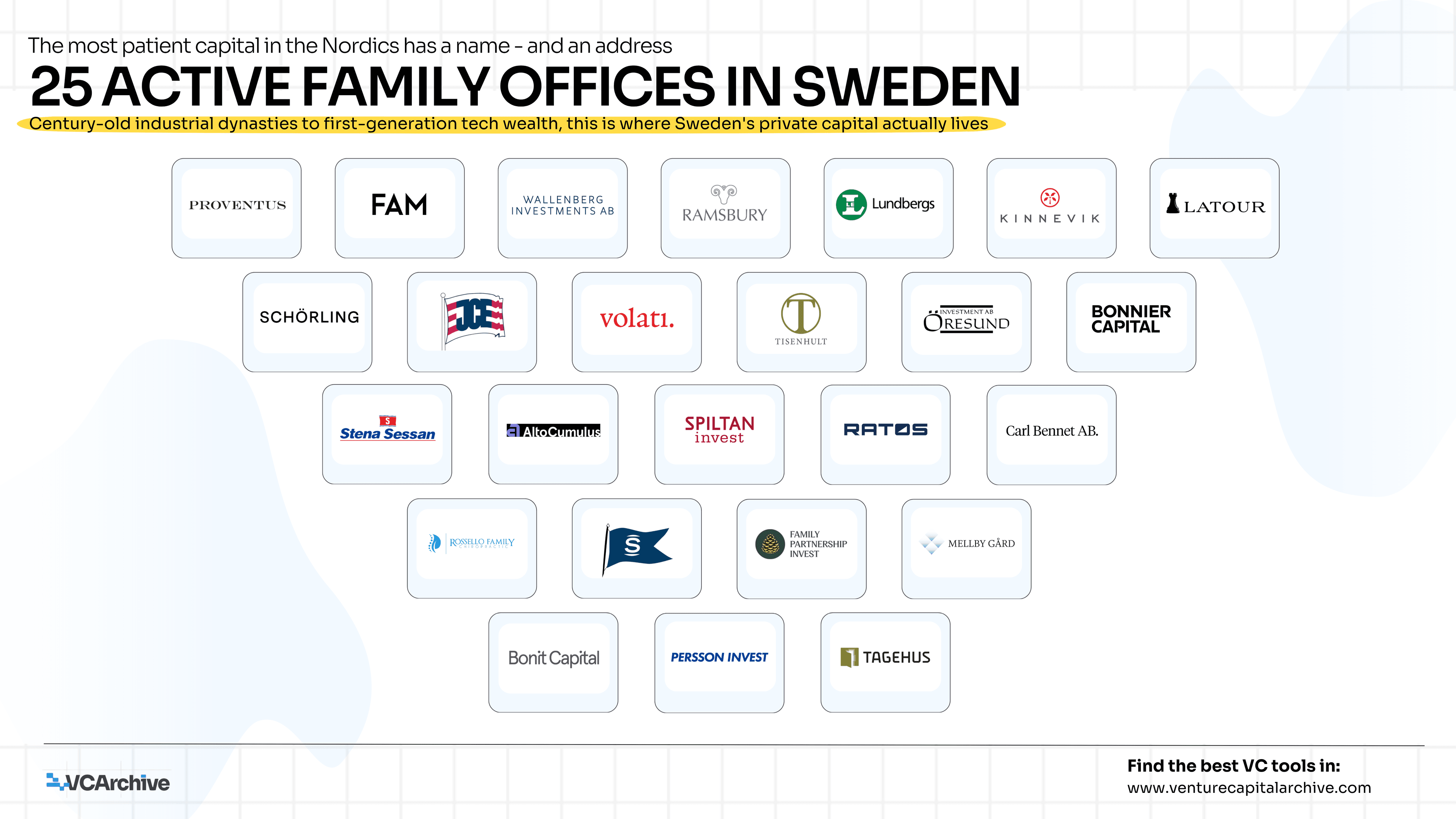
There is a reason Sweden keeps producing billionaires nobody has heard of.
It is not that they are hiding. It is that they genuinely do not care whether you know their name. The Swedes have a word for it- lagom, roughly translated as "just the right amount." Not too much. Not too little. Exactly enough. It is a philosophy that, when applied to capital allocation over a century or two, produces extraordinary wealth almost as a side effect.
Ramsbury Invest, the family office of Stefan Persson and his family, is the largest Swedish family office with assets under management of over €15 billion. You probably know H&M. You probably do not know Ramsbury. That gap between the brand and the capital behind it is a useful entry point for understanding how Swedish family office wealth actually works.
The families on this list built their fortunes by being right, repeatedly, over time horizons that most investors find genuinely uncomfortable. And now, in 2025 and 2026, they are deploying that capital with the same quiet confidence into AI infrastructure, healthcare, climate, and Nordic tech that they once deployed into shipping routes, forestry, and industrial manufacturing.
Three generations. Three completely different animals.
When you look at this list and see Wallenberg, Stena, and Lundberg sitting alongside Kinnevik, Bonit, and AltoCumulus, you are not looking at one category of investor. You are looking at three distinct generations of Swedish private capital and each one plays by a different set of rules.
Generation one built physical things.
The Wallenberg network executed seven private-market transactions in 2025 alone, spanning cybersecurity, AI compute infrastructure, and semiconductors, with its AI Factory initiative now anchoring Sweden's digital-sovereignty strategy. That is a family office operating at the scale of a sovereign wealth fund with the agility of a private investor. Investor AB and FAM hold positions in ABB, Ericsson, AstraZeneca, and Atlas Copco, companies that between them employ hundreds of thousands of people globally. Ticket sizes run from $100 million to $2 billion. This is patient capital at industrial scale.
Generation two translated those industrial fortunes into diversified empires.
Lundbergföretagen spans real estate, forestry, construction, and banking. Stena, built from Dan Sten Olsson's shipping empire, now runs recycling, energy, and property across Scandinavia. Ratos was a conglomerate before conglomerates were fashionable. These are not venture bets. These are businesses owning businesses owning businesses, with time horizons that stretch past the next election cycle.
Generation three reinvented the thesis entirely.
Kinnevik's transformation from consumer internet pioneer to disciplined growth platform shows how Nordic capital continuously reinvents itself while staying thesis-driven. Bonnier Capital is writing cheques into edtech, consumer internet, and healthcare tech. AltoCumulus is deploying into climate, renewables, and sustainable agriculture. They did not abandon their heritage. They composted it into something new.
Understanding which generation you are approaching before you send an email is not background reading. It is the entire job.
The geography tells you something the offices will not say out loud.
Twenty-one of the twenty-five offices are headquartered in Stockholm. Two in Gothenburg. One in Malmö. One in Norrköping. That concentration is not accidental.
Nordic family offices are deploying capital at an unprecedented pace in 2025, with Sweden's industrially-focused investors leading the charge. But the interesting story is not the mega-offices. It is the ones most founders have never encountered:
- Bonit Capital in Stockholm, quietly backing medical technology, life sciences, and digital health with a genuine impact mandate
- JCE Group in Gothenburg, deploying into industrial and marine engineering from a base that most international VCs would not think to look at
- Tisenhult-gruppen in Norrköping, sitting on consumer goods and e-commerce positions built over decades by a family that has never once needed a press release to find a deal
Growing numbers of wealthy Swedish families are pouring money into the impact sector, and Swedes are generally not known for being showy about their wealth or enjoying the spotlight. That cultural trait is part of why Swedish family offices remain so poorly understood by foreign founders and fund managers. They are not inaccessible because they are exclusive. They are inaccessible because they are genuinely uninterested in performing the role of investor for an audience.
What they are actually looking for and where most pitches go wrong.
The conversation you need to earn is not the pitch meeting. It is the one that happens six months before the pitch meeting, when someone who knows the family says your name in the right context. Sweden runs on trust networks that are old, dense, and largely invisible to outsiders.
Here is what consistently separates the founders and GPs who get through from those who do not:
With the industrial offices; Lundbergföretagen, Latour, Ratos, Melker Schörling: Their DNA is in manufacturing tolerances and logistics margins and the kind of EBITDA that does not evaporate when the market turns. Pitching them on a platform business with no clear path to profitability is not just a mismatch. It is a cultural one. Come in with a business that makes or does something real, with the numbers to back it up, and the conversation changes completely.
With the growth and tech offices; Kinnevik, Bonnier, Investment AB Spiltan: The demand is the same discipline in different clothes. Prove you understand your unit economics. Prove your growth is durable, not just a good quarter. Prove you have thought seriously about what happens when the macro turns against you. Kinnevik has backed Zalando and Spotify and has seen every version of the tech cycle. They will not be impressed by a TAM slide.
With the impact and specialist offices; AltoCumulus, Bonit, Proventus: These are probably the most misunderstood offices on the entire list. They are not soft money. They are not writing cheques because it feels good. They are applying the same return discipline to climate and health and culture that the industrial offices applied to steel and shipping. The difference is the sector, not the standards.
The number that puts all of this in context.
Sweden's family office landscape is anchored by Ramsbury Invest at over €15 billion AUM at the top end, with offices like Salénia, Tisenhult, and FPI Group operating at the $5M to $50M ticket range at the more accessible end.
That spread - three orders of magnitude between the largest and smallest offices on this list, is not a quirk of the data. It is the full architecture of Swedish private capital:
- Tier 1 - the dynasties that have been compounding since before the Second World War, deploying nine-figure tickets into positions they intend to hold for decades
- Tier 2 - the mid-generation offices that blend industrial heritage with modern investment structures, operating with more flexibility and faster decision timelines
- Tier 3 - the newer or smaller vehicles that are still defining their mandate, often the most accessible and the most willing to take a first call from someone they do not yet know
For any founder raising in the Nordics, any GP building a fund with pan-European LP ambitions, or any ecosystem builder trying to understand where the durable capital in this region actually comes from - this list is the starting point.
The 25 offices below are not waiting to be discovered. They are waiting to be understood.
25 Active Family Offices in Sweden