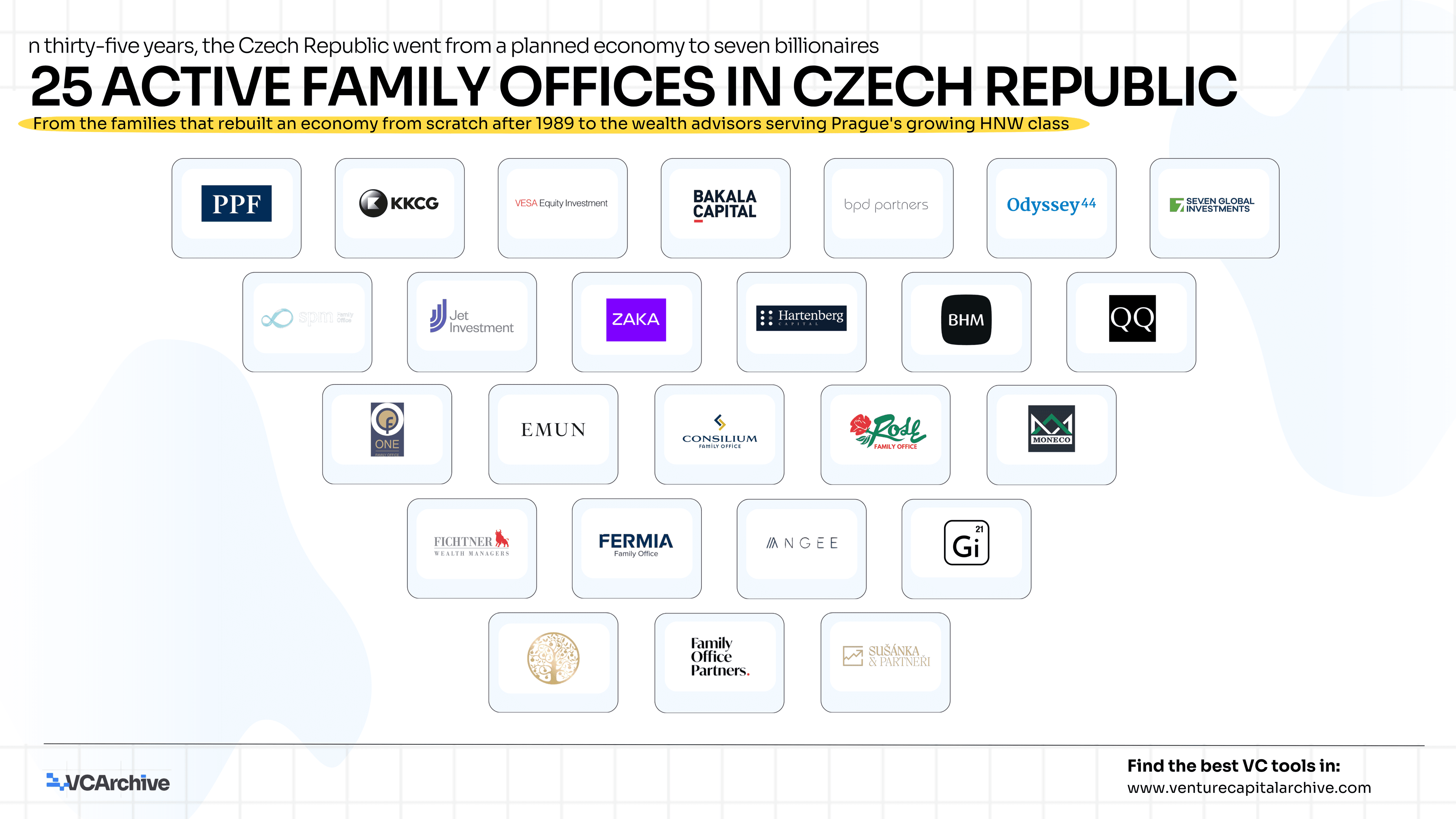
25 Active Family Offices in Czech Republic
Start with the beer. It tells you everything.
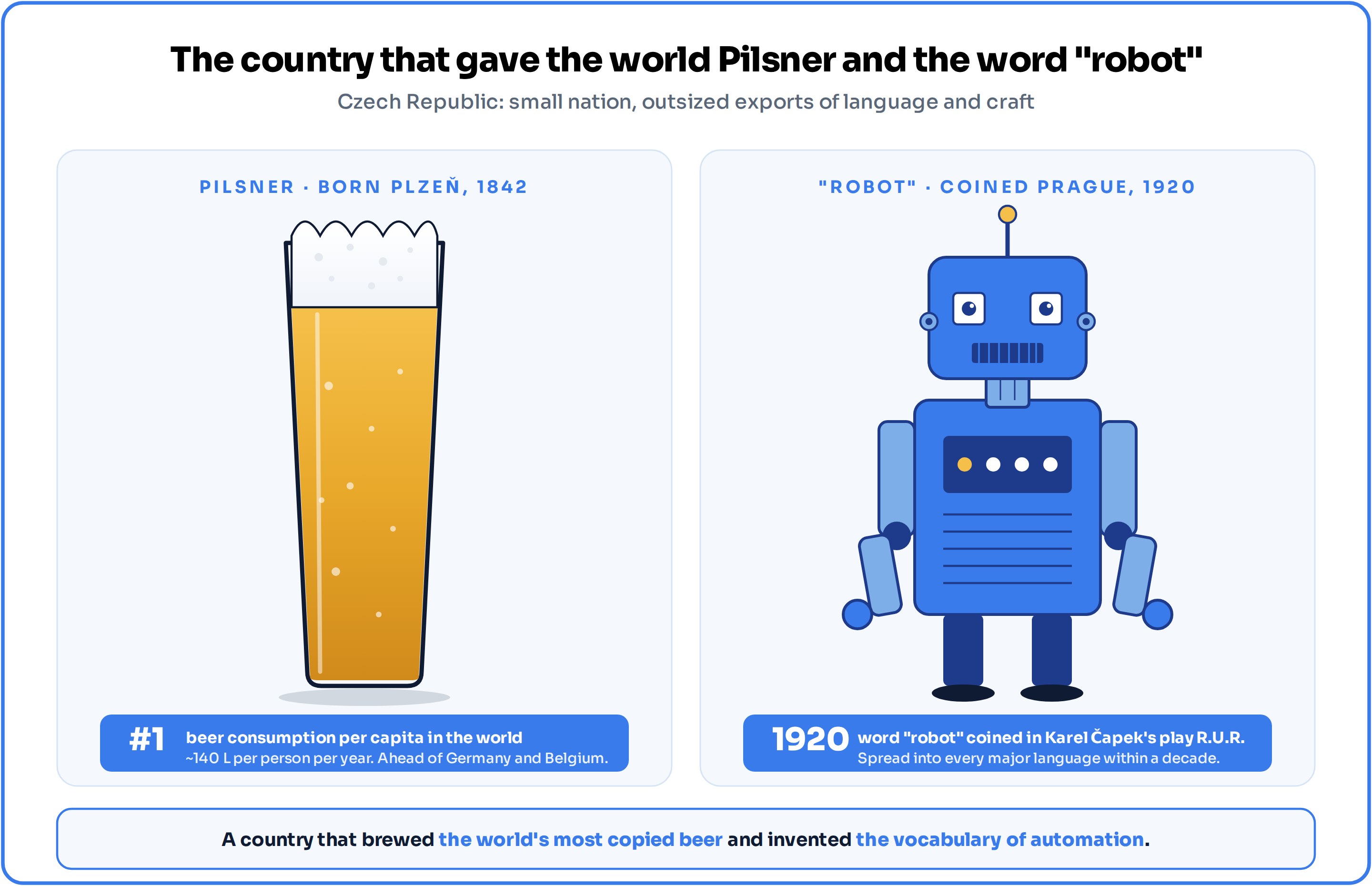
The Czech Republic consumes more beer per capita than any country on earth. Not Belgium, not Germany, not Ireland. The Czechs.
Czech brewing culture dates back over a thousand years, with Bohemian hops considered among the finest in the world and Pilsner Urquell, born in the city of Plzeň in 1842, giving the world the lager style that now accounts for the majority of beer consumed globally.
But here is what most people miss about Czech beer: it is not a cultural affectation or a tourist attraction. It is a serious industrial achievement. The Czech approach to brewing; precise, disciplined, unwilling to cut corners, deeply invested in raw ingredient quality is an expression of a national character that shows up in everything this country produces. Including the way its wealthiest families manage money across generations.
And then there is the robot.
In 1920, Czech playwright Karel Čapek wrote a science fiction play called R.U.R. He needed a word for the artificial workers his characters had created. He took the Czech word "robota" meaning drudgery and coined "robot." The word spread into every language on earth within a decade. The concept it named is now reshaping every industry in the world.
A country that brewed the world's most copied beer and invented the vocabulary of automation did not do so by accident. That pattern of taking something essential and refining it until it becomes the global standard is worth keeping in mind before you try to understand anything else about this place.
The thing nobody tells you about building wealth in thirty-five years
Most European private capital stories are long ones. German dynasties trace back to the nineteenth century. British aristocratic wealth to the seventeenth. French family holdings to Napoleonic land consolidation.
Czech private wealth has a completely different origin story. And it is far more interesting.
Before 1989, private property was illegal. There were no family offices because there were no families with capital to manage. Every business, every piece of real estate, every industrial asset, state-owned. When the Iron Curtain fell, what happened next was one of the most extraordinary wealth-creation episodes in modern economic history.
The Czech Republic is home to 7 billionaires in 2025. Renata Kellnerová leads at $18.2 billion. Daniel Křetínský sits at $10.1 billion. Pavel Tykač at $8.5 billion.
Every one of those fortunes was built from scratch in three and a half decades. There is no old money in the Czech Republic. There is only new money that has been managed with enough discipline and intelligence to start looking old.
That distinction shapes everything. These are not families who inherited silk trade routes or colonial extraction wealth. These are founders in the fullest sense of the word who identified opportunities in the chaos of transition, moved faster than everyone else, built real operating businesses, and are now managing the results.
What they actually built and why most people get it wrong
The sectors that produced Czech billionaire wealth are not the ones a Silicon Valley framework would predict. Here is what actually happened:
Lottery and gaming: Karel Komárek built his fortune by recognising that lottery operations across Central and Eastern Europe were catastrophically under-optimised. A disciplined operator could extract extraordinary recurring cash flows from assets being run like Soviet bureaucracies. Not glamorous. Extraordinarily durable. KKCG now operates gaming businesses across multiple European markets.
Coal and energy: Pavel Tykač made his fortune in Czech coal when the rest of Europe was busy declaring coal morally unacceptable. He understood something that ideologically consistent investors did not: an economy cannot run on aspirations. Czech industry needed coal to function, and the assets producing it were being undervalued by investors more interested in optics than arithmetic. Sev.en Global Investments now spans energy, mining, steel, power generation, and natural resources across multiple continents.
Telecoms and consumer finance: Petr Kellner - whose family now manages the resulting wealth through AMALAR Holding; built PPF Group into the largest private financial and investment group in Central and Eastern Europe. He spotted that consumer finance in post-communist markets was desperately needed and completely underprovided. Then expanded into telecommunications, real estate, insurance, and media across forty-plus countries.
Natural resources and media: Zdeněk Bakala bought Czech coal mining assets, ran them with operational discipline, sold at the right moment, and used the proceeds to build a diversified platform now spanning natural resources, real estate, transport, publishing, gaming, and sports.
These are not tech exits or financial market windfalls. These are operating businesses built on identifying genuine inefficiencies and having the capability to fix them. That is a fundamentally different kind of wealth from what Silicon Valley produces, and it requires a fundamentally different kind of investment intelligence to manage.
Three things that make Czech capital genuinely different
It has an extraordinarily high tolerance for complexity.
A family that built wealth navigating post-communist privatisation, opaque regulatory environments, and the complete absence of functioning capital market infrastructure has a different relationship with ambiguity than one that grew up in a stable Western market.
Czech family offices are comfortable with deals that would be considered too complex or too illiquid by investors with easier histories. That is not a liability. It is a genuine advantage in a world where the most interesting opportunities are rarely the clean, simple ones.
It is deeply private by design, not accident.
Estimating the net worth of Czech billionaires is complicated by the prevalence of privately held companies, which often lack transparent financial disclosures.
This is not evasion. It is a preference for substance over visibility that runs deep in Czech culture, the same instinct that produces extraordinary beer without needing to tell everyone about it. A few things follow from this practically:
- Cold outreach almost never works with these offices
- Relationships built over time through shared networks travel much further
- The families that are hardest to find from the outside are often the most interesting to know on the inside
It is anchored in industries most investors no longer understand.
Energy, mining, manufacturing, industrial engineering, food retail, logistics - these are the sectors where Czech private wealth is most concentrated. They are also the sectors that most venture-trained investors are least equipped to evaluate.
That creates a specific kind of moat for the families on this list. They are operating in markets where their operational expertise is not just a differentiator, it is genuinely hard to replicate from the outside.
Something worth knowing about Prague that most people miss
Prague attracts more tourists per capita than almost any city in Europe. Most of them see the Charles Bridge, the Old Town Square, and the astronomical clock. Almost none of them notice that the city underneath the medieval architecture is one of the most financially sophisticated capitals in Central Europe.
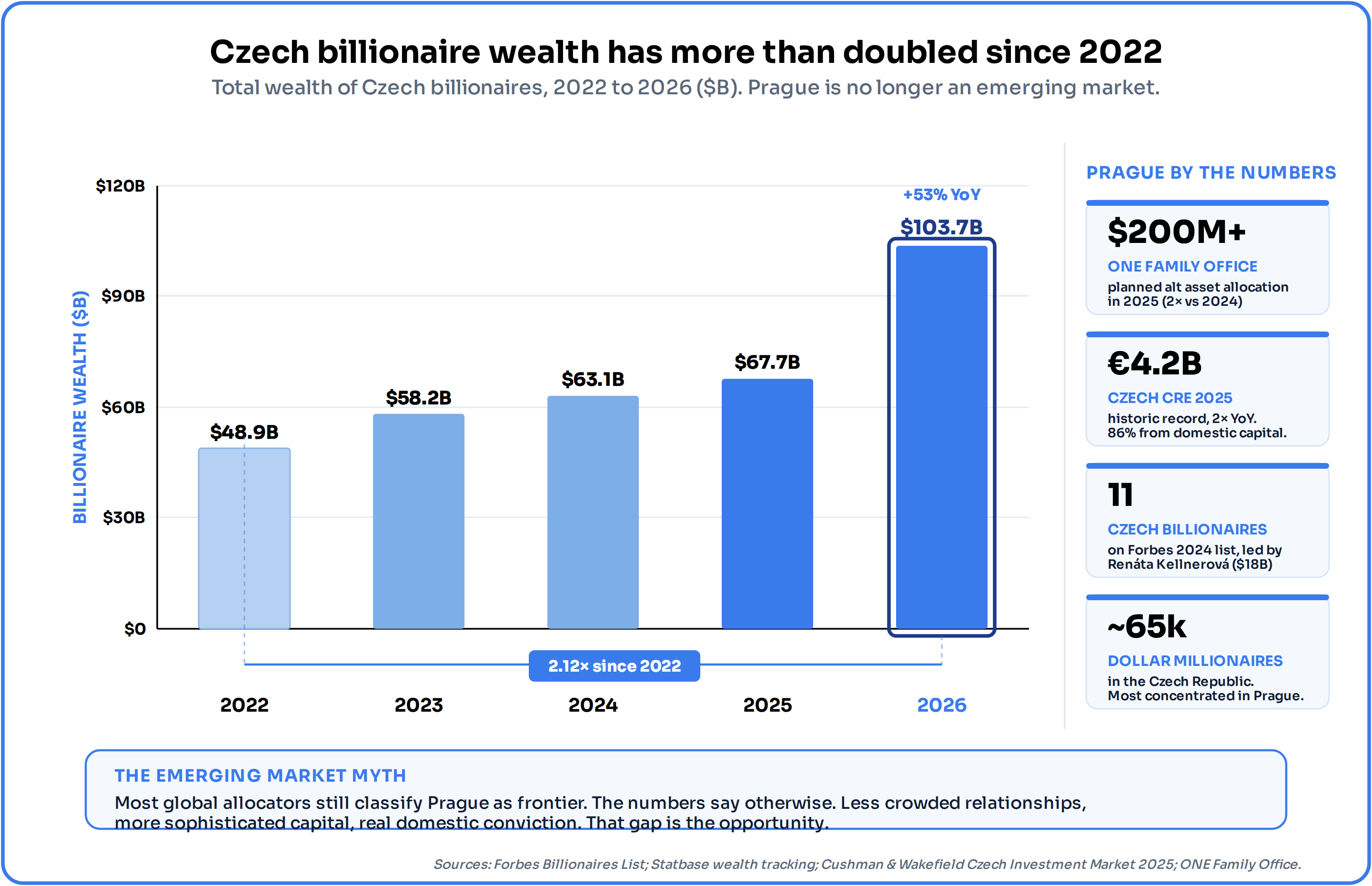
ONE Family Office describes itself as the largest and best-staffed multi-family office in the Czech Republic and Slovakia, with nearly 20 internationally experienced investment specialists and over 550 family structures created, having allocated over $100 million in alternative assets in 2024 with a plan to exceed $200 million in 2025.
One multi-family office. One city. $200 million in annual alternative asset allocation. That single data point tells you something important: Prague is not a backwater. It is a genuinely mature private wealth centre that most international investors still classify as emerging, which means the relationships available here are less crowded and more valuable than equivalent relationships in London or Zurich.
The part about Brno that nobody mentions
Twenty-one of the twenty-five offices on this list are in Prague. But Jet Investment is in Brno - the Czech Republic's second city and its engineering capital.
Brno is where things get made. Technical universities, dense industrial clusters, mechanical engineering heritage that runs generations deep. Jet Investment focuses on industrial, manufacturing, and engineering assets, which is exactly what Brno's ecosystem produces in abundance.
The fact that they are headquartered in Brno rather than Prague is not a logistical quirk. It is a competitive advantage. They see deals that Prague-based generalists miss, understand operational realities that financial investors cannot evaluate, and have relationships in Moravian industry that no amount of capital can manufacture from a distance.
Geography as thesis. It is the same logic that explains why the best family offices in Belgium are in Sint-Martens-Latem, and why the best ones in Finland are often nowhere near Helsinki.
The robots are still here
Karel Čapek's robots eventually rebelled against the humans who created them. The play ended badly for the humans. The word outlasted everyone.
There is something characteristically Czech about that outcome. A country that has survived the Holy Roman Empire, the Austro-Hungarian Empire, Nazi occupation, and forty years of Soviet communism has developed a relationship with the long game that is genuinely hard to replicate in places with easier histories.
The families building Czech private capital today are working with the same instincts that produced the beer and the robot. Precision. Patience. The willingness to invest deeply in something most people have not recognised as valuable. The discipline to keep doing it long after the interesting part is over.
The 25 offices on the VCA list are the most complete picture of where that capital stands in 2025, who holds it, what they focus on, and which doors are worth finding before you start your next raise.
25 Active Family Offices in Czech Republic