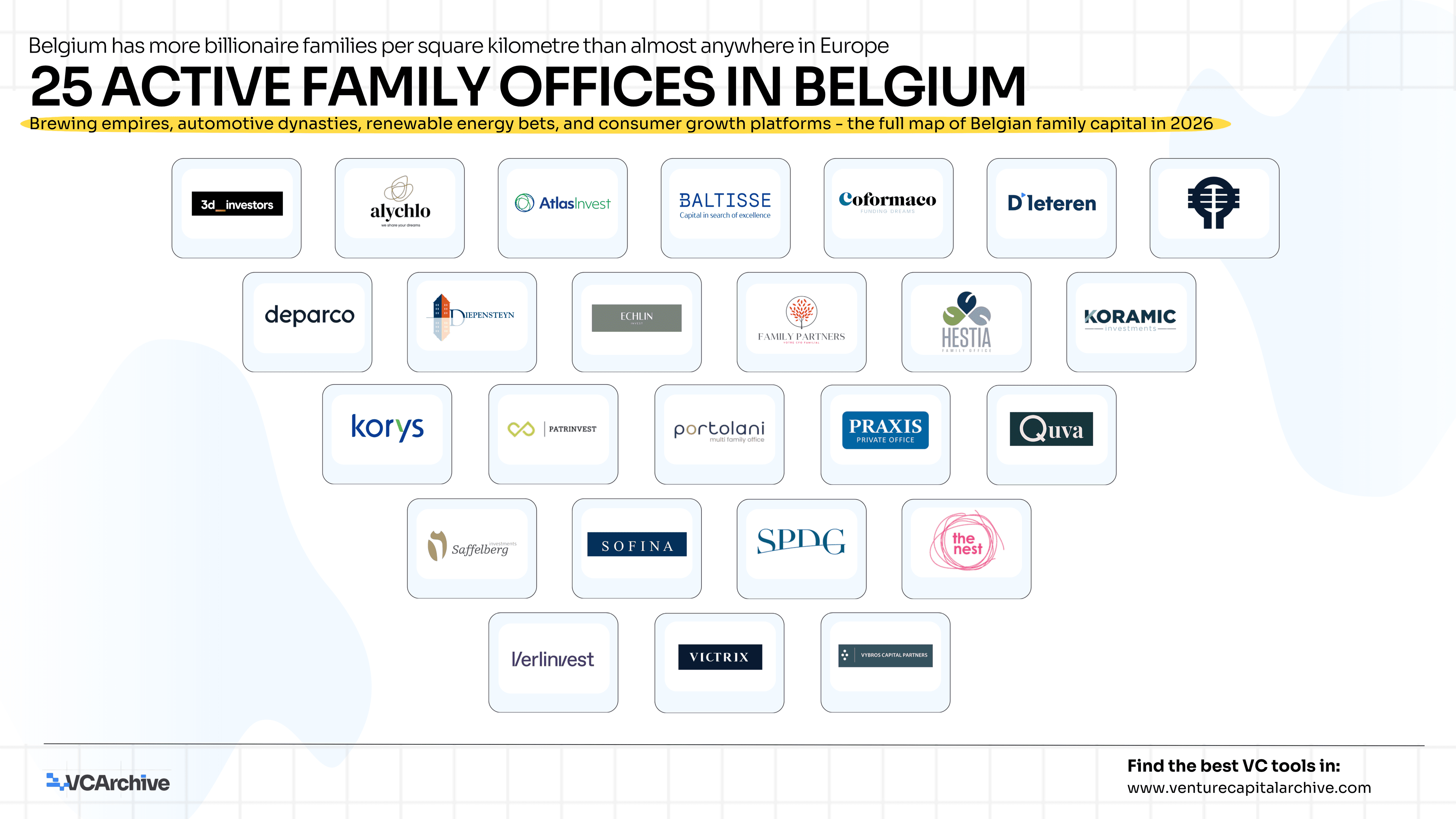
25 Active Family Offices in Belgium
Start with the chocolate. It tells you everything.
In 1912, a Brussels chocolatier named Jean Neuhaus did something nobody had done before. Instead of coating something else in chocolate, he made the chocolate itself the container - filling it with cream, ganache, and nut paste. He called it a praline. Belgium produces approximately 220,000 tonnes of chocolate per year, making it the chocolate capital of the world. Every major supermarket sells it. Every corner has an artisan chocolatier. In Bruges, locals buy their chocolates fresh daily, like other people buy pastries.
That detail matters more than it sounds. A country that treats luxury as routine, that applies centuries of craft to something as quotidian as an afternoon snack, that invented a new food category and then quietly made it the global standard, that country has a particular relationship with excellence, patience, and the long game.
The same instincts that built Belgian chocolate built Belgian family wealth. And the 25 offices on this list are where that wealth lives today.
The country that perfected the art of doing more with less
Belgium is roughly the size of Maryland. It produces over 3,000 varieties of beer, with a brewing culture recognised by UNESCO as Intangible Cultural Heritage of Humanity. It is the birthplace of Tintin, the Smurfs, Art Nouveau, and the saxophone. It hosts the headquarters of NATO, the European Commission, and more multinational corporations per capita than almost any country on earth.
 For a place most people associate with bureaucracy and grey skies, Belgium has a remarkable habit of quietly dominating things.
Private capital is one of them.
The wealth distribution in Belgium's family office market is striking. Fourteen family offices each hold more than €1 billion in equity and together control 59% of all equity. 75% of Belgian family offices report a positive net result. Total reported profit across the sector: €4.4 billion.
And perhaps most tellingly: the median debt-to-equity ratio across Belgian family offices is 0.10x. For every euro of equity, there is ten cents of debt. 54% of family offices have a net cash position. This is wealth built over generations and managed to survive them.
That last sentence deserves to be read twice. This is not leveraged buyout capital or growth-at-all-costs venture money. It is the kind of capital that has survived wars, currency crises, recessions, and the entire history of the twentieth century. Patient almost to the point of stubbornness. Disciplined almost to the point of conservatism. And when it does move, it moves with the quiet confidence of an institution that has never needed to announce itself.
How Belgian family wealth actually got built
To understand the offices on this list, you need to understand where the wealth came from. Belgium's industrial heritage is not glamorous. It is not tech IPOs or hedge fund windfalls. It is generations of families who built something physical, something operational, something that required real expertise and long time horizons to get right.
The wealthiest Belgian, Éric Wittouck, holds an estimated fortune derived from stakes managed through his investment firm Artal Group, originating from the family's longstanding sugar refining business founded in the 19th century. By 2025, his fortune had expanded to approximately €11.5 billion, driven by investments in commodities and international holdings.
Sugar. Not software. Not fintech. Sugar, refined over a century into one of the largest private fortunes in Europe.
That pattern repeats across this list.
- D'Ieteren Group built its wealth on automotive distribution - Toyota, Volkswagen, and the Belron glass repair empire and is now deploying $50M to $500M tickets across a portfolio that has evolved far beyond its origins.
- Diepensteyn Family Office in Londerzeel traces its roots to brewing, with the family's heritage in Belgian beer culture now funding positions in real estate, equestrian sports, and hospitality.
- Koramic Investments in Kortrijk started in building materials and ceramics and has since expanded into renewable energy and diversified holdings.
- Sofina Group in Brussels has been compounding since 1898, with a current portfolio spanning consumer, healthcare, education, and digital transformation across four continents.
These are not investors who discovered capitalism in a business school classroom. They are custodians of wealth built through industrial craft, operational discipline, and the particular Belgian instinct for getting very good at one thing and then quietly using that expertise to get good at everything adjacent to it.
What the geography of this list tells you
Equity is concentrated in Brussels and Flemish Brabant, together accounting for €20.7 billion or 48% of total family office equity. Brussels leads on average size at €852M per office.
But the list below is not a Brussels story. It stretches across the country in ways that reflect Belgium's genuinely decentralised wealth culture.
Antwerp is the most represented city on this list with eight offices, which should surprise nobody who knows that Antwerp controls approximately 85% of the world's rough diamond trade and has been a centre of European commerce since the fifteenth century.
Sint-Martens-Latem, a small village near Ghent that most people outside Belgium have never heard of, appears twice; Alychlo and Baltisse are both headquartered there. This is not a coincidence. It reflects the particular Flemish tradition of wealthy families choosing quiet, private settings precisely because they have no need to be near the action.
Kortrijk, Wevelgem, Londerzeel, Knokke-Heist, Halle - each city on this list is a signal. The family that chose to base their office there did so because that is where they built their business, where their relationships are, where they understand the market deeply and personally. For a founder or fund manager approaching any of these offices, that geographic rootedness is not a limitation. It is a feature. It tells you something real about how they make decisions and who they trust.
Three things that make Belgian family offices genuinely different
They are structurally patient in a way most capital is not.
Since 2015, Belgian family offices have shifted their investment focus from real estate and funds, which comprised 56% of deals, to direct investments including startups, M&A, and private equity, now representing 70% of deals in 2024. That shift toward direct investment is significant. It means these offices want ownership, involvement, and long-term relationships, not passive exposure through a fund they will never interact with.
They have local knowledge that foreign capital cannot replicate.
Belgian family offices often enjoy local relationships and deep understanding of the Belgian economy. Business owners in Belgium tend to prefer selling to buyers who understand the local market, Belgian employment practices, and regional nuances. This gives family offices a natural advantage in acquiring and integrating Belgian businesses compared to foreign private equity firms.
For a founder building in Belgium or the Benelux region, that local network and cultural fluency is worth more than any global brand name on the cap table.
They dominate the Benelux region by activity, not just by size.
In 2025, three of the five most active Benelux family offices are based in Belgium. Verlinvest, Alychlo, and Baltisse rank among the most active in the region. Belgium punches well above its weight. A country of eleven million people producing three of the five most active family office investors in a region that includes the Netherlands and Luxembourg says something real about the quality and ambition of Belgian private capital.
The list is the map
Belgium does not advertise its wealth. It never has. The families behind Sofina, Verlinvest, Korys, D'Ieteren, and the other 21 offices on this list have spent generations building capital in industries that reward craft over noise, patience over speed, and depth over breadth.
They invented the praline and kept improving it for a century. They brewed 3,000 varieties of beer and got UNESCO recognition for the culture around it. They cut diamonds in Antwerp and built a global trade network out of a medieval port city.
The same instincts that built all of that are now being applied to investment decisions worth tens or hundreds of millions of euros.
For any founder raising in Belgium or the broader European market, for any GP looking for an LP who will still be there in the next fund cycle, and for any ecosystem builder trying to understand where the real long-term capital in this country lives, the 25 offices below are the starting point.
25 Active Family Offices in Belgium