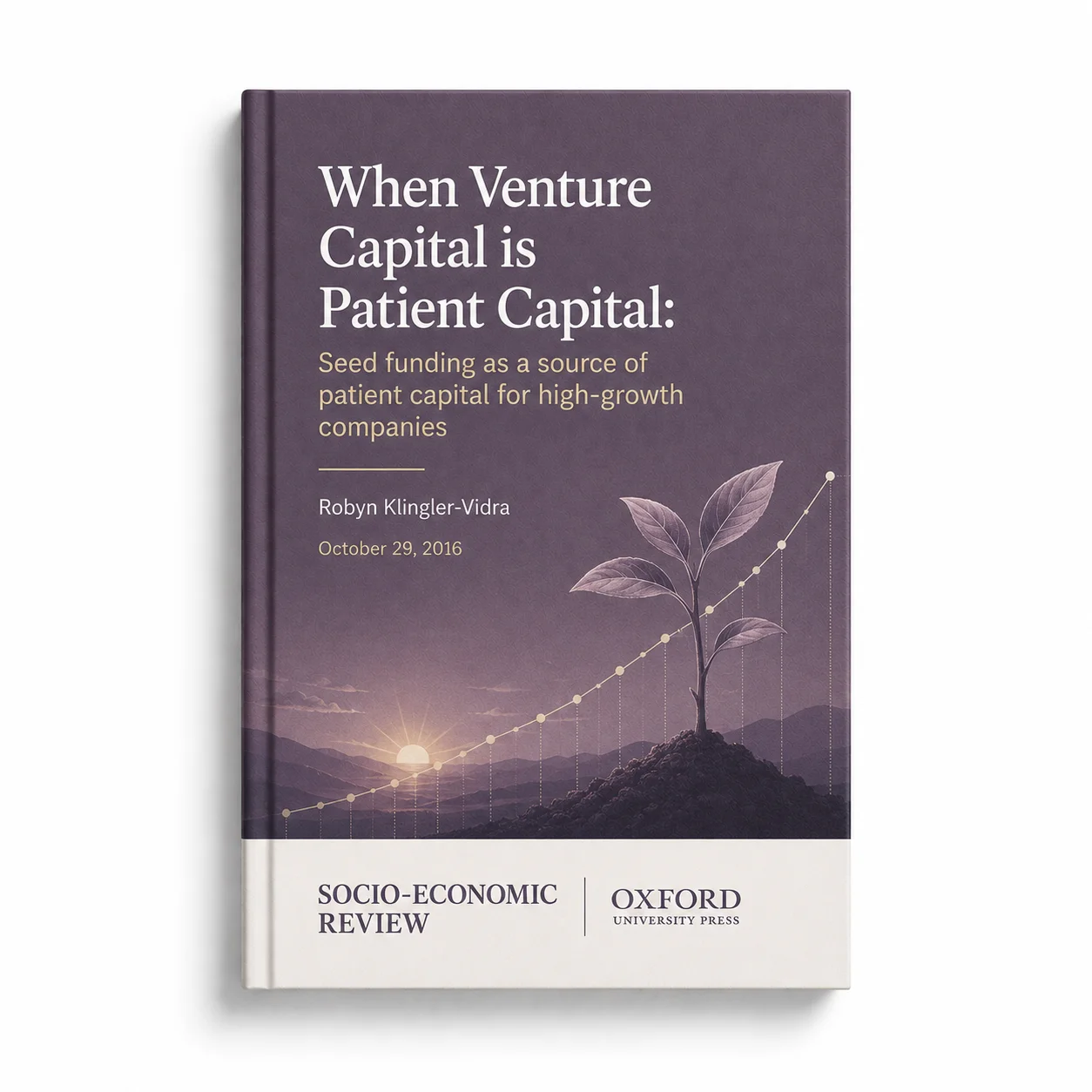
When Venture Capital is Patient Capital: Seed funding as a source of patient capital for high-growth companies
Klingler-Vidra conceptualizes patient capital in venture financing around three characteristics, a long intended investment horizon, engagement focused on long-term rather than short-term value, and loyalty to a company through poor short-term performance, and argues seed stage VC investing exhibits the most patience, with seed followed by follow-on funding representing the most patient form of venture capital available to startups. Using PitchBook deal data from 2000 through May 2016, she shows VC seed activity grew both in absolute deal volume and as a share of overall VC investment across the US and UK, liberal market economies, and Germany and Japan, coordinated market economies, with growth accelerating specifically around the 2008 Global Financial Crisis. She attributes this cross-national rise to a two-part policy dynamic: government efforts to build local Silicon Valley-style ecosystems increase entrepreneurial demand for seed funding, while tax incentives and initiatives like the UK's 2010 Tech City program directly encourage seed-stage investment supply, though she cautions several factors still confound VC's patience both over time and within a single fund's portfolio.
Why is relevant?
Founders and policymakers who assume all venture capital is inherently short-term and impatient get a genuinely useful corrective, since the paper shows seed stage VC specifically behaves as patient capital, with a long horizon and loyalty through poor short-term performance, distinguishing it from the more transactional, exit-focused behavior often associated with later-stage VC. The comparative framing across liberal market economies, the US and UK, versus coordinated market economies, Germany and Japan, is useful for researchers and policymakers studying how a specific financial instrument diffuses differently across distinct national economic systems, connecting directly to Klingler-Vidra's related work on how the Silicon Valley VC model gets adapted rather than simply copied elsewhere. The two-part policy framework, demand-side ecosystem building alongside supply-side tax incentives, gives policymakers a concrete, dual-lever model for understanding what actually drove the post-financial-crisis growth in seed funding, useful for any government designing similar interventions to grow their own local seed-stage investment activity.
Author
Robyn Klingler-Vidra
Publication date
October 29th, 2016
Difficulty
Advanced
Keywords
- patient capital
- seed stage venture capital
- liberal market economies
- coordinated market economies
- Global Financial Crisis
- VC investment horizon
- government VC policy
- entrepreneurship policy
- PitchBook data
Last update